The Bortle scale: how to find a dark sky near your city
The nine Bortle classes in plain words: what you can see in each, how to work out your own class and how far to drive from town for a dark sky.
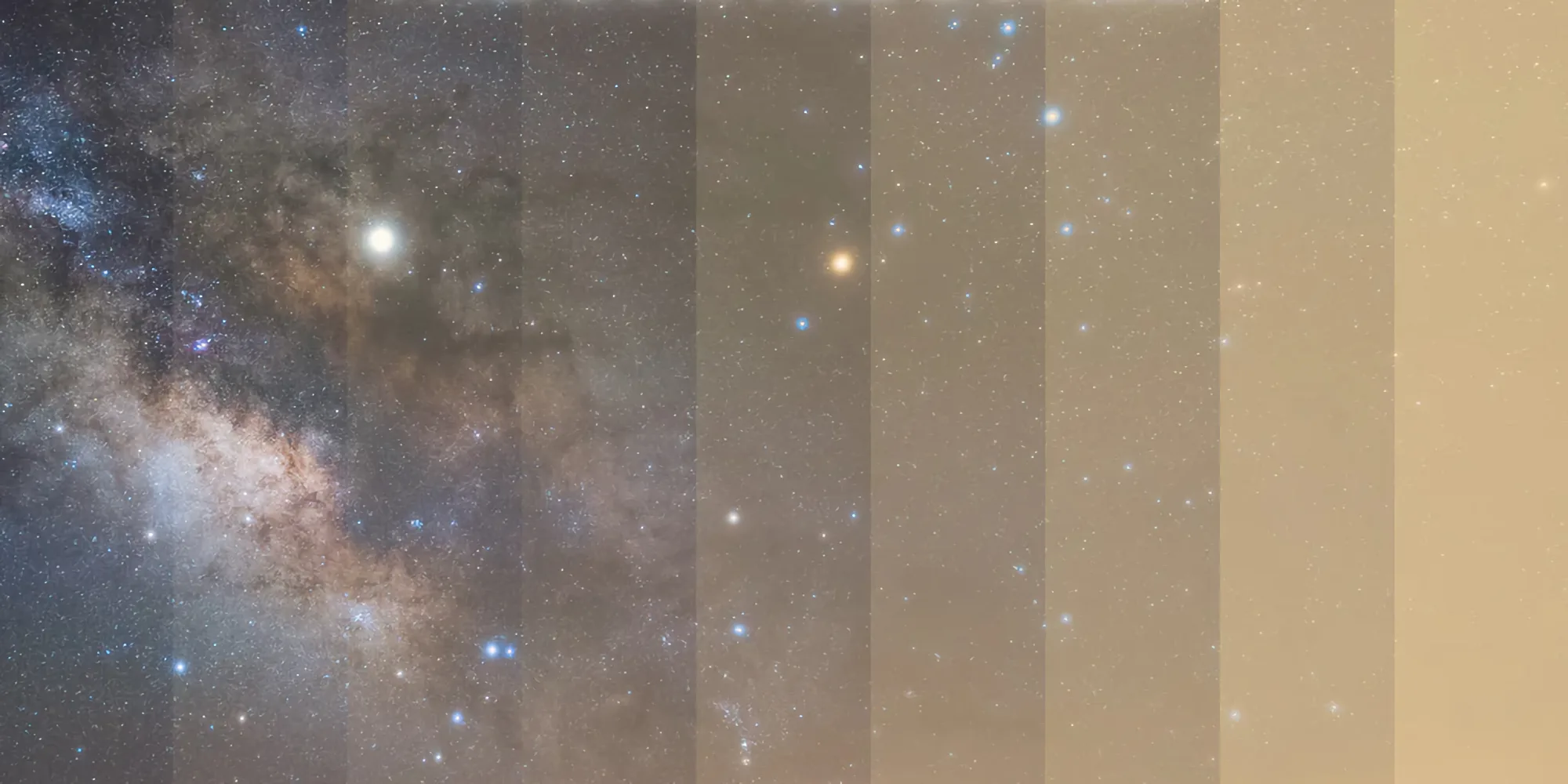
From the centre of a big city you can see two or three dozen stars. A hundred kilometres away there are several thousand, and the Milky Way lies right across the sky. It is the same sky — the only difference is light pollution. To measure it by something better than guesswork, amateur astronomers use the Bortle scale. Here is what its nine classes mean and how to find a dark site close to home.
What the Bortle scale is
The scale was proposed by the American observer John Bortle in 2001 in Sky & Telescope magazine. It divides the night sky into nine classes: from 1, perfectly dark, to 9, the sky over the centre of a megacity.
Its chief virtue is simplicity. No instruments are needed: the class is determined by what you can see with the naked eye. Is the Milky Way visible? Can you make out detail in it? Is there a glow along the horizon?
The nine classes in plain words
| Class | Type of sky | What you can see |
|---|---|---|
| 1 | Perfectly dark | The Milky Way casts shadows; the zodiacal light and gegenschein are visible |
| 2 | Truly dark | The Milky Way shows complex structure; clouds are noticeable only as black "holes" against the stars |
| 3 | Rural | Faint glow along the horizon; the Milky Way is still detailed |
| 4 | Rural–suburban transition | Light domes over towns; the Milky Way is clearly visible but lacks fine detail |
| 5 | Suburban | The Milky Way is pale and fades out near the horizon |
| 6 | Bright suburban | The Milky Way is barely discernible at the zenith |
| 7 | Suburban–urban transition | The sky is grey; no Milky Way |
| 8 | City | The sky is orange or greyish white; only the bright constellations can be traced |
| 9 | Inner city | The Moon, the planets and a handful of the brightest stars |
The practical dividing line runs between classes 4 and 5. Under a class 4 sky or darker, the Milky Way is plainly visible, meteor showers deliver almost everything they have, and faint nebulae are within reach of a small telescope. At class 5 and brighter, all of that fades fast.
Bortle, SQM and limiting magnitude
Two other figures are usually quoted alongside the Bortle class.
SQM is sky brightness in magnitudes per square arcsecond. It is measured with a meter or calculated from satellite data. The larger the number, the darker the sky: about 22 is the limit on Earth; 18 or less is a city centre.
Limiting magnitude is the faintest stars visible to the eye at the zenith. In a city that is magnitude 4 or brighter; under a dark sky, magnitude 7 or fainter.
| Bortle class | SQM | Limiting magnitude |
|---|---|---|
| 1 | 21.99–22.0 | 7.6–8.0 |
| 2 | 21.89–21.99 | 7.1–7.5 |
| 3 | 21.69–21.89 | 6.6–7.0 |
| 4 | 20.49–21.69 | 6.1–6.5 |
| 5 | 19.50–20.49 | 5.6–6.0 |
| 6 | 18.94–19.50 | 5.1–5.5 |
| 7 | 18.38–18.94 | 4.6–5.0 |
| 8–9 | below 18.38 | 4.5 or less |
The difference looks small, but the scale is logarithmic: a magnitude-22 sky is roughly 40 times darker than a magnitude-18 one.
How to find out your sky's class
From a map. The quickest way is the light pollution map. It shows the Bortle class, SQM and limiting magnitude for any point on Earth: just tap the map.
By eye. On a clear, moonless night, let your eyes get used to the dark — dark adaptation takes 20–30 minutes — and check:
- whether the Milky Way is visible at all — if so, you are at class 6 or better;
- whether it reaches down to the horizon — class 4 or better;
- how many stars you can see in the Little Dipper: all seven means class 4–5 or darker; only the three or four bright ones means city.
How far you need to go
It depends on the size of the city. As a rough guide:
- a town of up to 100,000 people — class 4 begins 10–20 km from the outskirts;
- a city of half a million to a million — you need 30–60 km;
- a megacity the size of London — at least 100–150 km, and the light dome will still be visible above the horizon.
Classes 1–2 are almost non-existent in densely populated regions: people travel to mountains, steppes, the far north or deserts for them. But you don't have to chase them — going from class 7 to class 4 gains you far more than going from 4 to 2.
How to choose a site on the map
- Look at the neighbours, not just the spot. A city 30 km to the south will brighten the southern part of the sky even if it is dark overhead. Choose a site so that the city's dome ends up behind you — on the opposite side from where you plan to look.
- Look for an open horizon. A field, a lake shore, a hilltop. Surrounding forest shields you from street lights but hides low objects.
- Avoid local lights. A single lamp in a car park or a main road with a stream of headlights does more harm than a distant city.
- Check the access. A dark site you can't reach at night in October is useless. Scout it in daylight.
- Check the Moon and the weather. A full Moon turns a class 3 sky into a class 6–7 one, and cloud cancels everything. The Moon page gives the phase and moonset time, and the astro-weather forecast gives cloud cover by layer and a score for the night.
What to observe under which sky
Not every object needs darkness, and you don't have to leave town for every observing session.
- Classes 7–9, city: the Moon, planets, double stars, ISS passes. Light pollution doesn't bother them.
- Classes 5–6, suburbs: bright star clusters, the brightest meteors, the Orion Nebula.
- Classes 3–4, countryside: the Milky Way, meteor showers in all their glory, the Andromeda Galaxy by eye, nebulae in binoculars.
- Classes 1–2: the zodiacal light, faint galaxies, astrophotography without compromise.
Questions and answers
What is the Bortle scale?
A nine-level scale of night-sky darkness. Class 1 is a perfectly dark sky with no trace of light pollution; class 9 is the sky over the centre of a major city.
What Bortle class do you need to see the Milky Way?
It is just detectable at class 6, plainly visible from class 4, and detail and dark lanes appear at class 3 and darker.
How do I find out the Bortle class where I live?
Open the light pollution map and tap your location — it will show the Bortle class, SQM and limiting magnitude.
What is SQM?
Sky brightness in magnitudes per square arcsecond. The larger the number, the darker the sky: 21.7 and above is a dark rural sky; below 18.4 is a city.
Does the Moon affect the sky's class?
Formally the scale describes a moonless sky, but in practice a full Moon brightens it just as badly as a city does. For faint objects, pick nights around new Moon.
The AstroTools app shows the Bortle class and sky brightness for your location, helps you find a dark site nearby and tells you which night is worth the trip — taking cloud cover, the Moon and atmospheric transparency into account.
Plan your observing with AstroTools
Weather, the Moon, light pollution and satellite passes — in one app.