Partial lunar eclipse, August 27–28, 2026: times, visibility and how to watch
On the night of August 27–28, 2026, Earth's shadow covers 93% of the Moon — a near-total eclipse visible end to end across the Americas.
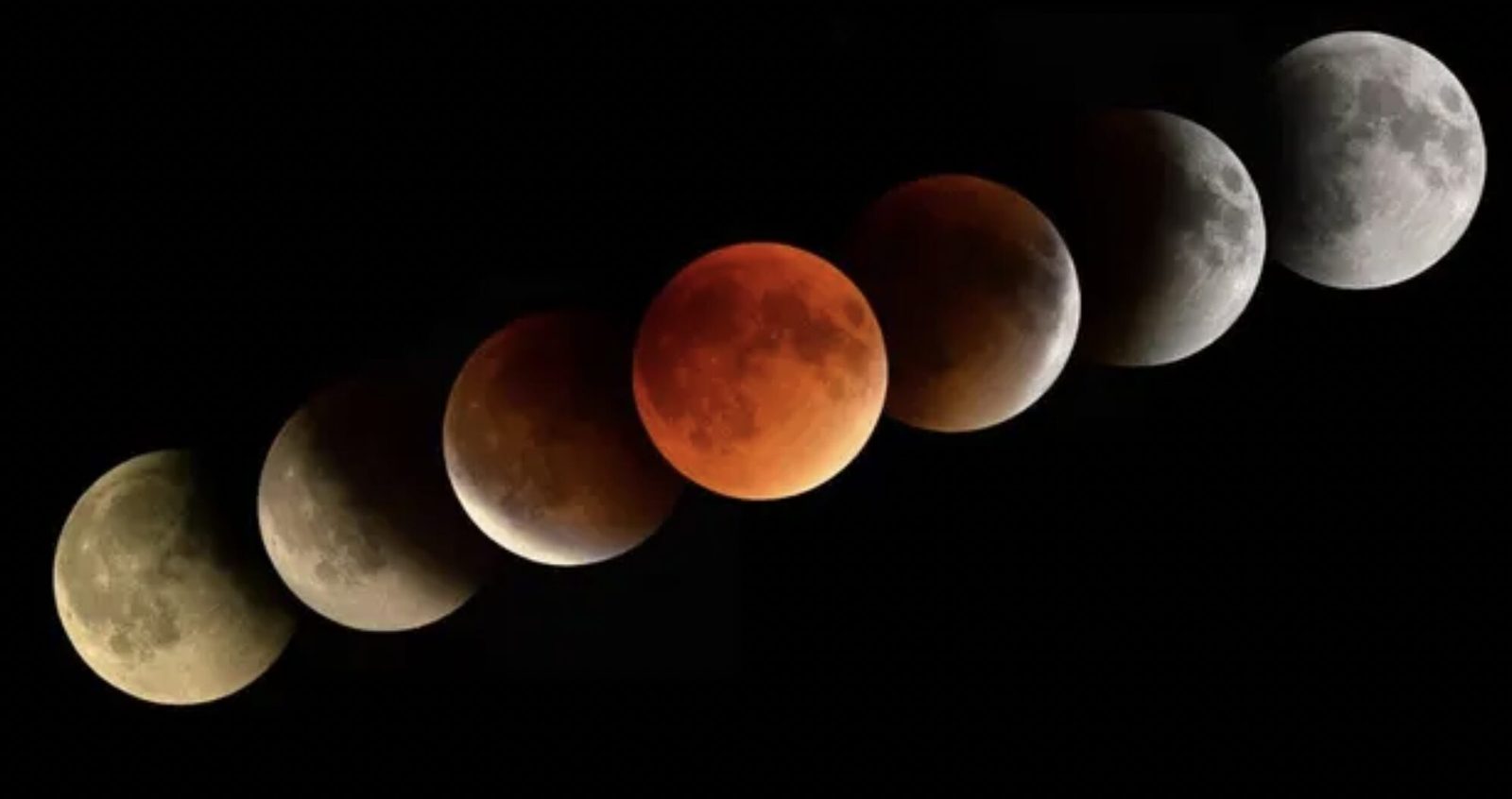
On the night of August 27–28, 2026, the Moon slides deep into Earth's shadow. Technically it is a partial lunar eclipse, but only just: at maximum, the shadow covers 93% of the Moon's diameter, leaving a thin bright sliver along one edge while the rest of the disc turns a deep copper red.
If you're in North or South America, this is the best lunar eclipse you'll get for years — the whole thing happens with the Moon high in a dark sky. And it's the last worthwhile one for a while: both 2027 eclipses are penumbral and barely noticeable.
Eclipse times
| Phase | UTC | EDT (New York) | PDT (Los Angeles) | BST (London) |
|---|---|---|---|---|
| Penumbral begins | 01:24 | 9:24 p.m. Aug 27 | 6:24 p.m. Aug 27 | 02:24 |
| Partial begins (umbra) | 02:34 | 10:34 p.m. Aug 27 | 7:34 p.m. Aug 27 | 03:34 |
| Maximum — 93% covered | 04:13 | 12:13 a.m. Aug 28 | 9:13 p.m. Aug 27 | 05:13 |
| Partial ends | 05:52 | 1:52 a.m. | 10:52 p.m. Aug 27 | 06:52 |
| Penumbral ends | 07:02 | 3:02 a.m. | 12:02 a.m. Aug 28 | 08:02 |
The partial phase lasts 3 hours 18 minutes — one of the longest partial lunar eclipses of the decade. The penumbral stages at either end are subtle: you won't see much until the Moon touches the true shadow (the umbra).
Where it's visible
A lunar eclipse is visible anywhere the Moon is above the horizon at the time. Since an eclipsed Moon is always full, it sets around sunrise — which decides who gets the show.
- North and South America — the entire eclipse. The Moon is well up and the sky fully dark. Brazil and Argentina get maximum near 1:13 a.m. local with the Moon high overhead; the US East Coast gets it just after midnight; the West Coast sees the Moon rise already shadowed in the early evening.
- Western Europe — most of it, including maximum. Lisbon and London see maximum near 5:13 a.m. local, Madrid, Paris and Rome near 6:13 a.m., low in the west with the sky already brightening.
- Western and northern Africa — good conditions before dawn.
- Central and Eastern Europe — the shadow creeps in, but the Moon sets around maximum.
- East Asia, Australia, most of Russia — not visible; it's daytime there, or the Moon has already set.
Check the exact moonset time for your location on the Moon page — 20 minutes either way changes what you can see near the horizon.
What's actually happening
The Moon has no light of its own; it reflects sunlight. When Earth passes directly between the Sun and the Moon, it casts a cone of shadow into space, and the Moon drifts into it.
It doesn't go black, though. Some sunlight bends through Earth's atmosphere, which scatters blue light and lets red through — so what reaches the shadowed Moon is the combined red glow of every sunrise and sunset on the planet at that moment. That's why the eclipsed part looks copper or brick red rather than dark.
One extra detail this time: the Moon passed apogee on August 22, so it's near the far end of its orbit and the disc will look slightly smaller than average — a "micromoon", the opposite of a supermoon.
How to watch
A lunar eclipse is the least demanding event in astronomy. No equipment needed, it's completely safe to look at (unlike a solar eclipse), and light pollution barely matters — the Moon outshines any city.
- Naked eye. All you need is a view of the right part of the sky. Changes become obvious within 10–15 minutes.
- Binoculars. These bring out the colour. In binoculars you can clearly see the shadow isn't black but red-brown, darker toward its centre.
- Photography. Use a tripod. For the shadowed disc, start around ISO 800–1600 at 1/2–2 seconds and bracket from there. On a phone, switch to night mode and brace it against something solid — handheld shots of the Moon almost never work.
- Clouds are the only real risk. Open the astro weather forecast a day or two ahead: it shows cloud cover by layer and scores the night from 0 to 100. The Moon is bright enough that thin high cloud won't ruin it.
Best practical advice: step outside near the start of the partial phase, then again 40 minutes later. The change in that interval is what makes an eclipse feel real, rather than something you read about.
When is the next lunar eclipse
This one closes out a good run — three total lunar eclipses across 2025–2026. Then it goes quiet:
- February 20–21, 2027 and August 17, 2027 — penumbral. The Moon only grazes the outer shadow; the dimming shows up on photos more than to the eye.
- January 12, 2028 — partial, visible from the Americas, Europe, Africa and western Asia.
- July 6, 2028 — partial, about 39% of the disc, visible across Asia and Australia.
- December 31, 2028 — a total lunar eclipse, 71 minutes of totality, fully visible from eastern Europe, Asia and Australia.
What else is coming up
- October 4 — Saturn at opposition: visible all night and brighter than on any other night of the year. The rings show in even a small telescope.
- October 8–9 — the Draconids with almost no Moon in the sky. An unpredictable shower that occasionally bursts. You can check which meteor shower is visible tonight any day.
- November 15–16 — Mars and Jupiter just 1°12′ apart in Leo: two bright points side by side before dawn, naked eye.
- December 14–15 — the Geminids, the strongest shower of the year (up to 150 per hour), and in 2026 the Moon sets early on peak night.
Install AstroTools so you don't have to work any of this out by hand: it gives you moonrise and moonset for your exact spot, the eclipse calendar, layered cloud forecasts for the nights ahead, and a notification before the event — whether that's a shower peak or an ISS pass.
Plan your observing with AstroTools
Weather, the Moon, light pollution and satellite passes — in one app.