What's that bright star in the sky: how to tell a planet from a star or a satellite
Is that bright point a planet, a star, the ISS or a plane? Four simple clues and a cheat sheet for what's visible in autumn and winter 2026–2027.
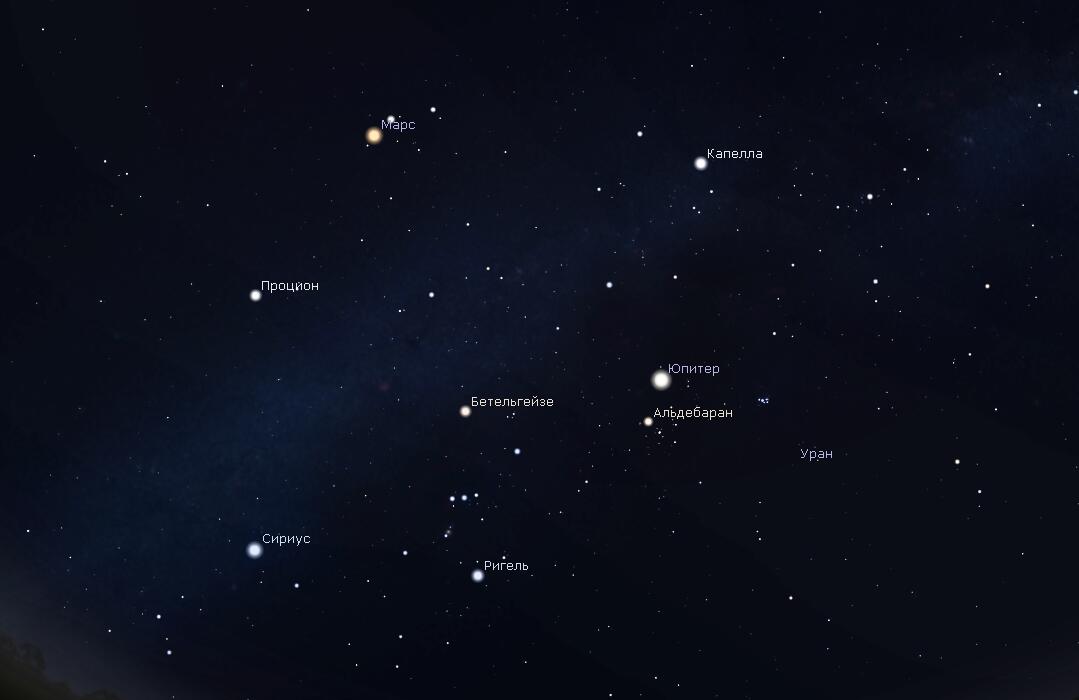
You look up and see a very bright point. It outshines everything around it, and you don't remember noticing it yesterday. A star? A planet? A satellite? Most often the answer is a planet: the brightest "stars" in the sky usually aren't stars at all. Here are four clues that will let you work it out in a minute, with no instruments and no charts.
Clue 1. Does it twinkle?
This is the main test. Stars twinkle; planets hardly do.
A star is so far away that it stays a point even in a telescope. Its thin beam is easily "broken" by the unsteady atmosphere, so the star trembles and shimmers. A planet is far closer and shows a tiny but real disc: light from different parts of it averages out, and the planet shines steadily and calmly.
One caveat: low on the horizon anything can twinkle, planets included. The test is most reliable for objects more than 20–30° above the horizon.
Clue 2. Is it moving?
Watch it for half a minute.
- Staying put — a star or a planet. They drift along with the whole sky, but too slowly for the eye to notice.
- Gliding smoothly without blinking — a satellite. The brightest of them, the ISS, crosses the sky in 2–6 minutes, can outshine any star and often fades out right in mid-sky as it slips into Earth's shadow. More in When and where to see the ISS.
- Moving and blinking, with red or green lights — a plane.
- A string of lights following one another — recently launched Starlink satellites.
- Flared and gone within a second — a meteor. To see which shower is active now, check which meteor shower is visible tonight.
Clue 3. Where and when you see it
Position in the sky rules out half the options.
Venus never strays far from the Sun. It is visible either in the west after sunset or in the east before dawn — and never in the middle of the night. A dazzlingly bright point in twilight is almost certainly Venus.
Jupiter, Mars and Saturn can be visible at any time of night, midnight included — but always along one line, the ecliptic. It is the same path the Sun and Moon follow across the sky. You will never find a planet in the north, high overhead or near the Pole Star.
Stars are tied to the seasons. Sirius is a winter star, Vega a summer one, Arcturus a spring one. Year after year they are in the same places in the same months. Planets, though, move from constellation to constellation — so a bright "star" that wasn't here a year ago is almost certainly a planet.
Clue 4. Brightness and colour
| Object | Magnitude | What it looks like |
|---|---|---|
| Venus | up to −4.7 | Dazzling white, only in or near twilight |
| Jupiter | up to −2.9 | Very bright, creamy white, steady light |
| Mars | +1.8 to −2.9 | Distinctly orange-red, brightness varies a lot |
| Sirius | −1.5 | Blue-white, twinkles hard and flashes colours |
| Saturn | about 0 to +1 | Yellowish, calm |
| Arcturus | 0 | Orange, twinkles |
| Vega | 0 | Blue-white, twinkles |
| Capella | +0.1 | Yellow, twinkles |
The smaller the number, the brighter the object. Two things are worth remembering: only Venus, Jupiter, sometimes Mars — and the ISS — ever outshine Sirius. And if a point low on the horizon is flashing red, blue and green, it isn't a UFO: it is Sirius or another bright star whose light the atmosphere is spreading into a rainbow.
Cheat sheet: autumn and winter 2026–2027
- In the evening, in the south-east and south — a calm yellowish point in a star-poor region. That is Saturn: it is at opposition in October 2026 and visible all night. Details in our guide Saturn at opposition.
- After midnight, in the east — a very bright point that doesn't twinkle. That is Jupiter, in Leo. By February 2027 it will be rising in the evening and will become the showpiece of the night.
- Before dawn, in the east, from November — the brightest thing in the sky. That is Venus. It has its own article: Venus, the morning star.
- On winter evenings, low in the south — a bright, furiously twinkling blue-white point below Orion's belt. That is Sirius.
- High overhead in autumn and winter — yellow Capella; in the north-west on autumn evenings — Vega.
Why these are all you see from the city
In the centre of a big city only a couple of dozen points remain in the sky — and nearly all of them are listed above. Light pollution wipes out the faint stars, while the planets and the brightest stars punch through any skyglow. That is why city dwellers notice planets most of all: in an urban sky they have no competition.
If you want to see the other few thousand stars, you need a darker sky. The light pollution map shows how bright yours is and where to go.
Questions and answers
How do you tell a planet from a star?
A planet shines steadily; a star twinkles. Planets also always lie near the ecliptic — the line the Sun and Moon follow across the sky.
What is the bright star in the evening sky?
Right after sunset in the west, it is usually Venus. If the bright point is in the south or east in full darkness, it is most likely Jupiter — or, in autumn 2026, Saturn.
What is the bright star next to the Moon?
Almost always a planet. The Moon travels along the ecliptic and passes each of the planets every month. Bright stars turn up beside it too, but less often: Aldebaran, Regulus, Spica, Antares.
Why is a star flashing different colours?
It is a bright star low on the horizon — most often Sirius. The thick layer of air acts like a prism, splitting its light into colours, and turbulence shuffles them rapidly.
A bright point is moving slowly across the sky without blinking — what is it?
A satellite. If it is very bright and travels from west to east for several minutes, it is the ISS.
The easiest way is to ask your phone. The AstroTools app shows which planets are visible tonight from where you are, when they rise and set, when the ISS will pass over and whether the sky will be clear.
Plan your observing with AstroTools
Weather, the Moon, light pollution and satellite passes — in one app.