Venus, the morning star: what is that bright point in the east before dawn
From November 2026 Venus blazes in the east before dawn. When it is at its brightest, how to find it and what binoculars will show.
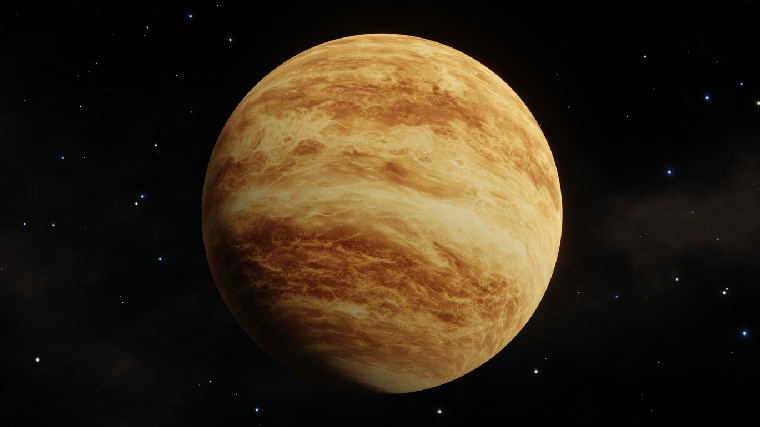
If you leave the house before daybreak in November or December and see a dazzlingly bright "star" in the east, it is not a plane and it is not a satellite. It is Venus. In autumn 2026 it moves from the evening sky to the morning sky and stays the "morning star" until summer 2027. Here is when it is brightest, where to look for it and what you can make out on it.
What Venus is doing in autumn 2026
On 24 October 2026 Venus passes through inferior conjunction — it sits between Earth and the Sun. For those few days it cannot be seen: the planet is lost in the solar glare. But within a couple of weeks it emerges on the other side of the Sun, in the morning sky, and from there things move quickly:
- early November — Venus shows up low in the east against the dawn glow;
- 27 November — greatest brilliancy, magnitude −4.7;
- 3 January 2027 — greatest western elongation: the planet stands its maximum 47° from the Sun;
- until June 2027 — Venus remains in the morning sky, gradually sinking back towards the dawn.
The best period is from mid-November to the end of January: in those weeks Venus rises more than three hours before the Sun and has time to climb high in a still-dark sky.
How to find Venus
You will hardly need to search. Go out an hour to an hour and a half before sunrise and look east to south-east. The brightest point in the sky is Venus.
There is nothing to confuse it with:
- It outshines everything except the Sun and the Moon. At its peak Venus is about 20 times brighter than Sirius, the brightest star in the night sky.
- It barely twinkles. Stars shimmer; planets shine with a steady light. Low on the horizon Venus may quiver a little, but higher up it settles down.
- It doesn't move. A plane blinks and shifts within seconds; the ISS crosses the sky in a few minutes. Venus stays put and only rises slowly along with the rest of the sky.
- It is white. A pure, brilliant white, sometimes slightly yellowish near the horizon.
In autumn 2026 Venus is in Virgo, and in the first half of November it passes within just 1–2° of Spica, the constellation's brightest star. The comparison is telling: Spica is a first-magnitude star, yet next to Venus it looks like a pale spark.
Its meetings with the Moon are a sight in their own right. A thin waning crescent lies near Venus once a month, a few days before new Moon: the next such mornings are around 5 December and around 4 January. The Moon page shows exactly when the Moon rises.
Why Venus is so bright
There are three reasons. Venus is the closest planet to us: in November it is only about 60 million km away. It is nearly the size of Earth. And it is entirely wrapped in dense cloud that reflects about three-quarters of the light falling on it — it is one of the "whitest" bodies in the Solar System.
At peak brightness Venus can be seen even in daylight — if you know exactly where to look. The easiest way is to pick a morning when the Moon is nearby and keep the planet in view after sunrise. And on a moonless night far from cities, Venus can cast faint shadows.
What binoculars and a telescope show
Like the Moon, Venus has phases — and autumn 2026 is the best time to see that for yourself.
Right after conjunction the planet turns its almost unlit side towards us and appears as a thin crescent. It is also close, so the crescent is large. In November even 10×50 binoculars will show it, provided you brace them against something solid or mount them on a tripod. Any telescope shows the crescent with ease.
After that Venus pulls away from Earth: the disc shrinks and the crescent "fattens". By 27 November about a quarter of the disc is lit; by 3 January exactly half, like the Moon at first quarter.
The best views come in a brightening sky, during morning twilight: against a black background the planet dazzles and throws out glare, while against blue the crescent turns crisp. Don't expect surface detail — all you see is cloud, smooth and white.
How to prepare
- Find an open eastern horizon. In the first weeks of November Venus is low, and buildings and trees will hide it. By December it climbs much higher.
- Don't chase dark skies. Light pollution is no problem for Venus: it is perfectly visible from the centre of a big city, from a balcony, or on your way to work.
- Check the cloud cover. Morning haze and low cloud along the horizon are the only obstacle. The astro-weather forecast shows cloud cover hour by hour, including the hours before dawn.
- Look higher and you'll see more. While it is still dark, find Jupiter above and to the right of Venus: in the winter of 2026–2027 it shines in Leo and is second in brightness only to Venus. For how to tell planets from stars, see What's that bright star in the sky.
Questions and answers
What is the bright star in the east in the morning?
From November 2026 to June 2027 it is Venus. It is brighter than any star, shines with a steady white light and is visible before dawn in the east and south-east.
When is Venus brightest in 2026?
On 27 November 2026, when it reaches magnitude −4.7. It stays practically as bright from mid-November to mid-December.
Why is Venus called the morning star?
Venus is closer to the Sun than Earth is, and in the sky it never strays more than 47° from it. So it is visible either in the evening after sunset or in the morning before dawn — and never at midnight.
Can you see the phases of Venus with binoculars?
Yes, in November 2026, while the crescent is large. You need binoculars of 10× or more and a firm support or a tripod. In a telescope the crescent is visible at any magnification.
How long will Venus be visible in the mornings?
Until June 2027. Conditions are best from mid-November to the end of January; after that the planet gradually sinks towards the dawn glow.
To take the guesswork out of when to get up, install the AstroTools app: it shows when Venus and the other planets rise from exactly where you are, and tells you whether the sky will be clear by morning.
Plan your observing with AstroTools
Weather, the Moon, light pollution and satellite passes — in one app.