Orionids 2026: the Halley's Comet meteor shower peaks on the night of 21–22 October
The Orionids peak on the night of 21–22 October 2026. When the Moon sets, where to look and how many meteors you can realistically expect.
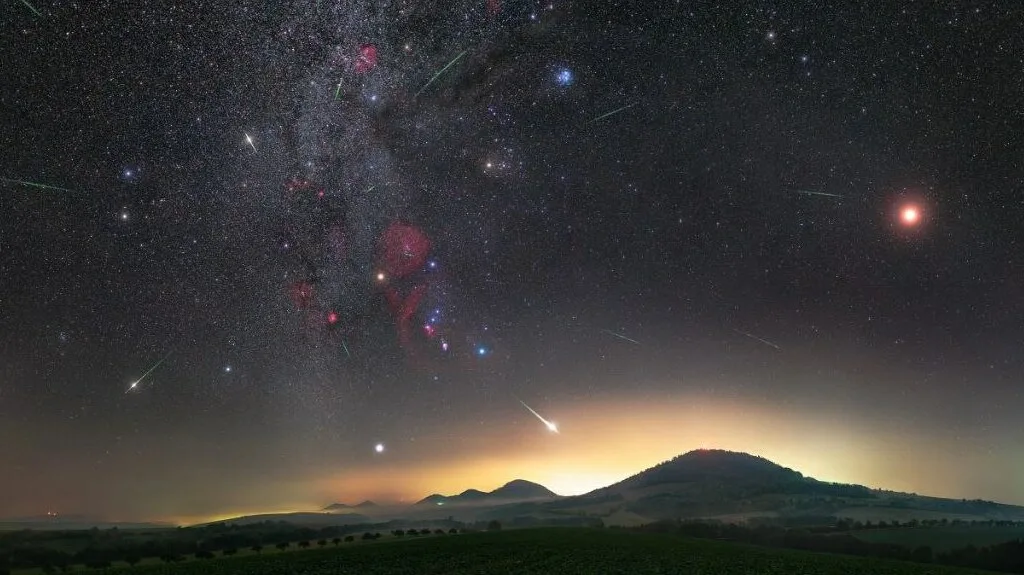
Halley's Comet won't return until 2061, but you can see its dust this autumn. Every October Earth crosses the trail of particles the comet left behind, and they burn up in the atmosphere as the Orionids — one of the fastest and most beautiful meteor showers of the year. In 2026 the peak falls on the night of 21–22 October. Here is when to go out, where to look and how to work around this year's main obstacle: a bright Moon.
When to watch
The Orionids are active from 2 October to 7 November, with the predicted maximum on 21 October at around 18:00 UTC. For Europe that makes the best night 21–22 October; for North America the nights of 20–21 and 21–22 October are equally good.
The shower has no sharp peak: activity sits on a plateau for several days. If the 22nd is clouded out, any night from 20 to 24 October will give you nearly the same show — the Orionids' most convenient feature.
The radiant — the point the meteors appear to fly out of — rises at around 10–11 pm local time and is highest just before dawn. So the rule is simple: the closer to morning, the more meteors. The best hours run from 2–3 am until the first light of dawn.
The Moon in 2026: wait for it to set
Full Moon comes on 26 October, so on peak night a bright waxing Moon, about 80% lit, will be in the sky. In the evening and the first half of the night it will wash out the sky noticeably and swallow the fainter meteors.
The good news: a waxing Moon sets long before sunrise. At mid-latitudes it drops below the horizon at about 2–3 am, leaving two to three hours of properly dark sky before dawn — exactly when the radiant is highest. Check the exact moonset time for your location on the Moon page and build your plan around it.
How many meteors to expect
The Orionids' zenithal hourly rate is about 20 meteors per hour. That figure assumes ideal conditions: the radiant overhead and a flawlessly dark sky. In practice, out in the countryside after moonset, you can count on 10–15 meteors per hour; in the suburbs, 3–5.
What the Orionids lack in numbers they make up in quality. Their particles hit the atmosphere at 66 km/s — faster than almost any other shower. That gives them their character:
- the meteors are swift and sharp, like the stroke of a pen;
- bright ones often leave a glowing train that hangs in the sky for a second or two;
- now and then there is a fireball — a very bright flash.
The shower sometimes springs surprises: in 2006–2009 activity climbed to 50–70 meteors per hour. No outburst is forecast for 2026, but the Orionids have defied forecasts before.
Where to look
The radiant lies in Orion, a little above and to the left of reddish Betelgeuse, near the border with Gemini. Orion is easy to recognise by the three stars of its belt lined up in a row; after midnight it climbs in the south-east.
There is no need to stare straight at the radiant: meteors there are short. They are longer and more striking 40–60° away from it. Lie back so that you take in as much sky as possible and aim your gaze about halfway between the horizon and the zenith. Until the Moon sets, keep it behind you.
Where to watch from
City light pollution hides faint meteors just as the Moon does. Driving 20–30 km beyond the edge of town is enough. The light pollution map will suggest a spot: aim for the green and blue zones — class 3–4 on the Bortle scale.
October weather is fickle, and cloud is the main risk. A day or two before you set out, open the astro-weather forecast: it shows cloud cover by layer and an overall score for the night from 0 to 100. The activity plateau gives you a choice: if peak night is overcast and the next one is clear, go on the clear one.
How to prepare
- Dress warmer than seems necessary. Before dawn in late October it can be close to freezing, and you will be lying still for an hour or more. A mat, a sleeping bag and a flask of something hot are essentials.
- Let your eyes adjust. Dark adaptation takes 20–30 minutes, and a single glance at a phone screen resets it. If you need light, bring a red torch.
- No optics needed. Binoculars and telescopes narrow your field of view. Your own eyes are the best instrument.
- Allow plenty of time. Meteors come unevenly: ten minutes of nothing, then three in a row. Set aside at least an hour.
Questions and answers
When do the Orionids peak in 2026?
On the night of 21–22 October. The predicted maximum is on 21 October at around 18:00 UTC, but activity stays high from 20 to 24 October.
Will the Moon interfere with the Orionids in 2026?
In the first half of the night, yes: the Moon is about 80% lit. But it sets at around 2–3 am, and the hours before dawn stay dark.
What is the best time to watch?
After moonset and before dawn begins — roughly 2–3 am to 5–6 am local time. That is when the radiant is highest.
Where do the Orionids come from?
They are particles from Halley's Comet. Earth crosses its dust trail twice a year: in May that produces the Eta Aquariids, in October the Orionids.
Can you see the Orionids from a city?
Only the brightest ones — a few meteors per hour. To see the shower properly you need to get out of town.
So you don't miss peak night, install the AstroTools app: it shows the moonset time and a sky score for your location, and tells you which of the nights from 20 to 24 October will be the clearest. And to find out which shower is active right now, see which meteor shower is visible tonight.
Plan your observing with AstroTools
Weather, the Moon, light pollution and satellite passes — in one app.