Supermoons on 24 November and 24 December 2026: when and how to watch
Two supermoons close out 2026 — 24 November and 24 December. December's is the closest full Moon of the year.
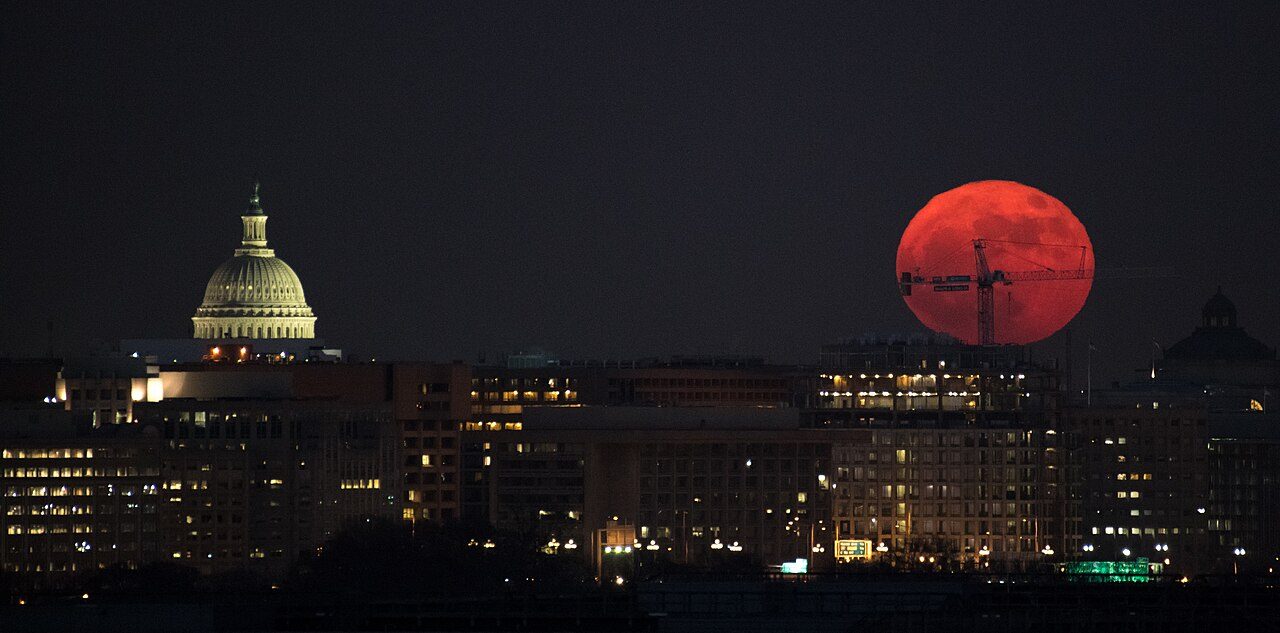
"Supermoon" is the word that circles the news every year, promising a giant Moon over the rooftops. The reality is calmer but more interesting. There are three in 2026, and two are still ahead: 24 November and 24 December. December's is the closest full Moon of the year. Here is what you will actually see — and what you won't.
Dates and times
- 24 November 2026, 14:54 UTC — distance to the Moon 360,768 km.
- 24 December 2026, 01:28 UTC — distance 356,740 km. This is the closest full Moon of 2026.
The year's first supermoon came on 3 January, so December's closes out 2026 — and does it in style, right before the holidays.
Note that these are the times of the full phase itself. You don't have to be outside at that minute: the Moon looks full the night before and the night after. The exact moment often falls in daylight anyway, as it does on 24 November across Europe.
What a supermoon actually is
The Moon's orbit is an ellipse, not a circle. At its nearest point, perigee, the Moon is some 42,000 km closer than at its most distant, apogee. When a full Moon coincides with perigee, the disc is larger and brighter than usual. There is no strict astronomical definition of "supermoon" — the term came from astrology in 1979 and stuck in the press.
How much larger? The honest numbers:
| Full Moon | Distance | Apparent diameter |
|---|---|---|
| 24 November 2026 | 360,768 km | ≈ 33.1′ |
| 24 December 2026 | 356,740 km | ≈ 33.5′ |
| Average | 384,400 km | ≈ 31.1′ |
| Most distant | ≈ 406,700 km | ≈ 29.4′ |
So December's Moon will be about 8% wider than an average full Moon and 14% wider than the smallest full Moon of the year — and roughly 30% brighter than that smallest one.
Honestly: will you notice?
Probably not, if you have nothing to compare it with. Eight percent of diameter is below what the eye can judge from memory: the difference between a supermoon and an ordinary full Moon is like telling a 10 mm coin from an 11 mm one six months apart.
In photographs, though, it shows beautifully. Shoot the full Moon on 24 December and again in, say, May, with the same lens at the same focal length, then put the frames side by side. The contrast is obvious.
The brightness is noticeable, however. On a clear night a supermoon gives enough light to read large print outdoors and to cast sharp shadows.
Why the Moon looks enormous near the horizon
The most common supermoon question isn't really about supermoons at all. That huge orange Moon over the houses is the Moon illusion — a trick of perception, not a closer Moon.
Test it yourself: hold your arm out and cover the low Moon with your little fingernail. Hours later, when it rides high, do it again — the same fingernail covers it. The size never changed; only your reading of it did. Near the horizon your brain has houses, trees and treelines to compare against.
The practical takeaway: the best time to watch and photograph is moonrise, shortly after sunset. The illusion works at full strength, and the low altitude adds a warm orange cast as the light travels through a thick slice of atmosphere, exactly as at sunset.
The Moon page gives moonrise for your location, along with the phase, illumination and a month-ahead lunar calendar.
How to photograph a supermoon
- Use a tripod. Even a bright Moon needs stability at long focal lengths.
- Don't trust auto exposure. The Moon is a brightly lit object on a black field; automatic metering will blow it out. Start from ISO 100, f/8, about 1/125 s.
- Use 200 mm or longer. On a wide lens the Moon is a dot. A long lens also lets you frame it beside something earthly — a tower, a tree, a bridge.
- Shoot at moonrise. A low Moon over a landscape beats a white disc at the zenith every time; the app gives you the exact time and azimuth.
What else to look at on those nights
A full Moon is the worst time for meteors and nebulae: the sky is flooded with light and faint objects disappear. If you are planning a meteor hunt or a dark-sky trip, keep the dates apart — the Geminids of 2026 fall neatly on a new Moon, ten days before December's supermoon.
What a full Moon is perfect for is looking at the Moon itself through binoculars. One catch, though: at full phase the Sun shines straight down on the Moon, shadows vanish and the relief flattens out. Craters look their most dramatic along the terminator, the line between light and dark — a few days before or after full.
Questions and answers
When are the supermoons in 2026?
Two remain: 24 November 2026 (14:54 UTC) and 24 December 2026 (01:28 UTC). December's is the closest full Moon of the year at 356,740 km.
How much bigger is a supermoon?
About 8% wider than an average full Moon and 14% wider than the year's smallest one. That difference is essentially invisible to the naked eye but obvious when you compare photographs.
What time should I watch a supermoon?
At moonrise, shortly after sunset: the Moon illusion is in full effect and the disc looks huge and orange. Check the Moon page for moonrise where you live.
Is a supermoon dangerous?
No. It raises tides by a few centimetres, and that is the whole story. It has no link to earthquakes, weather or how you feel.
How is a supermoon different from a normal full Moon?
Only in distance. A full Moon happens every 29.5 days; we call it a supermoon when it coincides with the Moon passing perigee, the closest point of its orbit.
To catch the moonrise, install the AstroTools app: it gives the time and azimuth of moonrise for your exact spot, the phase for any date, and the cloud forecast for the evening.
Plan your observing with AstroTools
Weather, the Moon, light pollution and satellite passes — in one app.