Geminids 2026: the year's best meteor shower on the night of 13–14 December
The Geminids are the richest meteor shower of the year, up to 150 meteors an hour. In 2026 the peak falls on 13–14 December with almost no Moon in the sky.
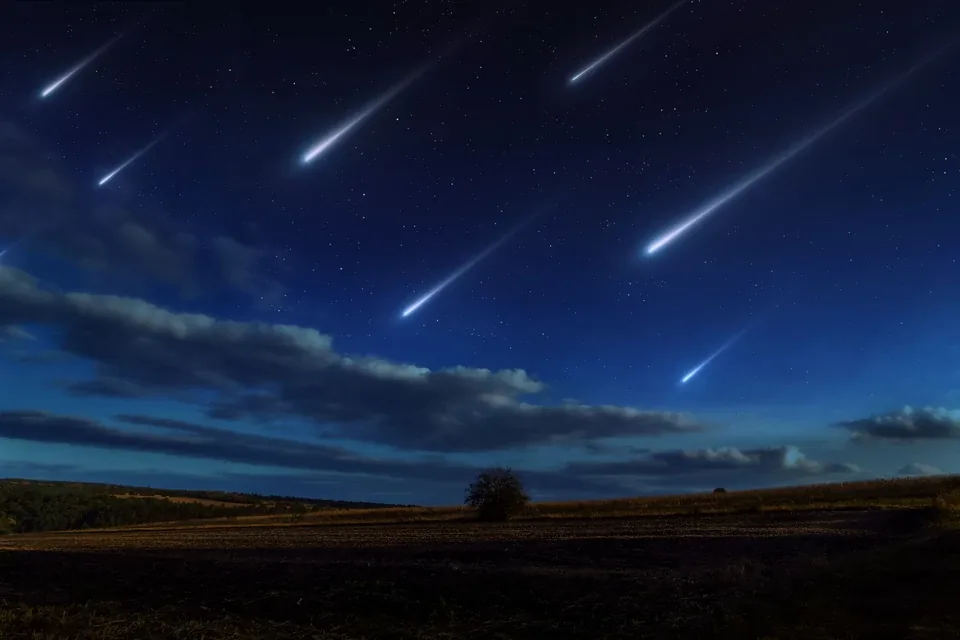
If the Perseids are the most famous meteor shower, the Geminids are the richest. Their nominal ZHR is 150 meteors an hour against the Perseids' hundred. Only one thing works against them: December. But in 2026 they finally got lucky with the Moon — the peak falls on a dark, moonless sky.
When to watch the Geminids in 2026
The shower is active from 4 to 20 December, but everything worth seeing fits into two nights:
- The night of 13–14 December is the main one. The International Meteor Organization puts the maximum across a broad window from 21ʰ UT on 13 December to 18ʰ UT on 14 December.
- The night of 14–15 December covers the second half of that window, with activity almost as high.
The Geminids are known for a broad maximum: rates above 100 meteors an hour hold for 10–12 hours, not for half an hour as with some showers. Missing the peak is therefore nearly impossible — both nights will be generous.
The Geminids' hidden advantage: they start early
Almost every meteor shower asks you to wait for the small hours. The Geminids don't, and it is their most underrated quality.
The radiant sits in Gemini, next to the bright star Castor, and in December Gemini rises early:
- by 20:00 the radiant is already about 30° above the horizon at mid-northern latitudes (around 50°N);
- by 02:00 it culminates near the zenith, above 70°.
The higher the radiant, the more meteors you see, so the best hours are still after midnight. But you can step out for a look right after dinner — which changes everything if you are watching with children.
The Moon won't interfere in 2026
The Moon usually ruins the December shower. Not in 2026: new Moon falls on 9 December, so by peak night the Moon is a thin waxing crescent that sets early in the evening. Through the whole second half of the night — exactly when the radiant is high — the sky is completely dark.
In terms of moonlight, the 2026 Geminids are the best meteor shower of the year.
What the Geminids are
The Geminids have a quirk that sets them apart. Almost every meteor shower is dust shed by a comet. The Geminids' parent body is asteroid 3200 Phaethon, a rocky object about 5 km across. It is nicknamed a "rock comet": passing closer to the Sun than Mercury, it bakes and sheds material, though it grows no ordinary comet tail.
That shapes the meteors. Geminid particles are denser than cometary dust and enter the atmosphere more slowly — 35 km/s against the Perseids' 59 km/s. The result: unhurried, bright, often coloured meteors — yellow, greenish, sometimes with a reddish tinge. They are more pleasant to watch than the Perseids' quick streaks.
How to watch without freezing
The real enemy on a Geminid night is not cloud or light pollution — it is cold. Watching meteors means two hours of complete stillness in winter, and ordinary winter clothing, designed for walking, is not up to it.
- Dress two layers warmer than for a walk. Thermal base layer, fleece, down jacket, winter boots a size up so your socks aren't compressed.
- Lie down, don't sit. A camping mat with a sleeping bag over a deck chair is ideal — you need insulation between you and the ground or snow.
- Bring a flask of something hot. Not alcohol: it dilates blood vessels and speeds up heat loss.
- Hand and foot warmers. Cheap chemical warmers in pockets and boots buy you a couple more comfortable hours.
- Watch in shifts. Half an hour outside, ten minutes in the car or indoors, and you will last the night.
Where to go
Geminids are bright enough that some get through from town, but the difference against a dark sky is enormous: under streetlights you will count a dozen an hour instead of a hundred.
Twenty to thirty kilometres beyond the edge of the city is enough. The light pollution map will find you a spot — aim for the green and blue zones, Bortle 3–4. Winter has a bonus: cold air is dry air, and dry air is transparent. A December sky is cleaner than a July one.
A day or two before you set out, check the astro-weather forecast: layered cloud cover and a single score for the night will tell you whether to go, and whether shifting fifty kilometres sideways would help. Also check which shower is visible tonight — late in their run the Geminids overlap with the Ursids.
Practical tips
- No telescope, no binoculars. Optics narrow your field of view, and a meteor can flash anywhere. This is a naked-eye event.
- Let your eyes adapt. Dark adaptation takes 20–30 minutes and one glance at a phone screen resets it. If you need light, use a red torch.
- Don't stare at the radiant. Meteors near Gemini are foreshortened and short; the long, spectacular ones flare 40–60° away. Just take in as much sky as you can.
- Count by the hour. The first fifteen minutes always feel empty. Meteors arrive unevenly: a five-minute lull can be followed by five in a row.
Questions and answers
When is the meteor shower in December 2026?
The Geminids peak on the night of 13–14 December 2026, with the maximum extending into the evening of 14 December. The night of 14–15 December gives almost the same rates. The shower is active from 4 to 20 December.
How many meteors will I see?
The nominal ZHR of the Geminids is 150 an hour under perfect conditions. Realistically, under a dark rural sky on peak night, expect 80–120 an hour — and several times fewer in a city.
What time should I start watching?
The first meteors show by 20:00, when the radiant is already around 30° up. The best window is after midnight until 3–4 a.m., when Gemini stands near the zenith.
Will the Moon get in the way?
No. New Moon falls on 9 December 2026, so by peak night the Moon is a thin crescent that sets early. The second half of the night is completely dark.
How do the Geminids differ from the Perseids?
They are richer (ZHR 150 against 100), their meteors are slower, brighter and often coloured, and the radiant climbs high early in the evening. The drawback is the December cold. One more difference: the Geminids' parent body is not a comet but asteroid 3200 Phaethon.
To catch the maximum, install the AstroTools app: it sends a notification at the Geminid peak, shows the radiant's altitude and the cloud forecast for your location, and scores the night in a single number.
Plan your observing with AstroTools
Weather, the Moon, light pollution and satellite passes — in one app.