The Meteor and the Star Cluster
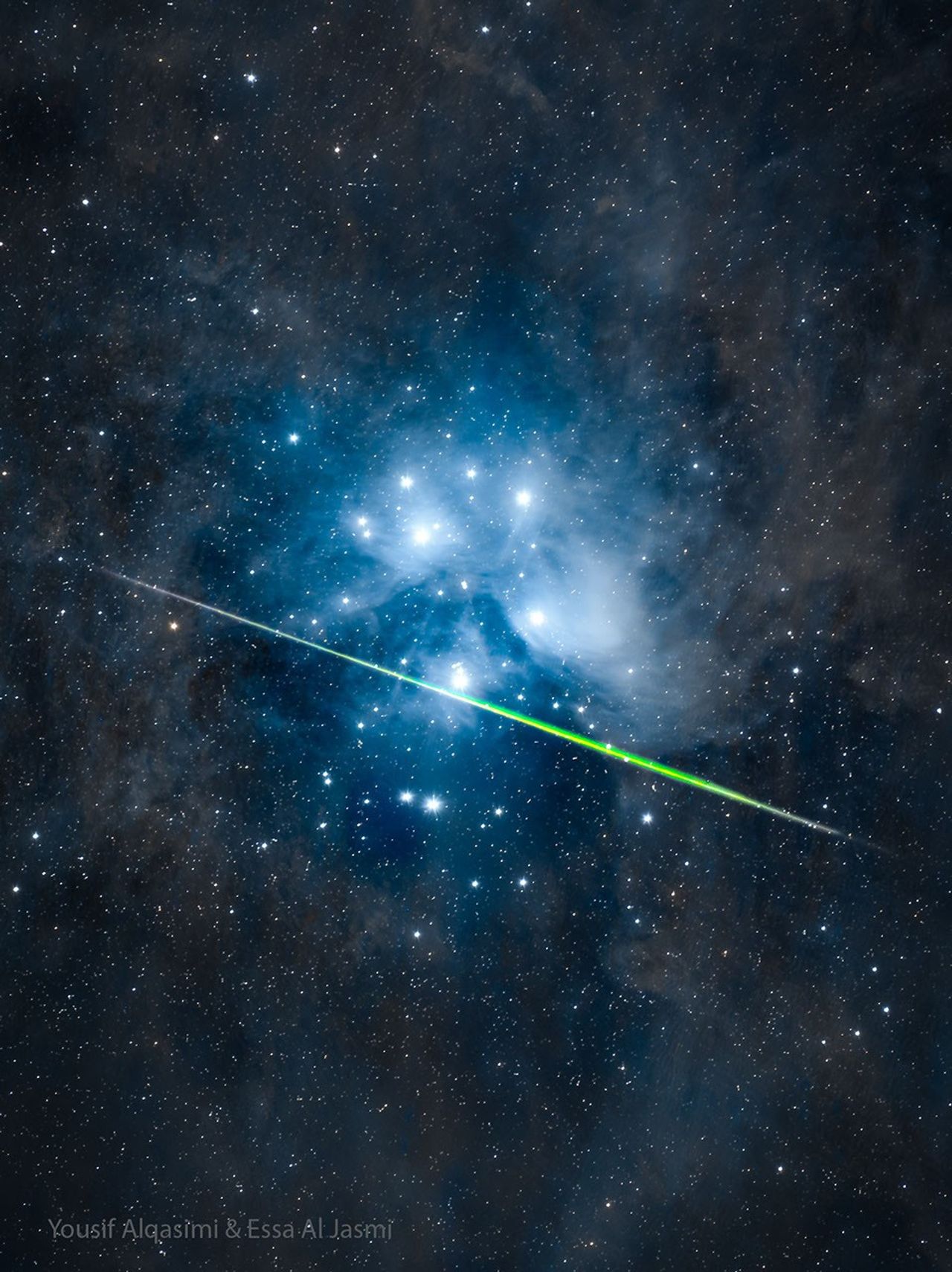
Sometimes even the sky surprises you.
To see more stars and faint nebulosity in the Pleiades star cluster (M45), long exposures are made.
Many times, less interesting items appear on the exposures that were not intended -- but later edited out. These include stuck pixels, cosmic ray hits, frames with bright clouds or Earth's Moon, airplane trails, lens flares, faint satellite trails, and even insect trails.
Sometimes, though, something really interesting is caught by chance. That was just the case a few weeks ago in al-Ula, Saudi Arabia when a bright meteor streaked across during an hour-long exposure of the Pleiades. Along with the famous bright blue stars, less famous and less bright blue stars, and blue-reflecting dust surrounding the star cluster, the fast rock fragment created a distinctive green glow, likely due to vaporized metals.
Jigsaw Universe: Astronomy Puzzle of the Day
Text from NASA APOD.
How to see it yourself
Pleiades (M45) — open star cluster in the constellation Taurus.
- Best seen in October – December, when it stands highest around midnight.
- From New York it climbs to 73° above the horizon. Visible from latitudes -56° to 90°.
- Visible to the naked eye under a dark sky away from city lights.
- Constellation
- Taurus
- Magnitude
- 1,6m
- Apparent size
- 110′ arcminutes
Whether M45 is up for you tonight, and how the clouds and the Moon look — AstroTools shows it.