The Spinning Pulsar of the Crab Nebula
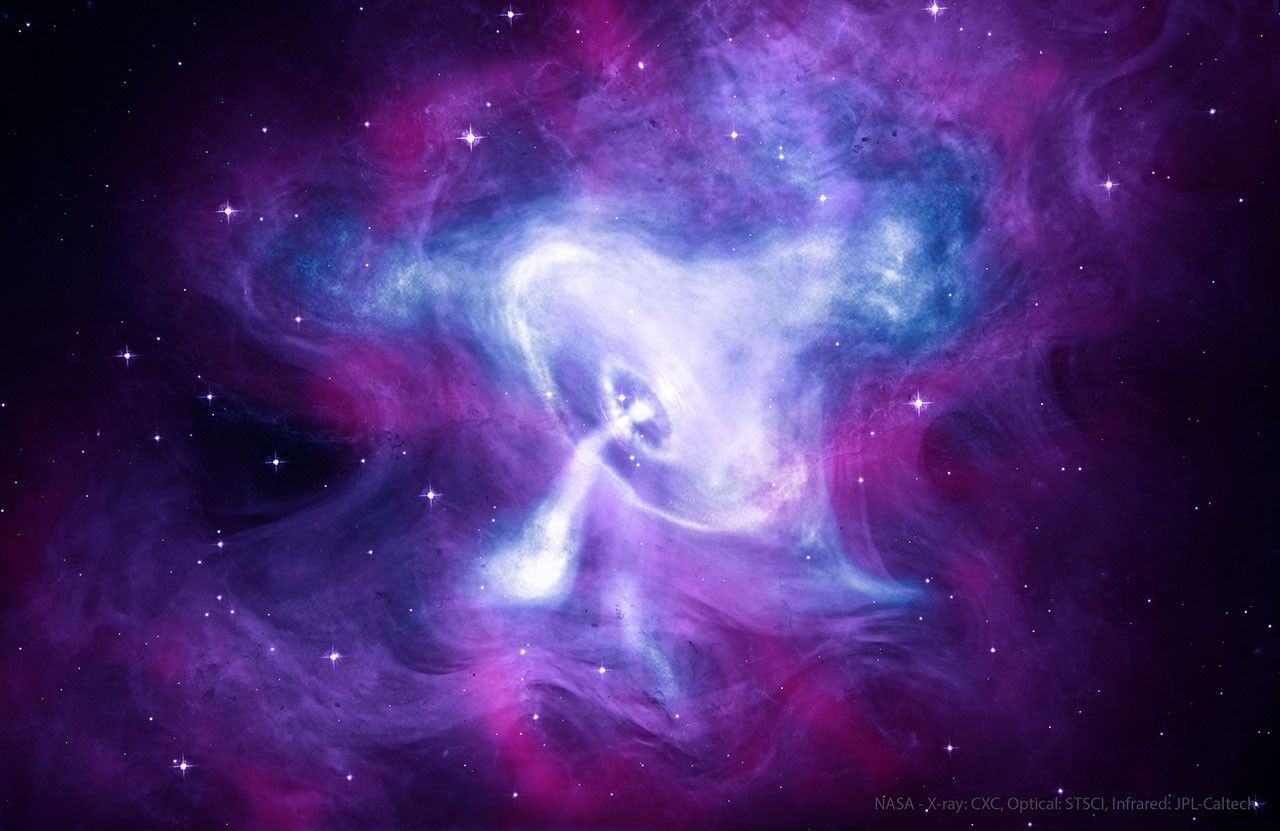
At the core of the Crab Nebula lies a city-sized, magnetized neutron star spinning 30 times a second. Known as the Crab Pulsar, it is the bright spot in the center of the gaseous swirl at the nebula's core. About twelve light-years across, the spectacular picture frames the glowing gas, cavities and swirling filaments near the Crab Nebula's center.
The featured picture combines visible light from the Hubble Space Telescope in purple, X-ray light from the Chandra X-ray Observatory in blue, and infrared light from the Spitzer Space Telescope in red.
Like a cosmic dynamo, the Crab pulsar powers the emission from the nebula, driving a shock wave through surrounding material and accelerating the spiraling electrons. With more mass than the Sun and the density of an atomic nucleus,the spinning pulsar is the collapsed core of a massive star that exploded. The outer parts of the Crab Nebula are the expanding remnants of the star's component gases. The supernova explosion was witnessed on planet Earth in the year 1054.
Sky Surprise: What picture did APOD feature on your birthday? (after 1995)
Text from NASA APOD.
How to see it yourself
Crab Nebula (M1) — supernova remnant in the constellation Taurus.
- Best seen in November – January, when it stands highest around midnight.
- From New York it climbs to 71° above the horizon. Visible from latitudes -58° to 90°.
- Needs a small telescope, 70–100 mm, and a sky free of light pollution. A UHC or OIII filter brings out its contrast.
- Constellation
- Taurus
- Magnitude
- 8,4m
- Apparent size
- 8′ arcminutes
Whether M1 is up for you tonight, and how the clouds and the Moon look — AstroTools shows it.