The Pleiades in Red and Blue
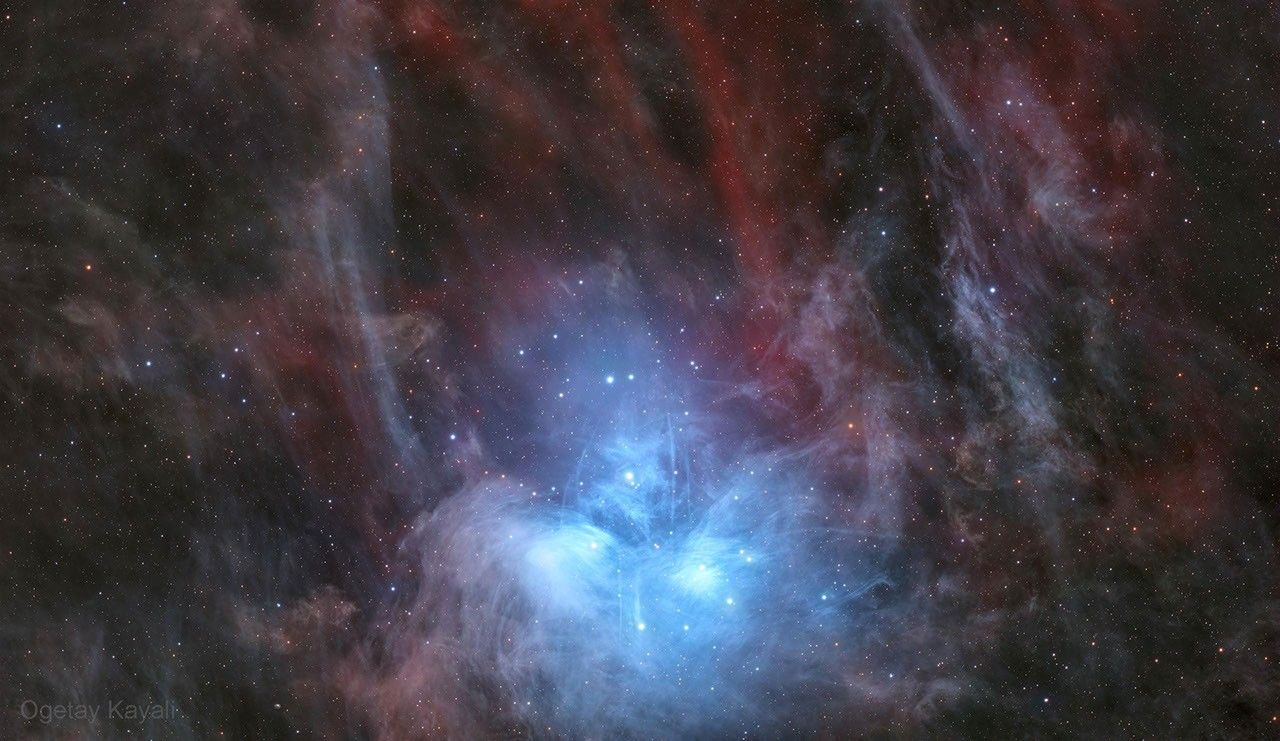
If you have looked at the sky and seen a group of stars about the size of the full Moon, that's the Pleiades (M45). Perhaps the most famous star cluster in the sky, its brightest stars can be seen even from the light-polluted cities. But your unaided eye can also see its nebulosity -- the gas and dust surrounding it -- under dark skies. However, telescopes can catch even more. The bright blue stars of the Pleiades, also known as the Seven Sisters, light up their surrounding dust, causing it to appear a diffuse blue that can only be seen under long exposures. But that's not all. The cosmic dust appears to stretch upward like ethereal arms. And the entire structure is surrounded by a reddish glow from the most abundant element in the universe: hydrogen. The featured image is composed of nearly 25 hours of exposure and was captured last year from Starfront Observatory, in Texas, USA Explore Your Universe: Random APOD Generator
Text from NASA APOD.
How to see it yourself
Pleiades (M45) — open star cluster in the constellation Taurus.
- Best seen in October – December, when it stands highest around midnight.
- From New York it climbs to 73° above the horizon. Visible from latitudes -56° to 90°.
- Visible to the naked eye under a dark sky away from city lights.
- Constellation
- Taurus
- Magnitude
- 1,6m
- Apparent size
- 110′ arcminutes
Whether M45 is up for you tonight, and how the clouds and the Moon look — AstroTools shows it.