The Dusty Surroundings of Orion and the Pleiades
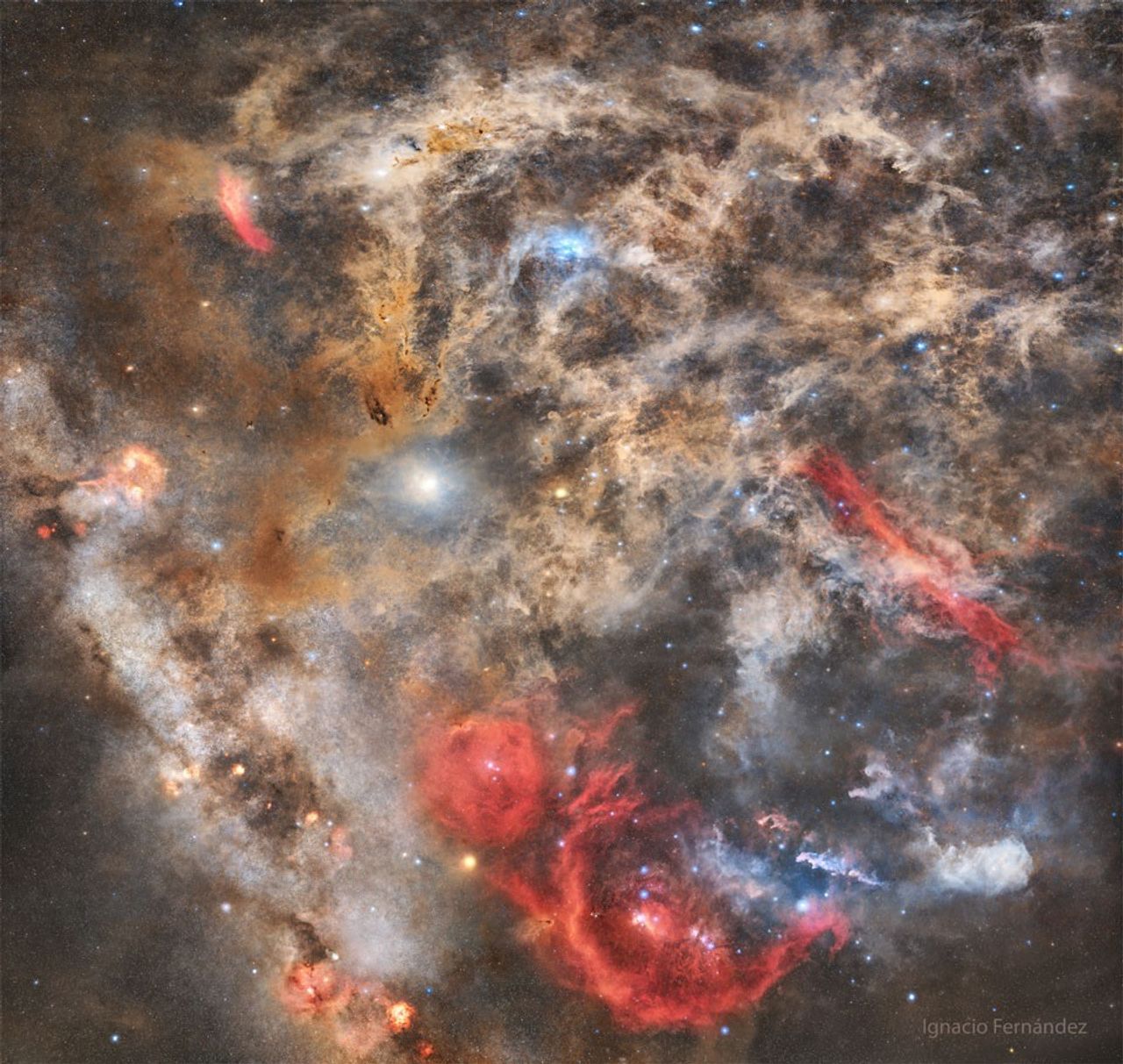
How well do you know the night sky? OK, but how well can you identify famous sky objects in a very deep image? Either way, here is a test: see if you can find some well-known night-sky icons in a deep image filled with filaments of normally faint dust and gas.
This image contains the Pleiades star cluster, Barnard's Loop, Orion Nebula, Aldebaran, Betelgeuse, Witch Head Nebula, Eridanus Loop, and the California Nebula. To find their real locations, here is an annotated image version.
The reason this task might be difficult is similar to the reason it is initially hard to identify familiar constellations in a very dark sky: the tapestry of our night sky has an extremely deep hidden complexity.
The featured composite reveals some of this complexity in a 16 hours of sky exposure in dark skies over Granada, Spain.
Tonight: Total Lunar Eclipse
Text from NASA APOD.
How to see it yourself
Pleiades (M45) — open star cluster in the constellation Taurus.
- Best seen in October – December, when it stands highest around midnight.
- From New York it climbs to 73° above the horizon. Visible from latitudes -56° to 90°.
- Visible to the naked eye under a dark sky away from city lights.
- Constellation
- Taurus
- Magnitude
- 1,6m
- Apparent size
- 110′ arcminutes
Whether M45 is up for you tonight, and how the clouds and the Moon look — AstroTools shows it.