The Moon, Venus, and the Pleiades
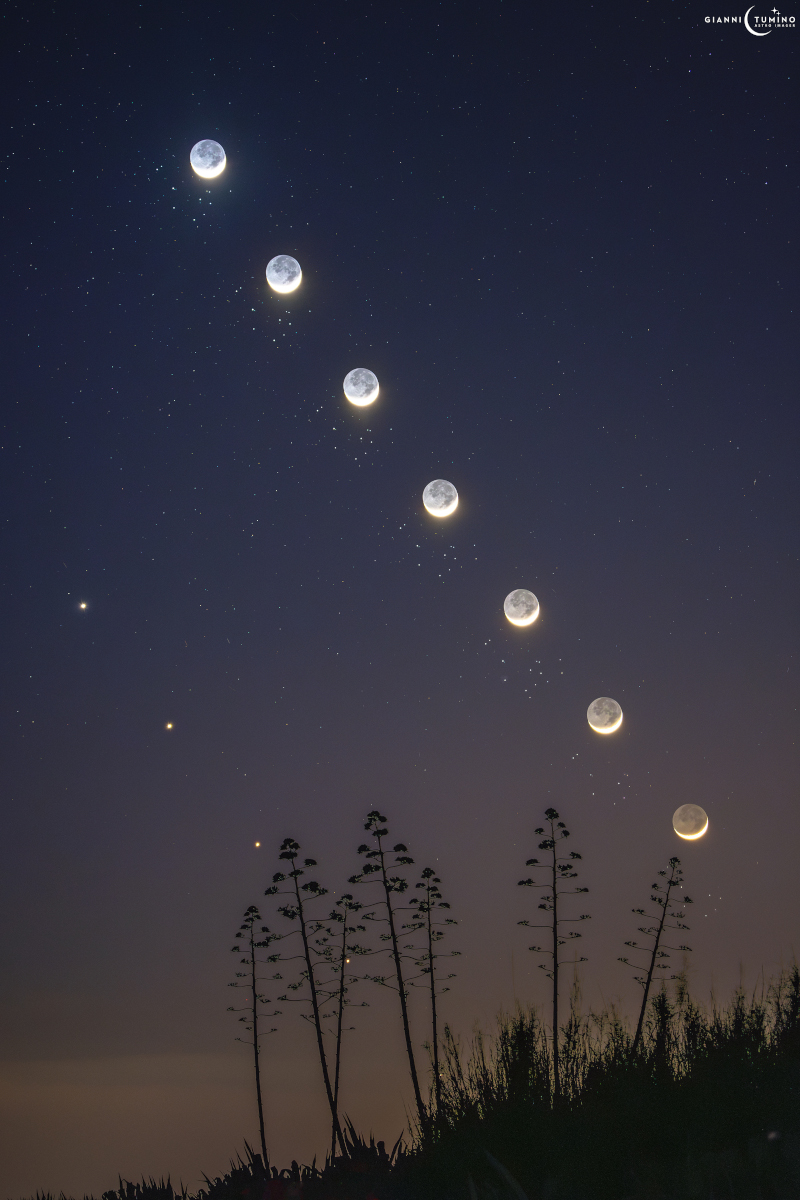
No, Earth did not recently acquire six more moons!
Today’s APOD is a combination of images following the Moon, Venus, and the Pleiades across a southern Sicilian sky as twilight turned to evening on April 19. From 2023 to 2029, the Pleiades' and the Moon “visit" each other once per month due to the Pleiades' location in the ecliptic plane. April 2026 saw the celestial alignment of their visit with Venus.
About six stars in the Pleiades cluster (Messier 45) are typically visible with the unaided eye. Due to the cluster’s visibility across the world, there are many myths and legends across cultures associated with the Pleiades. The Haudenosaunee people of North America, for example, say that seven boys danced so enthusiastically that they lifted off into the sky. Astronomers recently found thousands more Pleiades members, showing that after thousands of years of gazing upon this cluster, there is yet more to learn about the Pleiades.
Text from NASA APOD.
How to see it yourself
Pleiades (M45) — open star cluster in the constellation Taurus.
- Best seen in October – December, when it stands highest around midnight.
- From New York it climbs to 73° above the horizon. Visible from latitudes -56° to 90°.
- Visible to the naked eye under a dark sky away from city lights.
- Constellation
- Taurus
- Magnitude
- 1,6m
- Apparent size
- 110′ arcminutes
Whether M45 is up for you tonight, and how the clouds and the Moon look — AstroTools shows it.