Pleiades from Planet Earth
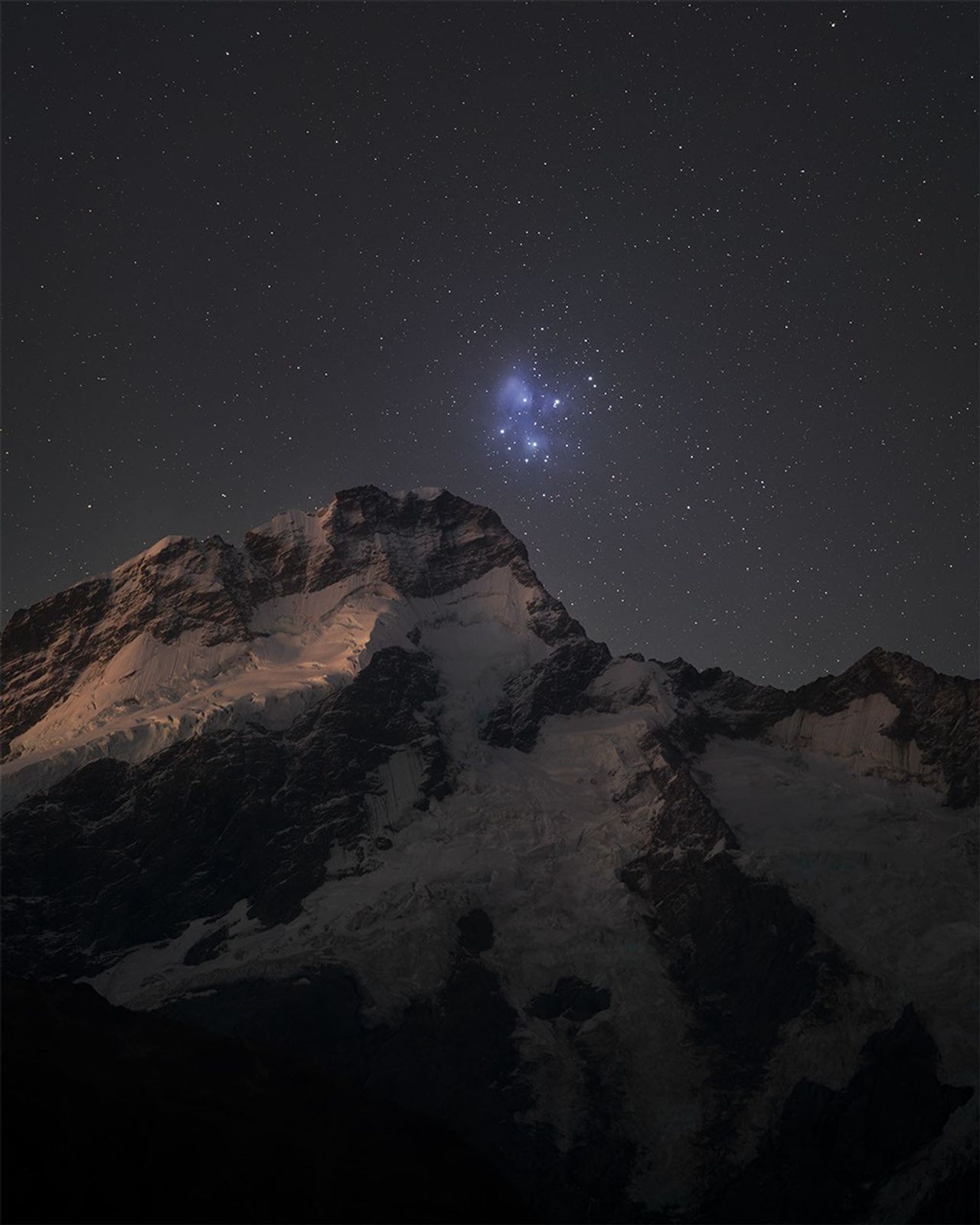
The lovely Pleiades star cluster shines in Earth's night sky, a compact group of stars some 400 light-years distant toward the constellation Taurus and the Orion Arm of our Milky Way galaxy. Recognized since ancient times, the remarkable celestial gathering is visible to the unaided eye. The Pleiades cluster is also well-placed for viewing from both northern and southern hemispheres, and over the centuries has become connected to many cultural traditions and celebrations, including the cross-quarter day celebration Halloween. In Greek myth, the Pleiades were seven daughters of the astronomical titan Atlas and sea-nymph Pleione. Galileo first sketched the star cluster viewed through his telescope with stars too faint to be seen by eye and Charles Messier recorded the position of the cluster as the 45th entry in his well-known catalog of things which are not comets. In this dramatic night skyscape from planet Earth, the stars of the Pleiades appear embedded in dusty blue reflection nebulae, poised above Mt Sefton, one of the tallest peaks in New Zealand. There known as Matariki, the star cluster is associated with the celebration of the Maori new year.
Text from NASA APOD.
How to see it yourself
Pleiades (M45) — open star cluster in the constellation Taurus.
- Best seen in October – December, when it stands highest around midnight.
- From New York it climbs to 73° above the horizon. Visible from latitudes -56° to 90°.
- Visible to the naked eye under a dark sky away from city lights.
- Constellation
- Taurus
- Magnitude
- 1,6m
- Apparent size
- 110′ arcminutes
Whether M45 is up for you tonight, and how the clouds and the Moon look — AstroTools shows it.