A Beautiful Trifid
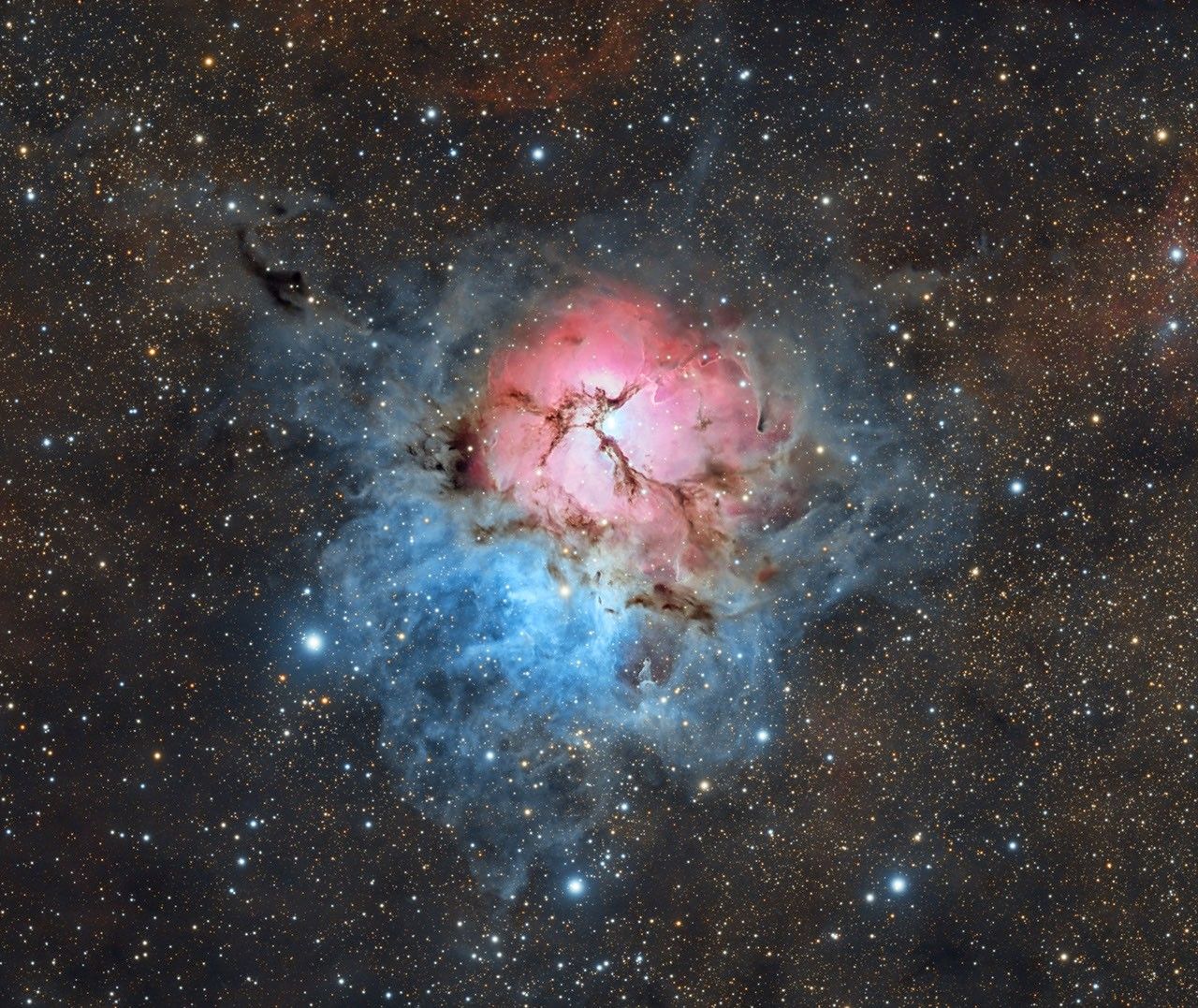
The beautiful Trifid Nebula is a cosmic study in contrasts. Also known as M20, it lies about 5,000 light-years away toward the nebula rich constellation Sagittarius. A star forming region in the plane of our galaxy, the Trifid does illustrate three different types of astronomical nebulae; red emission nebulae dominated by light from hydrogen atoms, blue reflection nebulae produced by dust reflecting starlight, and dark nebulae where dense dust clouds appear in silhouette. But, the red emission region roughly separated into three parts by obscuring dust lanes is what lends the Trifid its popular name. Pillars and jets sculpted by newborn stars, above and right of the emission nebula's center, appear in famous Hubble Space Telescope close-up images of the region. The Trifid Nebula is about 40 light-years across. Too faint to be seen by the unaided eye, in this deep telescopic view it almost covers the area of a full moon on planet Earth's sky.
Text from NASA APOD.
How to see it yourself
Trifid Nebula (M20) — emission nebula in the constellation Sagittarius.
- Best seen in May – July, when it stands highest around midnight.
- From New York it climbs to 26° above the horizon. Visible from latitudes -90° to 57°.
- Needs a small telescope, 70–100 mm, and a sky free of light pollution. A UHC or OIII filter brings out its contrast.
- Constellation
- Sagittarius
- Magnitude
- 8,5m
- Apparent size
- 28′ arcminutes
Whether M20 is up for you tonight, and how the clouds and the Moon look — AstroTools shows it.