Halo of the Cats Eye
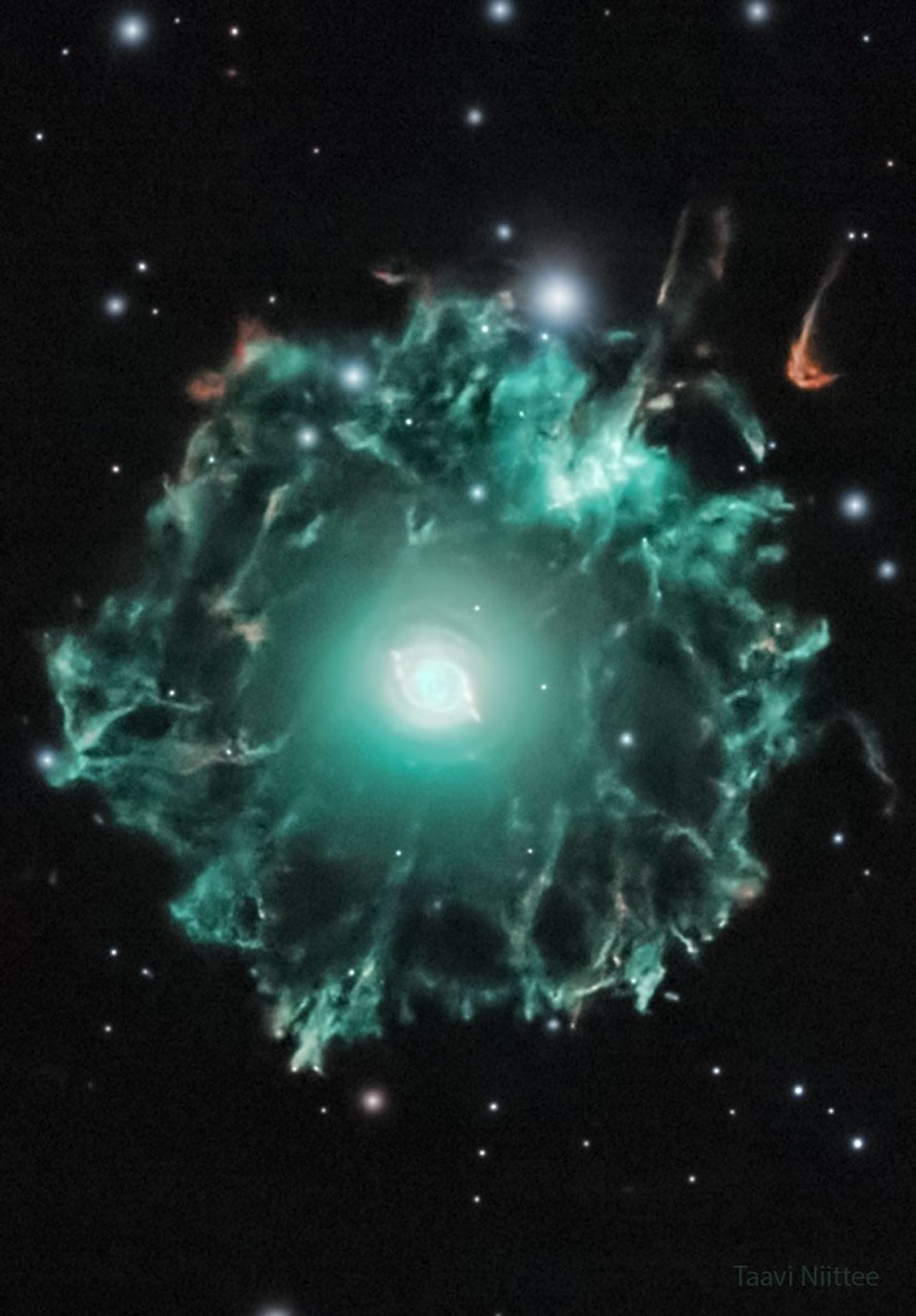
What created the unusual halo around the Cat’s Eye Nebula? No one is sure. What is sure is that the Cat’s Eye Nebula (NGC 6543) is one of the best known planetary nebulae on the sky. Although haunting symmetries are seen in the bright central region , this image was taken to feature its intricately structured outer halo, which spans over three light-years across. Planetary nebulae have long been appreciated as a final phase in the life of a Sun-like star. Only recently however, have some planetaries been found to have expansive halos , likely formed from material shrugged off during earlier puzzling episodes in the star’s evolution . While the planetary nebula phase is thought to last for around 10,000 years, astronomers estimate the age of the outer filamentary portions of the Cat’s Eye Nebula ‘s halo to be 50,000 to 90,000 years.
Text from NASA APOD.
How to see it yourself
Cat's Eye Nebula (NGC 6543) — planetary nebula in the constellation Draco.
- Best seen in May – July, when it stands highest around midnight.
- From New York it never sets and climbs to 64°. Visible from latitudes -13° to 90°.
- Needs a small telescope, 70–100 mm, and a sky free of light pollution. A UHC or OIII filter brings out its contrast.
- Constellation
- Draco
- Magnitude
- 9,0m
- Apparent size
- 0,9′ arcminutes
Whether NGC 6543 is up for you tonight, and how the clouds and the Moon look — AstroTools shows it.