M27: The Dumbbell Nebula
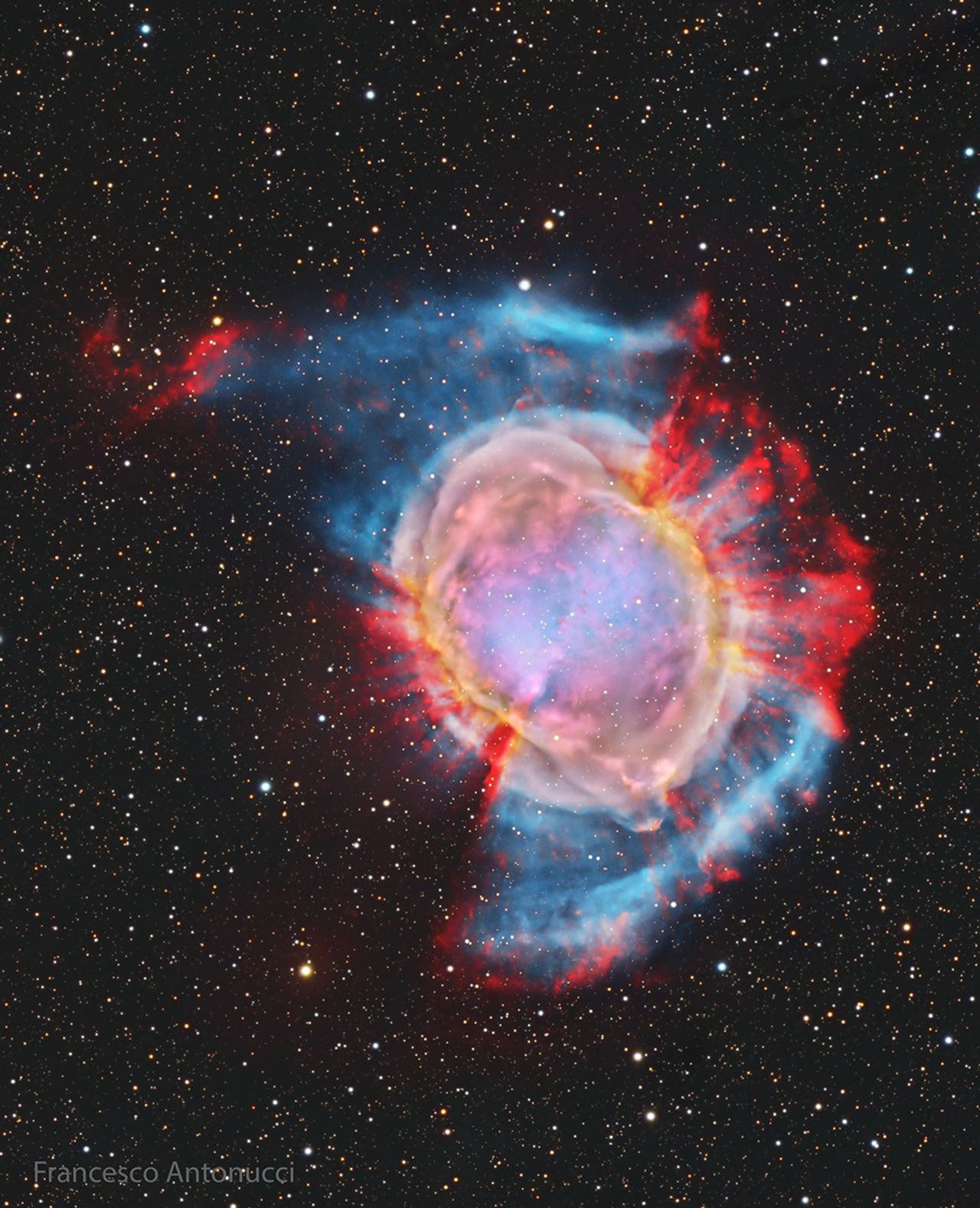
Is this what will become of our Sun? Quite possibly.
The first hint of our Sun's future was discovered inadvertently in 1764. At that time, Charles Messier was compiling a list of diffuse objects not to be confused with comets. The 27th object on Messier's list, now known as M27 or the Dumbbell Nebula, is a planetary nebula, one of the brightest planetary nebulas on the sky and visible with binoculars toward the constellation of the Fox (Vulpecula). It takes light about 1000 years to reach us from M27, featured here in colors enhanced by red for hydrogen and blue for oxygen. We now know that in about 6 billion years, our Sun will shed its outer gases into a planetary nebula like M27, while its remaining center will become an X-ray hot white dwarf star.
Understanding the physics and significance of M27 was well beyond 18th century science, though. Even today, many things remain mysterious about planetary nebulas, including how their intricate shapes are created.
Text from NASA APOD.
How to see it yourself
Dumbbell Nebula (M27) — planetary nebula in the constellation Vulpecula.
- Best seen in June – August, when it stands highest around midnight.
- From New York it climbs to 72° above the horizon. Visible from latitudes -57° to 90°.
- An easy binocular target; under a dark sky it shows in a finder scope too. A UHC or OIII filter brings out its contrast.
- Constellation
- Vulpecula
- Magnitude
- 7,4m
- Apparent size
- 6,7′ arcminutes
Whether M27 is up for you tonight, and how the clouds and the Moon look — AstroTools shows it.