Shapley 1: An Annular Planetary Nebula
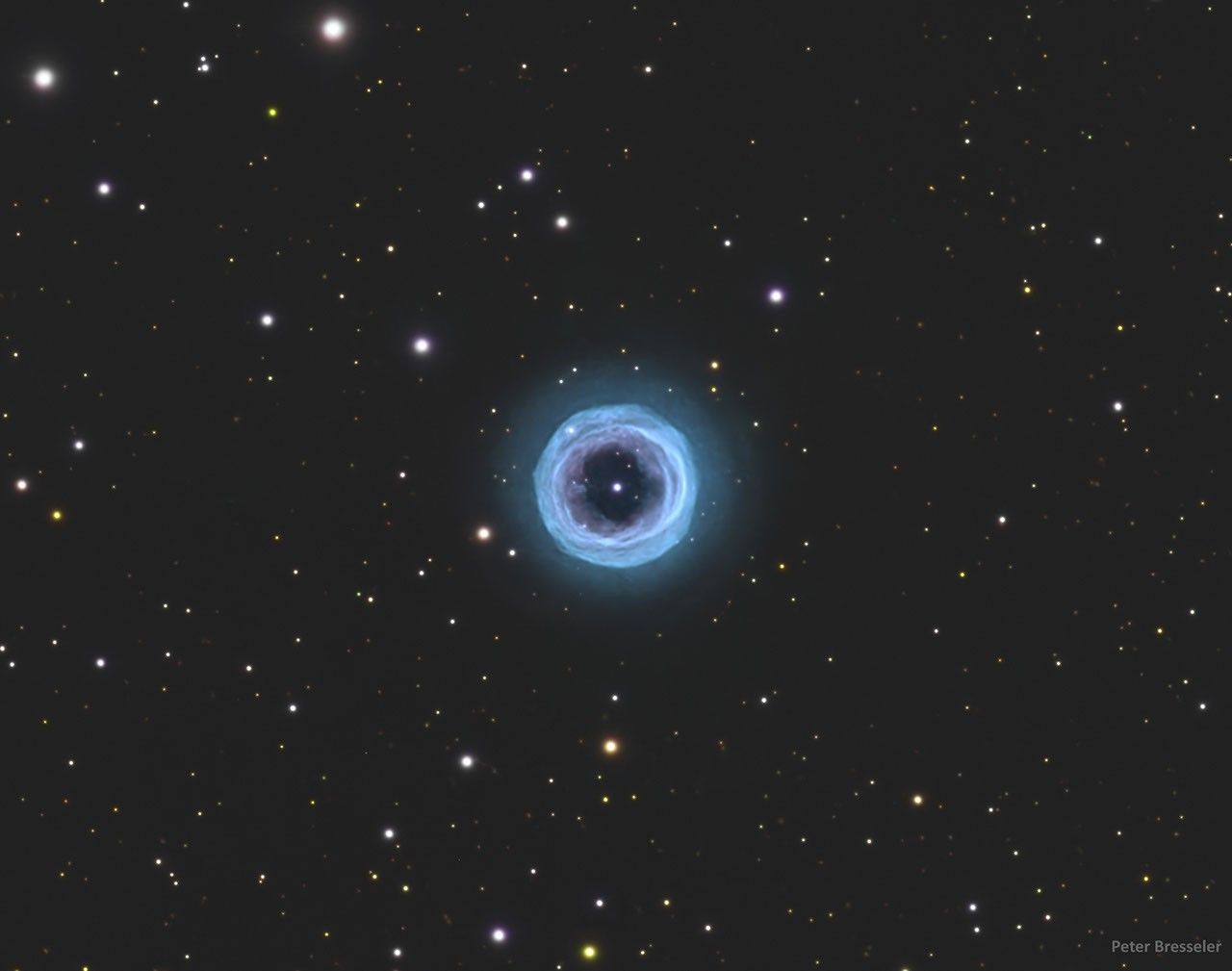
What’s looking back at you isn’t a cosmic eye, but Shapley 1, a beautifully symmetric planetary nebula.
Shapley 1, also known as the Fine Ring Nebula or PLN 329+2.1, bejewels the southern sky constellation of the Carpenter's Square (Norma).
The nebula is the result of a star near the mass of our Sun running out of fuel and shedding its outer layers.
Glowing oxygen from those expelled layers makes up the circular halo.
The bright central point is actually a binary: a white dwarf, the remaining stellar core after the outer layers are expelled into space, and another star, orbiting each other every 2.9 days.
Shapley 1’s annular shape is due to our top-down view of the system and provides insight into the influence of central stars on planetary nebula structures.
Text from NASA APOD.
How to see it yourself
Ring Nebula (M57) — planetary nebula in the constellation Lyra.
- Best seen in June – August, when it stands highest around midnight.
- From New York it climbs to 82° above the horizon. Visible from latitudes -47° to 90°.
- Needs a small telescope, 70–100 mm, and a sky free of light pollution. A UHC or OIII filter brings out its contrast.
- Constellation
- Lyra
- Magnitude
- 8,8m
- Apparent size
- 1,3′ arcminutes
Whether M57 is up for you tonight, and how the clouds and the Moon look — AstroTools shows it.