Planetary Nebula NGC 1514 from Webb
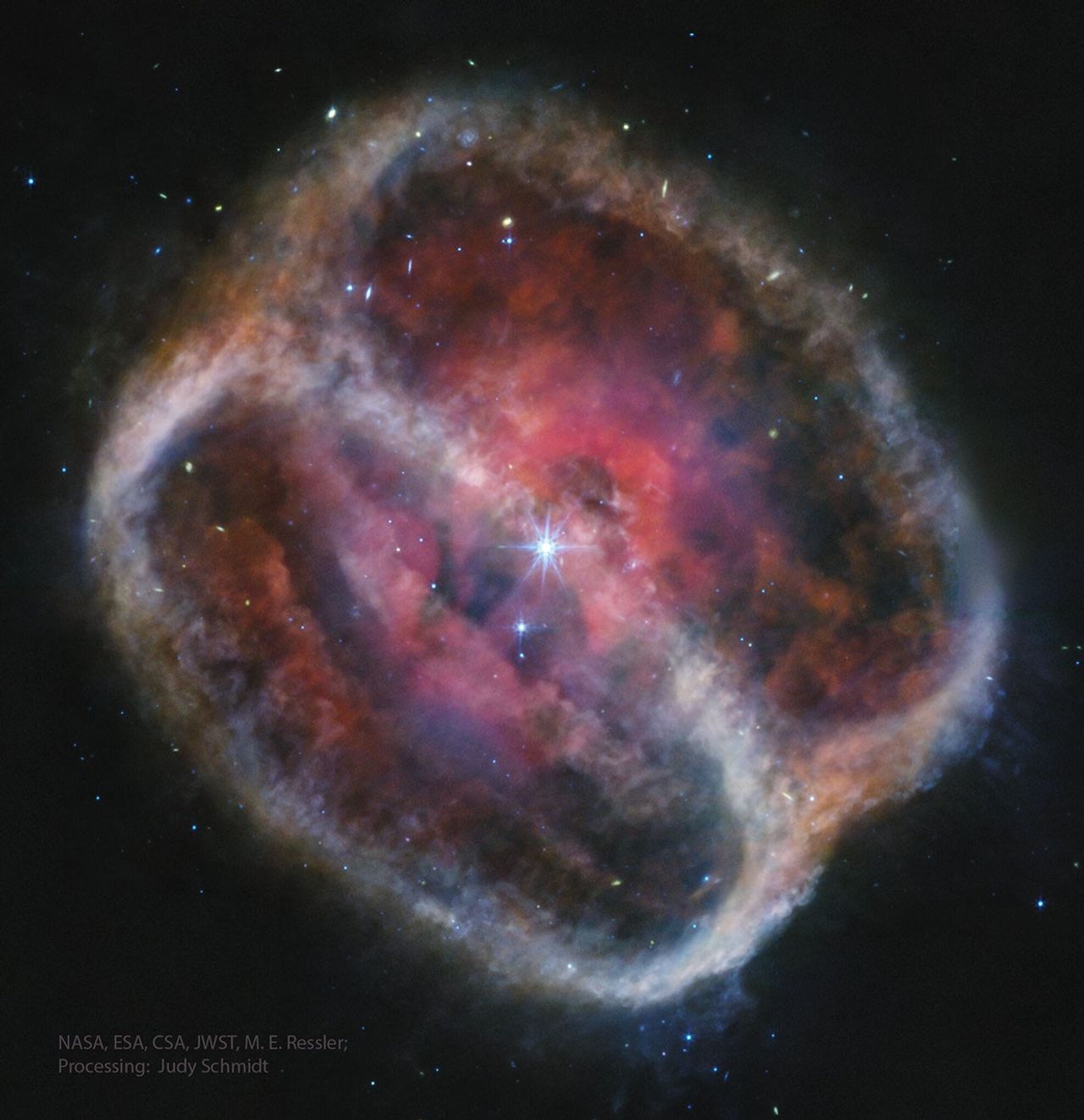
What happens when a star runs out of nuclear fuel ? For stars like our Sun , the center condenses into a white dwarf while the outer atmosphere is expelled into space to appear as a planetary nebula . The expelled outer atmosphere of planetary nebula NGC 1514 appears to be a jumble of bubbles — when seen in visible light . But the view from the James Webb Space Telescope in infrared , as featured here , confirms a different story: in this light the nebula shows a distinct hourglass shape , which is interpreted as a cylinder seen along a diagonal. If you look closely at the center of the nebula, you can also see a bright central star that is part of a binary system . More observations might better reveal how this nebula is evolving and how the central stars are working together to produce the interesting cylinder and bubbles observed. Jump Around the Universe: Random APOD Generator
Text from NASA APOD.
How to see it yourself
NGC 1514 — planetary nebula in the constellation Taurus.
- Best seen in October – December, when it stands highest around midnight.
- From New York it climbs to 80° above the horizon. Visible from latitudes -49° to 90°.
- Needs a 150–200 mm telescope and a dark sky outside the city. A UHC or OIII filter brings out its contrast.
- Constellation
- Taurus
- Magnitude
- 10,2m
- Apparent size
- 2,2′ arcminutes
Whether NGC 1514 is up for you tonight, and how the clouds and the Moon look — AstroTools shows it.