JWST Images The Lion's Head Nebula
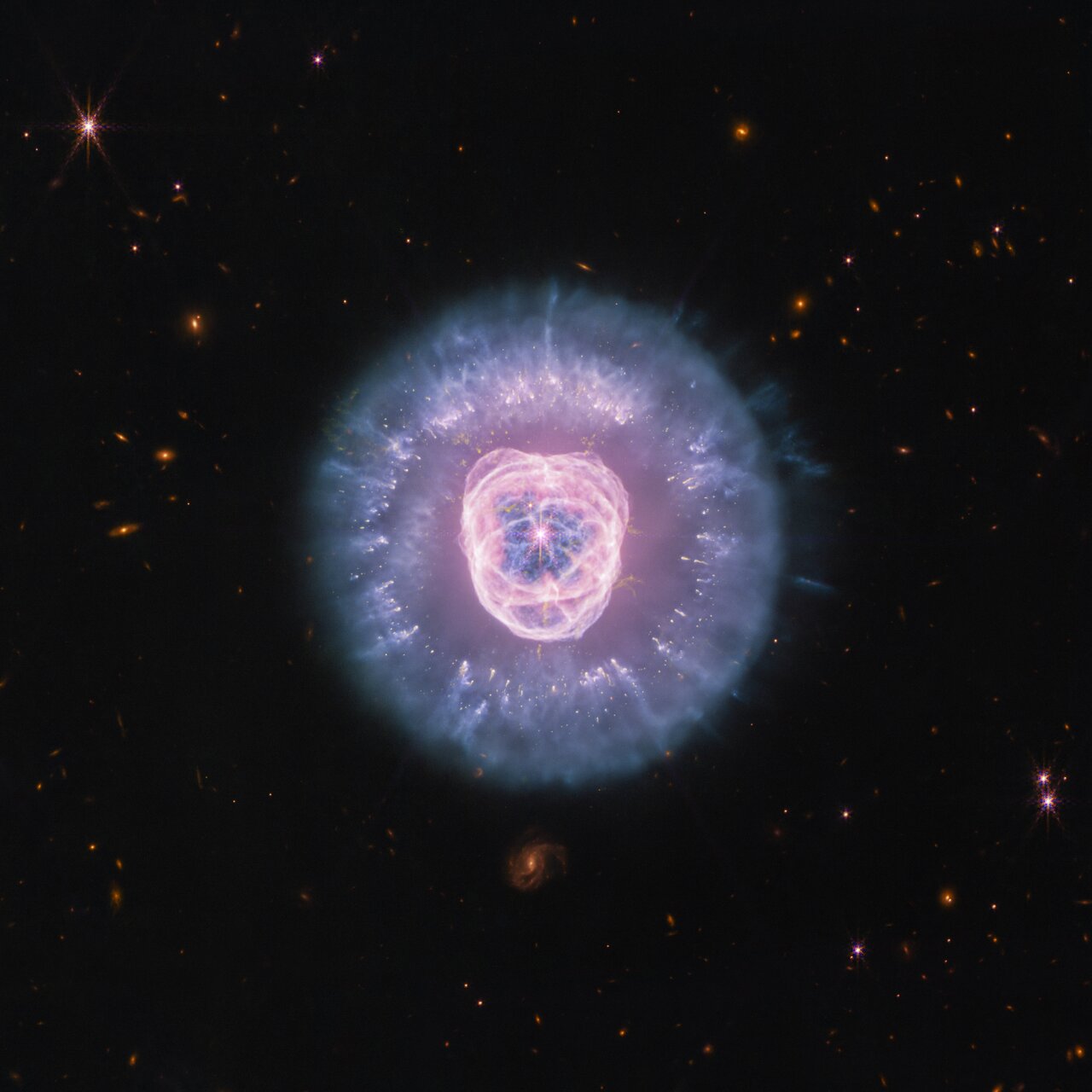
Are we looking at the future of our Sun? The James Webb Space Telescope captured today’s composite image of the Lion’s Head Nebula (NGC 2392) with its NIRCam and MIRI instruments. The Lion’s Head Nebula is the remnant of a Sun-like star. This star was unable to sustain the nuclear fusion in its core needed to remain stable. It began to shed layers of gas and dust into space, forming this planetary nebula. A hot stellar core, called a white dwarf, is left behind within the lion’s nose. Do not boop this nose! Intense radiation from the white dwarf is ionizing the gas as it expands, creating the irregular bubble that makes up the lion’s face. Dust clumps that have survived the white dwarf’s radiation and a cloud of ionized gas make up the lion’s mane. This new and more detailed view of the nebula will help humanity learn more about how the gas and dust interact with each other and the white dwarf radiation.
Text from NASA APOD.
How to see it yourself
Eskimo Nebula (NGC 2392) — planetary nebula in the constellation Gemini.
- Best seen in December – February, when it stands highest around midnight.
- From New York it climbs to 70° above the horizon. Visible from latitudes -59° to 90°.
- Needs a 150–200 mm telescope and a dark sky outside the city. A UHC or OIII filter brings out its contrast.
- Constellation
- Gemini
- Magnitude
- 9,6m
- Apparent size
- 0,9′ arcminutes
Whether NGC 2392 is up for you tonight, and how the clouds and the Moon look — AstroTools shows it.