NGC 1514: The Crystal Ball Nebula
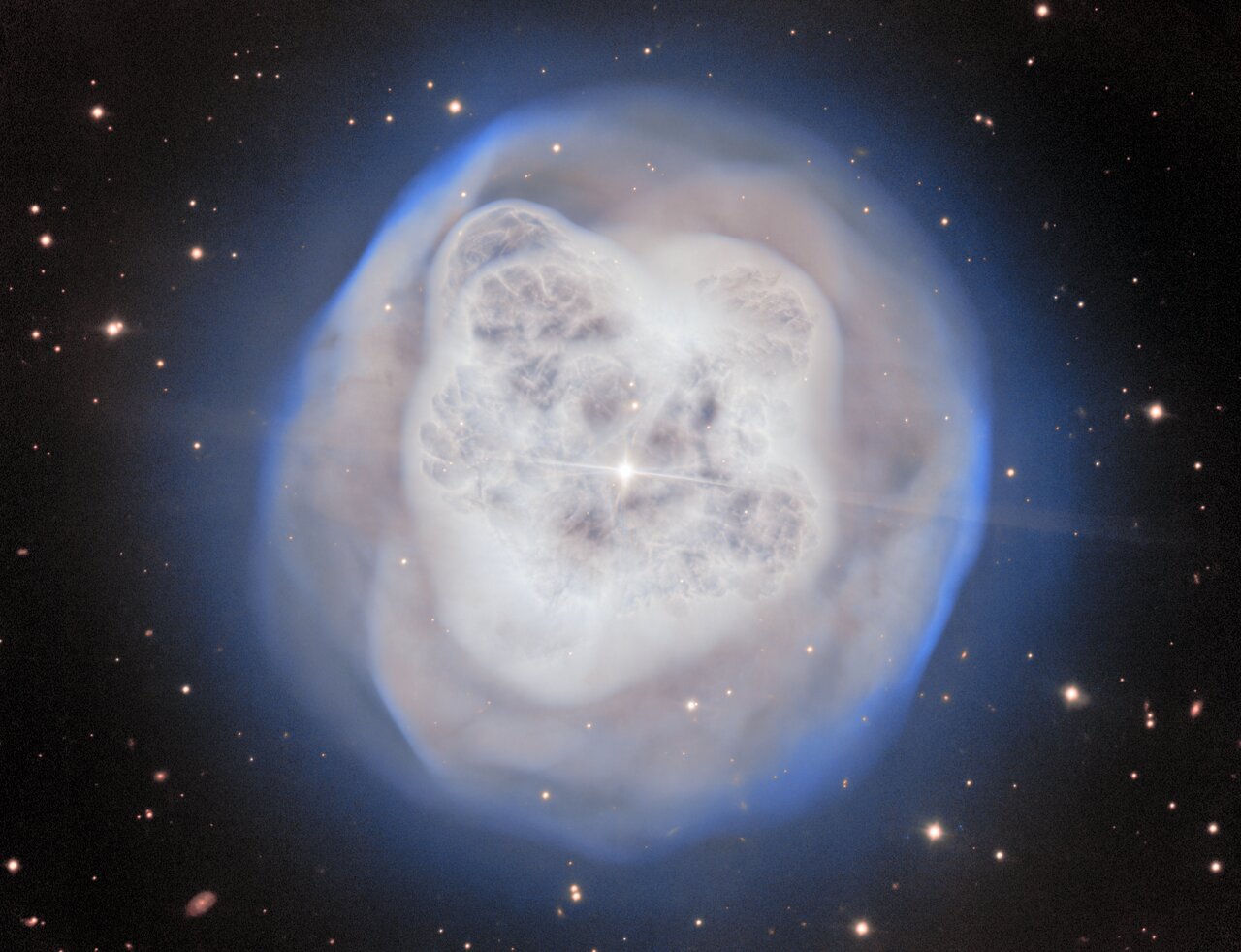
What do you see in this crystal ball?
The featured image shows NGC 1514, known as the Crystal Ball Nebula, observed by the Gemini North telescope on Maunakea, in Hawai'i.
NGC 1514 is 1,500 light-years away and was discovered by William Herschel in 1790.
This planetary nebula is formed when a star becomes a red giant and ejects its outer gas layers.
The ejected shell of gas is heated up by the core of the star to temperatures hotter than the surface of our Sun: that makes the gas shine, creating beautiful images like this one.
The slightly asymmetrical shape of the Crystal Ball Nebula reveals a secret: the bright star in the center has a companion.
As the two stars orbit each other with a period of about nine years, they shape the gas around them.
In about 10,000 - 25,000 years the nebula will be dissipated by their stellar winds.
Text from NASA APOD.
How to see it yourself
NGC 1514 — planetary nebula in the constellation Taurus.
- Best seen in October – December, when it stands highest around midnight.
- From New York it climbs to 80° above the horizon. Visible from latitudes -49° to 90°.
- Needs a 150–200 mm telescope and a dark sky outside the city. A UHC or OIII filter brings out its contrast.
- Constellation
- Taurus
- Magnitude
- 10,2m
- Apparent size
- 2,2′ arcminutes
Whether NGC 1514 is up for you tonight, and how the clouds and the Moon look — AstroTools shows it.