Seven Sisters versus California
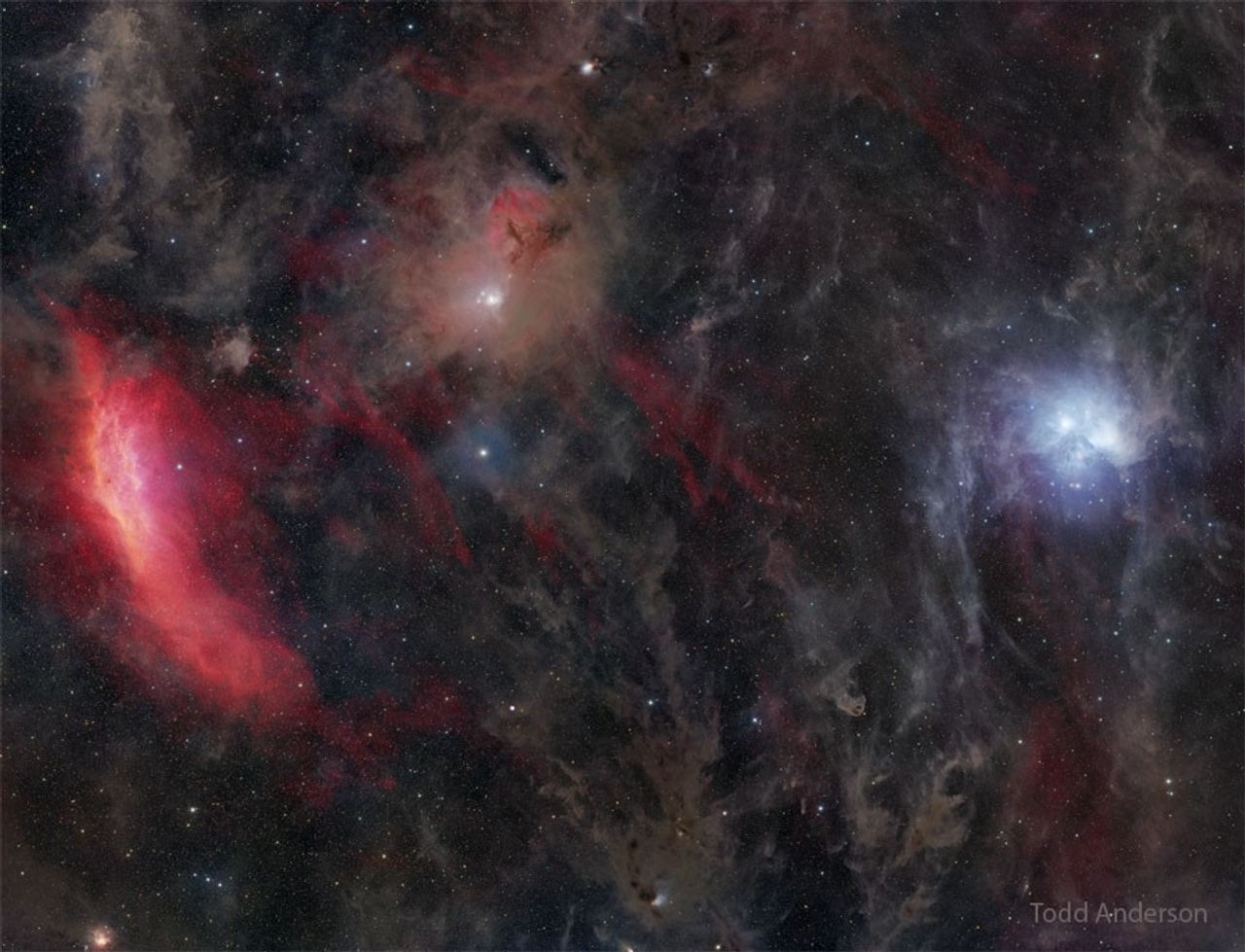
On the right, dressed in blue, is the Pleiades . Also known as the Seven Sisters and M45 , the Pleiades is one of the brightest and most easily visible open clusters on the sky. The Pleiades contains over 3,000 stars, is about 400 light years away, and only 13 light years across. Surrounding the stars is a spectacular blue reflection nebula made of fine dust . A common legend is that one of the brighter stars faded since the cluster was named. On the left, shining in red, is the California Nebula . Named for its shape, the California Nebula is much dimmer and hence harder to see than the Pleiades . Also known as NGC 1499 , this mass of red glowing hydrogen gas is about 1,500 light years away. Although about 25 full moons could fit between them , the featured wide angle, deep field image composite has captured them both . A careful inspection of the deep image will also reveal the star forming region IC 348 and the molecular cloud LBN 777 (the Baby Eagle Nebula). Jump Around the Universe: Random APOD Generator
Text from NASA APOD.
How to see it yourself
Pleiades (M45) — open star cluster in the constellation Taurus.
- Best seen in October – December, when it stands highest around midnight.
- From New York it climbs to 73° above the horizon. Visible from latitudes -56° to 90°.
- Visible to the naked eye under a dark sky away from city lights.
- Constellation
- Taurus
- Magnitude
- 1,6m
- Apparent size
- 110′ arcminutes
Whether M45 is up for you tonight, and how the clouds and the Moon look — AstroTools shows it.