Starburst Galaxy Messier 94
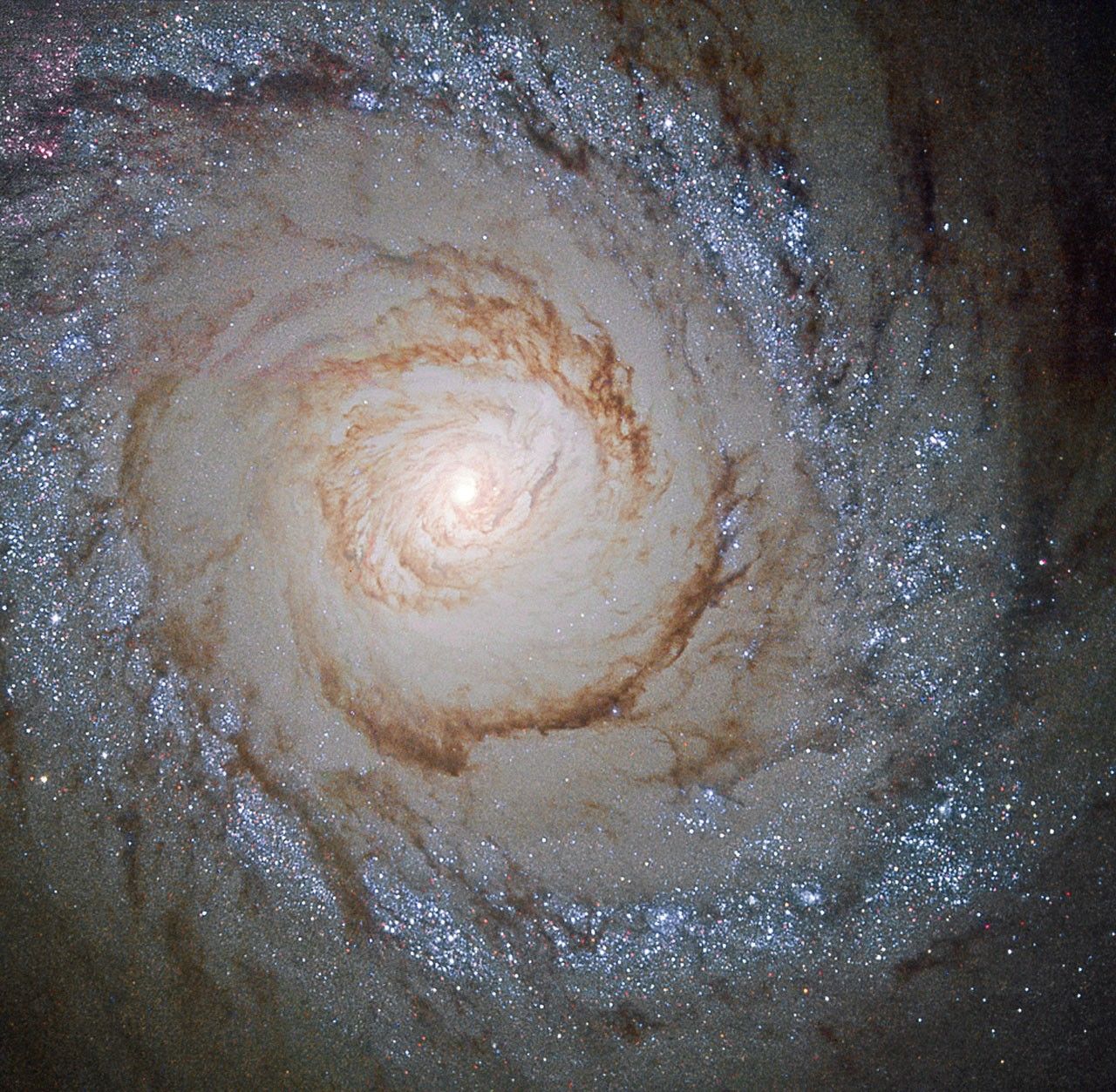
Beautiful island universe Messier 94 lies a mere 15 million light-years distant in the northern constellation of the hunting dogs, Canes Venatici . A popular target for earth-based astronomers, the face-on spiral galaxy is about 30,000 light-years across, with spiral arms sweeping through the outskirts of its broad disk. But this Hubble Space Telescope field of view spans about 7,000 light-years or so across M94’s central region. The sharp close-up examines the galaxy’s compact, bright nucleus and prominent inner dust lanes, surrounded by a remarkable bluish ring of young, massive stars. The massive stars in the ring appear to be less than about 10 million years old, indicating the galaxy experienced a corresponding well-defined era of rapid star formation. As a result, while the small, bright nucleus is typical of the Seyfert class of active galaxies, M94 is also known as a starburst galaxy . Because M94 is relatively nearby, astronomers can explore in detail reasons for the galaxy’s burst of star formation.Today’s Coverage: Moon Landing
Text from NASA APOD.
How to see it yourself
M94 — galaxy in the constellation Canes Venatici.
- Best seen in March – May, when it stands highest around midnight.
- From New York it climbs to 90° above the horizon. Visible from latitudes -39° to 90°.
- Needs a small telescope, 70–100 mm, and a sky free of light pollution.
- Constellation
- Canes Venatici
- Magnitude
- 8,2m
- Apparent size
- 7,7′ arcminutes
Whether M94 is up for you tonight, and how the clouds and the Moon look — AstroTools shows it.