Saturn at opposition on 4 October 2026: how to see the rings
On 4 October 2026 Saturn is closest to Earth and at its brightest for the year.
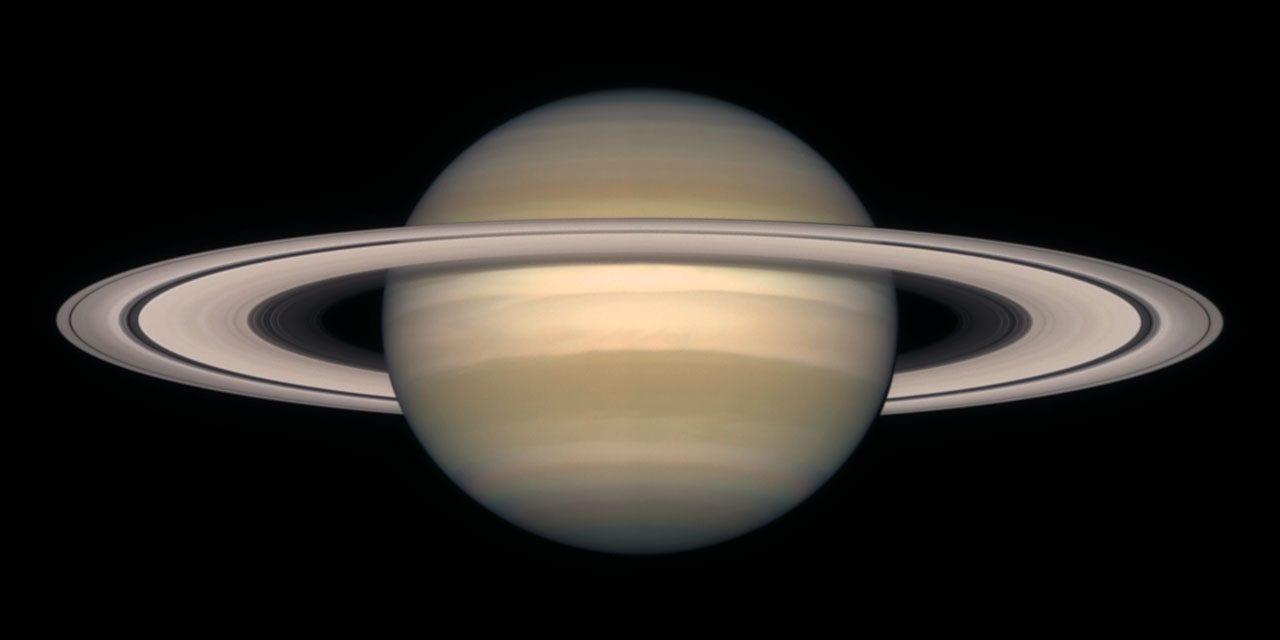
Saturn is the planet that makes people buy their first telescope. And 4 October 2026 is the best night of the year to do it: the planet reaches opposition, comes closest to Earth and shines brighter than on any other night of 2026. Here is where to find it, what each kind of optics will show you, and why the rings look different from the pictures you know.
When to look
Opposition falls on 4 October 2026 at 12:21 UTC. The exact moment barely matters — the planet stays essentially this bright for weeks. Good conditions hold from late August through mid-October.
What matters more is the geometry. At opposition Saturn sits directly opposite the Sun, which means it:
- rises in the east as the Sun sets;
- culminates around local midnight — its highest and best-looking moment;
- sets in the west at sunrise.
In other words, on opposition night the planet is available all night long, with no waiting.
Where to find Saturn
In October 2026 Saturn lies in Cetus, right on the border with Pisces (right ascension 00ʰ44ᵐ, declination +1°49′). That is almost exactly on the celestial equator, and two practical things follow.
First, the planet rises almost due east and sets almost due west, so it is easy to orient yourself. Second, how high it climbs depends on your latitude: from the mid-northern latitudes of Europe (around 50°N) Saturn reaches roughly 40° above the horizon; from northern Britain or Scandinavia, less. Pick a spot with an open southern horizon, clear of buildings and trees.
Identifying it is easy. This part of the sky is poor in bright stars, so Saturn will be the most obvious object there, shining at magnitude +0.3 — as bright as a first-magnitude star. And crucially, it does not twinkle: planets give a steady light, stars flicker.
Don't want to hunt for it? Wait for 6 October, when the Moon passes close to Saturn — there is no simpler way to point straight at it. The Moon page gives you moonrise for that evening.
What each instrument shows
Naked eye. A yellowish, non-twinkling "star". No rings — Galileo didn't see them either; his telescope showed only puzzling "handles" on each side of the planet.
10×50 binoculars. The disc looks visibly elongated — those same handles. Still not a ring you could call a ring.
A 60–70 mm telescope at 50× or more. Now the rings read as rings, clearly separated from the globe. This is the view everybody comes for.
A 100–150 mm telescope. The Cassini Division appears — the dark gap between rings A and B — and cloud belts show up on the disc itself.
Look for Titan as well, Saturn's largest moon at about magnitude 8.5. Even a small telescope shows it as a star-like point beside the planet, and it visibly shifts position from night to night.
Why the rings look so narrow in 2026
Compare your view with photos online and the rings will seem suspiciously thin. They are: in October 2026 they are tilted just 7.5° to our line of sight, and we are seeing their southern face.
The reason is that Saturn is tipped 26.7° to its orbital plane, so over its 29.5-year orbit we see the rings swing from nearly 27° open to edge-on. In spring 2025 Earth passed exactly through the ring plane and they briefly vanished. They are opening again now, but the wide-open views of 2015–2023 are still years away.
That is a reason to look, not to skip it: this geometry won't return for another decade and a half. Narrow rings also uncover the moons and the globe itself, which the rings usually partly hide.
One extra treat for the attentive: for a few hours either side of opposition the rings brighten noticeably as their icy particles reflect sunlight straight back at us. It is called the Seeliger effect, and it is at its best on the nights of 3–4 and 4–5 October.
How to prepare
- Check the forecast first. Transparency matters most: a day or two ahead, open the astro-weather forecast for layered cloud cover and a single score for the night.
- Don't chase dark skies. Unlike meteor showers and nebulae, planets are perfectly visible from town — light pollution barely touches something as bright as Saturn. No need to drive anywhere.
- Let the telescope cool. Put it outside 30–40 minutes before you observe; warm optics give a shimmering, soft image.
- Observe near culmination. Low down, the air boils and the image swims. Around local midnight Saturn is highest and steadiest.
- Don't max out the magnification. For a 70–80 mm telescope, 100–120× is the sensible ceiling. Beyond that you magnify blur, not detail.
Questions and answers
When is Saturn's opposition in 2026?
4 October 2026 at 12:21 UTC. On that night Saturn is closest to Earth for the year — 8.43 astronomical units, about 1.26 billion km — and at its brightest.
Can you see Saturn's rings with the naked eye?
No. To the unaided eye Saturn is a steady yellowish star. To see the rings as rings you need a telescope of at least 60 mm working at 50× or more.
Which constellation is Saturn in during autumn 2026?
Cetus, close to the border with Pisces. It rises almost due east at sunset and culminates around midnight.
Why are Saturn's rings barely visible right now?
They are tilted only 7.5° towards us — we are looking at them nearly edge-on. Earth crossed the ring plane in spring 2025, and they are only now starting to open up again.
Can I see Saturn from a city?
Yes. Saturn outshines most stars, and urban light pollution hardly affects it — unlike nebulae or meteors. A window or balcony facing south is enough.
To skip the mental arithmetic, install the AstroTools app: it shows when Saturn rises and reaches its highest point from exactly where you are, and tells you whether tonight is worth carrying the telescope outside.
Plan your observing with AstroTools
Weather, the Moon, light pollution and satellite passes — in one app.