Earth's Shadow Visualized with Lunar Eclipses
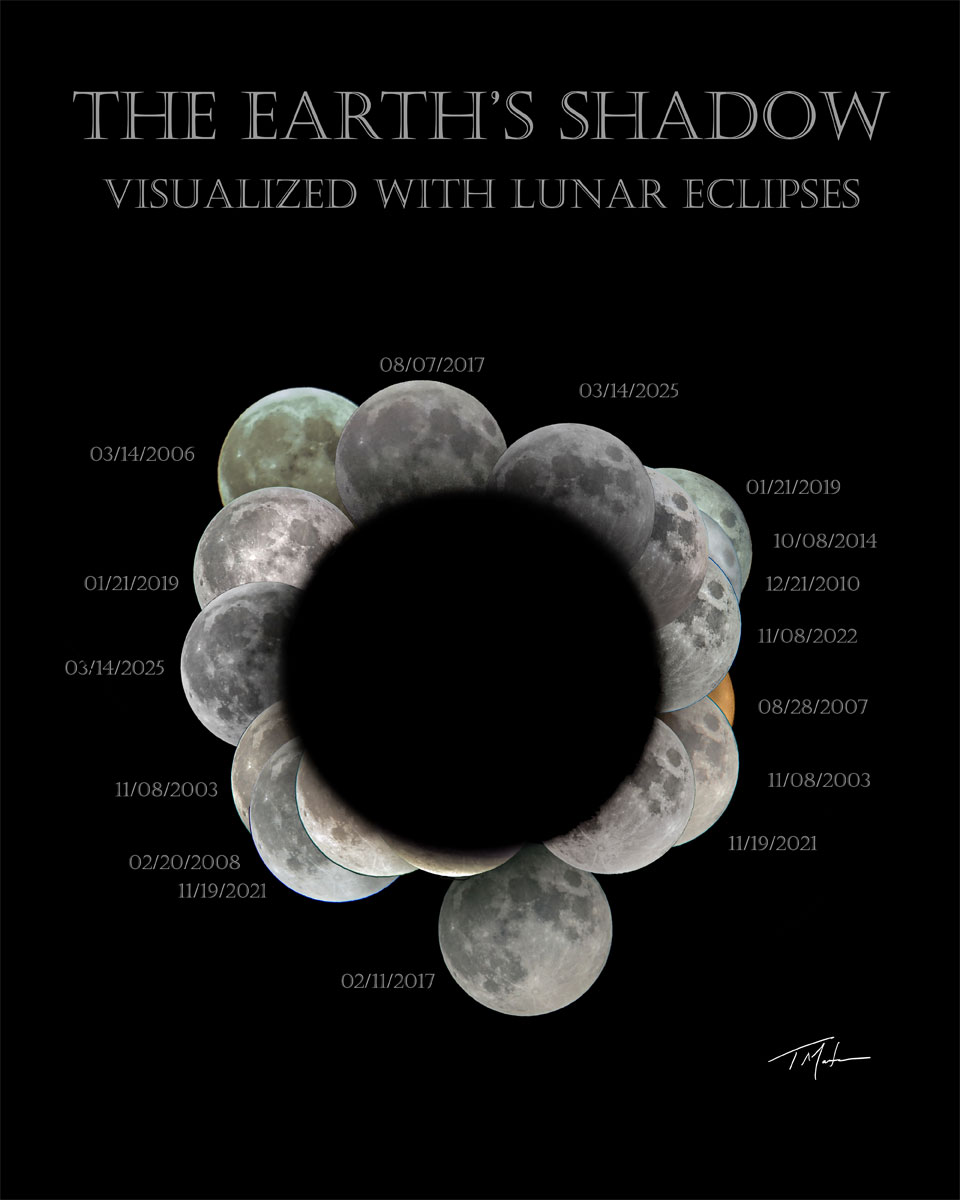
What’s creating this giant hole in space? This is not a black hole — it’s a shadow.
It’s Earth’s shadow.
Since at least the time of Aristotle, people have noted that Earth's dark shadow on the Moon during a partial lunar eclipse is circular -- although never a whole circle.
Using modern digital technology, though, the images of multiple lunar eclipses can be combined to show Earth's complete shadow.
The featured image compilation by a perseistent astrophotographer is constructed from 22 years of lunar eclipses.
The Moon is not eclipsed every month (moon-th) because the Moon's orbit is slightly tilted relative to Earth's orbit.
Close inspection of some lunar eclipse images shows a faint blue band where Earth’s atmosphere filters out more red sunlight than blue.
Later this week, a new lunar eclipse will occur and will be best visible in parts of North and South America, Europe, and Africa.
APOD's main NASA site is moving : From apod.nasa.gov to science.nasa.gov/apod
Text from NASA APOD.
How to see it yourself
Upcoming eclipses and where they are visible — in AstroTools.