A Tale of Two Nebulae
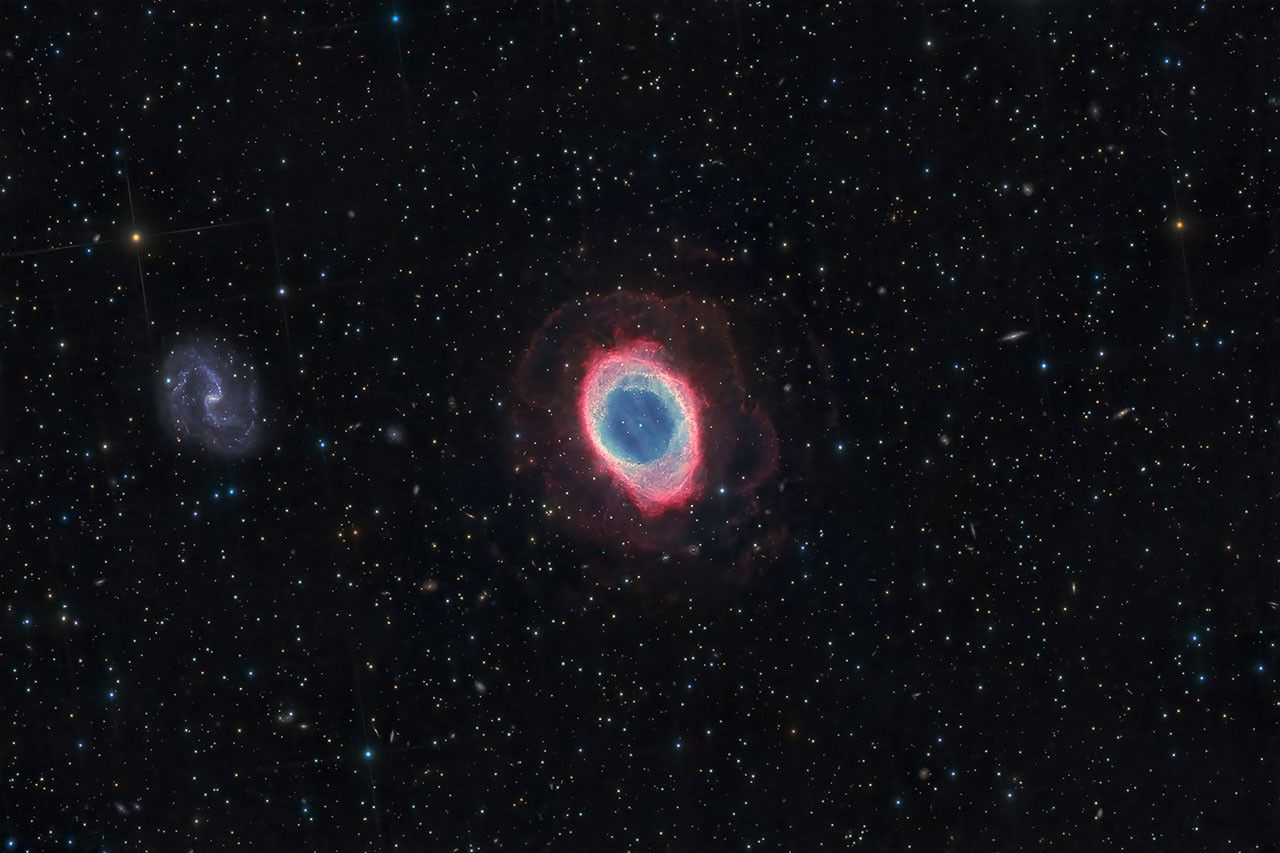
This colorful telescopic view towards the musical northern constellation Lyra reveals the faint outer halos and brighter central ring-shaped region of M57, popularly known as the Ring Nebula. To modern astronomers M57 is a well-known planetary nebula. With a central ring about one light-year across, M57 is definitely not a planet though, but the gaseous shroud of one of the Milky Way's dying sun-like stars. Roughly the same apparent size as M57, the fainter and more often overlooked barred spiral galaxy at the left is IC 1296. In fact, over 100 years ago IC 1296 would have been known as a spiral nebula. By chance the pair are in the same field of view, and while they appear to have similar sizes they are actually very far apart. At a distance of a mere 2,000 light-years M57 is well within our own Milky Way galaxy. Extragalactic IC 1296 (aka PGC62532) is more like 200,000,000 light-years distant. That's about 100,000 times farther away than M57 but since they appear roughly similar in size, former spiral nebula IC 1296 must also be about 100,000 times larger than planetary nebula M57. Look closely at the sharp 21st century astroimage to spot even more distant background galaxies scattered through the frame.
Text from NASA APOD.
How to see it yourself
Ring Nebula (M57) — planetary nebula in the constellation Lyra.
- Best seen in June – August, when it stands highest around midnight.
- From New York it climbs to 82° above the horizon. Visible from latitudes -47° to 90°.
- Needs a small telescope, 70–100 mm, and a sky free of light pollution. A UHC or OIII filter brings out its contrast.
- Constellation
- Lyra
- Magnitude
- 8,8m
- Apparent size
- 1,3′ arcminutes
Whether M57 is up for you tonight, and how the clouds and the Moon look — AstroTools shows it.