A Helix Nebula Deep Field
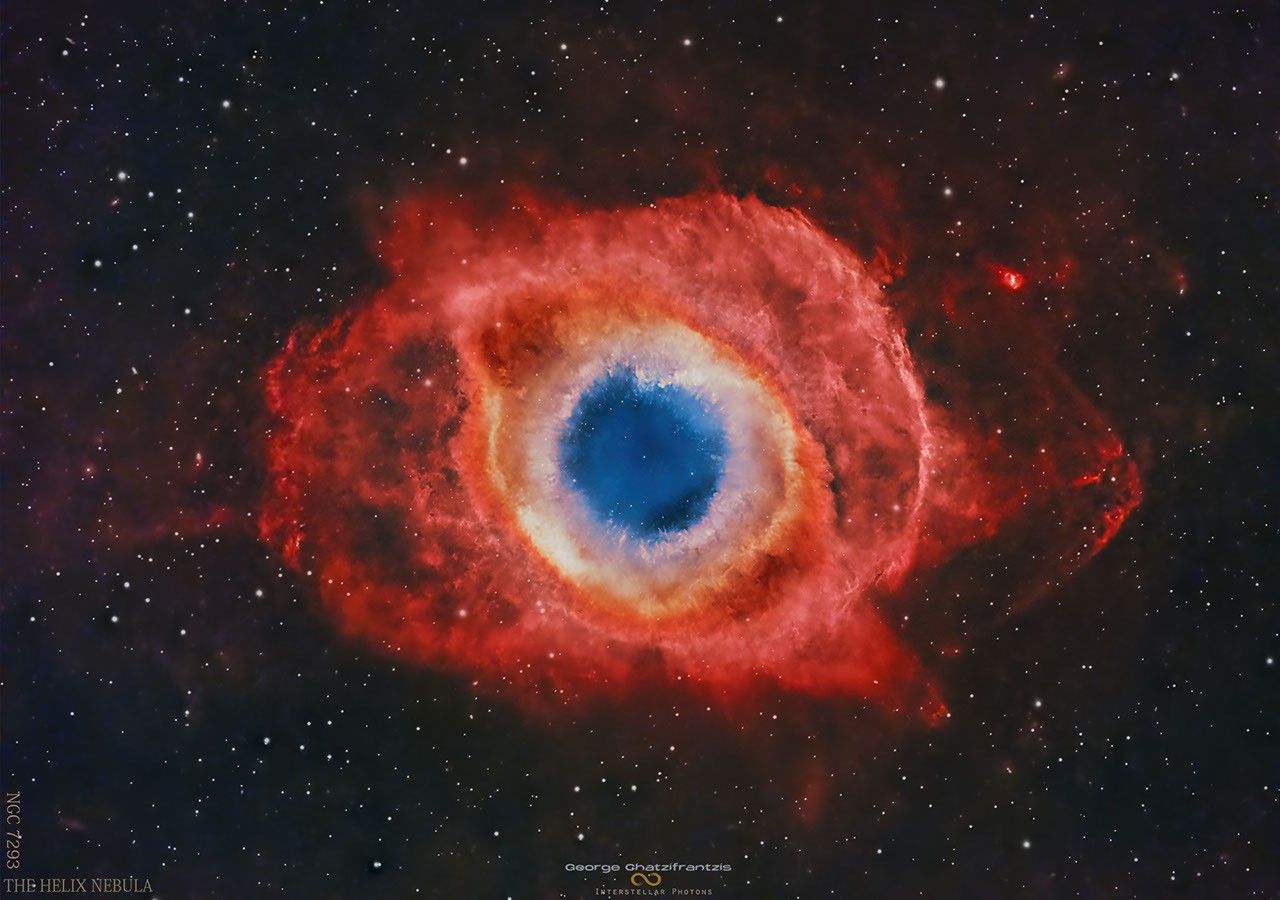
Is the Helix Nebula looking at you? No, not in any biological sense, but it does look quite like an eye. The Helix Nebula is so named because it also appears that you are looking down the axis of a helix. In actuality, it is now understood to have a surprisingly complex geometry, including radial filaments and extended outer loops.
The Helix Nebula (aka NGC 7293) is one of brightest and closest examples of a planetary nebula, a gas cloud created at the end of the life of a Sun-like star. The remnant central stellar core, destined to become a white dwarf star, glows in light so energetic it causes the previously expelled gas to fluoresce. The featured picture, taken in red, green, and blue but highlighted by light emitted primarily by hydrogen was created from 12 hours of exposure through a personal telescope located in Greece.
A close-up of the inner edge of the Helix Nebula shows complex gas knots the origin of which are still being researched.
Portal Universe: Random APOD Generator
Text from NASA APOD.
How to see it yourself
Helix Nebula (NGC 7293) — planetary nebula in the constellation Aquarius.
- Best seen in July – September, when it stands highest around midnight.
- From New York it climbs to 28° above the horizon. Visible from latitudes -90° to 59°.
- An easy binocular target; under a dark sky it shows in a finder scope too. A UHC or OIII filter brings out its contrast.
- Constellation
- Aquarius
- Magnitude
- 7,3m
- Apparent size
- 16,3′ arcminutes
Whether NGC 7293 is up for you tonight, and how the clouds and the Moon look — AstroTools shows it.