NGC 6302: The Butterfly Nebula
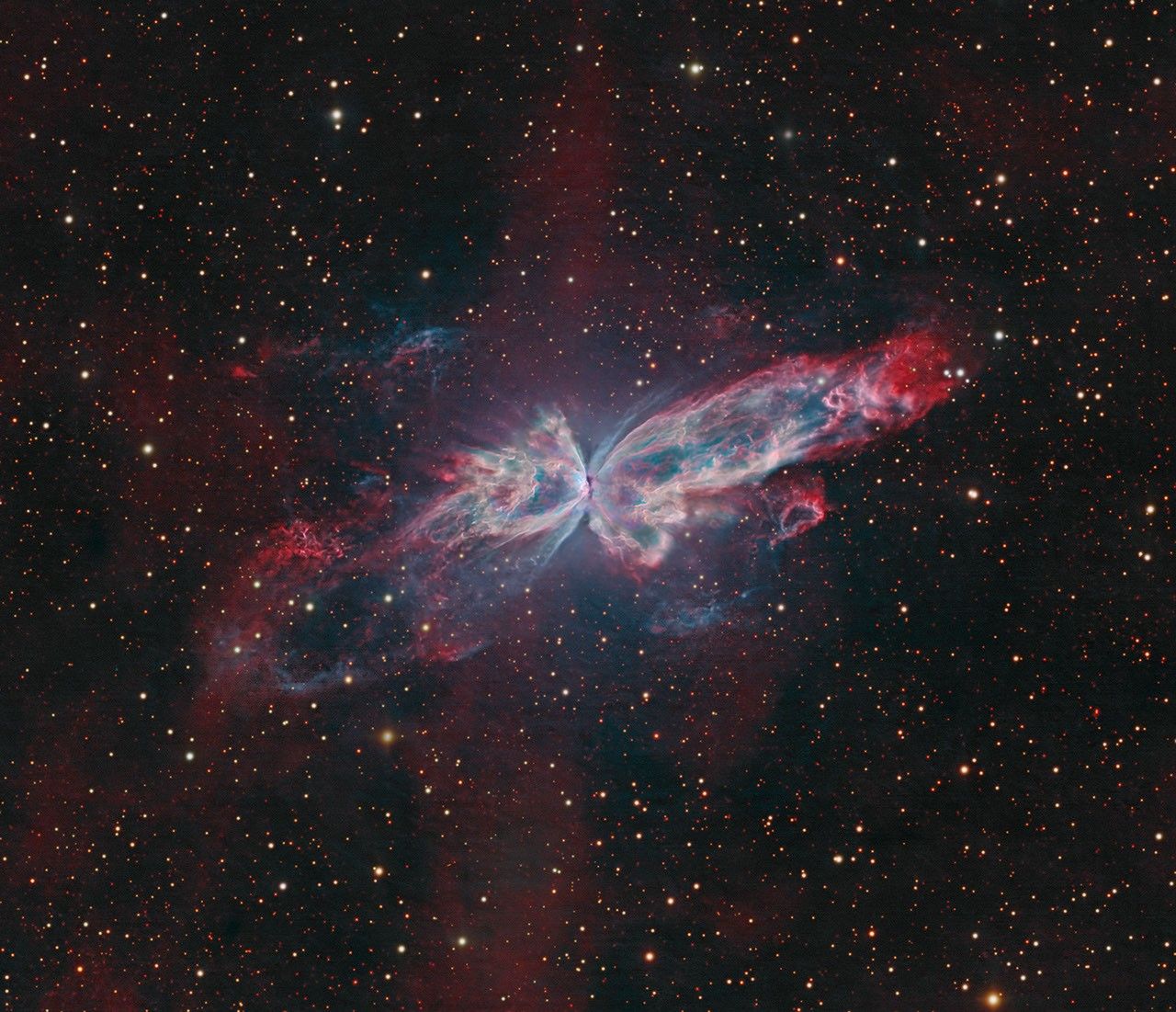
The bright clusters and nebulae of planet Earth's night sky are often given the names of flowers or insects, and its whopping 3 light-year wingspan, NGC 6302 is no exception. With an estimated surface temperature of about 250,000 degrees C, the central star of the planetary nebula is transforming into a white dwarf star, becoming exceptionally hot, and shining brightly in ultraviolet light. The central star is hidden from direct view by a torus of dust, but its energetic ultraviolet light ionizes atoms in the nebula. In this sharp, telescopic view composed with narrowband image data, the ionized hydrogen and doubly ionized oxygen atoms are shown in their characteristic red and blue-green hues to reveal a stunning complex of knots and filaments within the nebula's wing-like bipolar outflows. NGC 6302 lies about 4,000 light-years away in the arachnologically correct constellation of the Scorpion (Scorpius).
Text from NASA APOD.
How to see it yourself
Bug Nebula (NGC 6302) — planetary nebula in the constellation Scorpius.
- Best seen in May – July, when it stands highest around midnight.
- From New York it climbs to 12° above the horizon. Visible from latitudes -90° to 43°.
- Needs a 150–200 mm telescope and a dark sky outside the city. A UHC or OIII filter brings out its contrast.
- Constellation
- Scorpius
- Magnitude
- 9,6m
- Apparent size
- 0,7′ arcminutes
Whether NGC 6302 is up for you tonight, and how the clouds and the Moon look — AstroTools shows it.