NGC 1360: The Robin's Egg Nebula
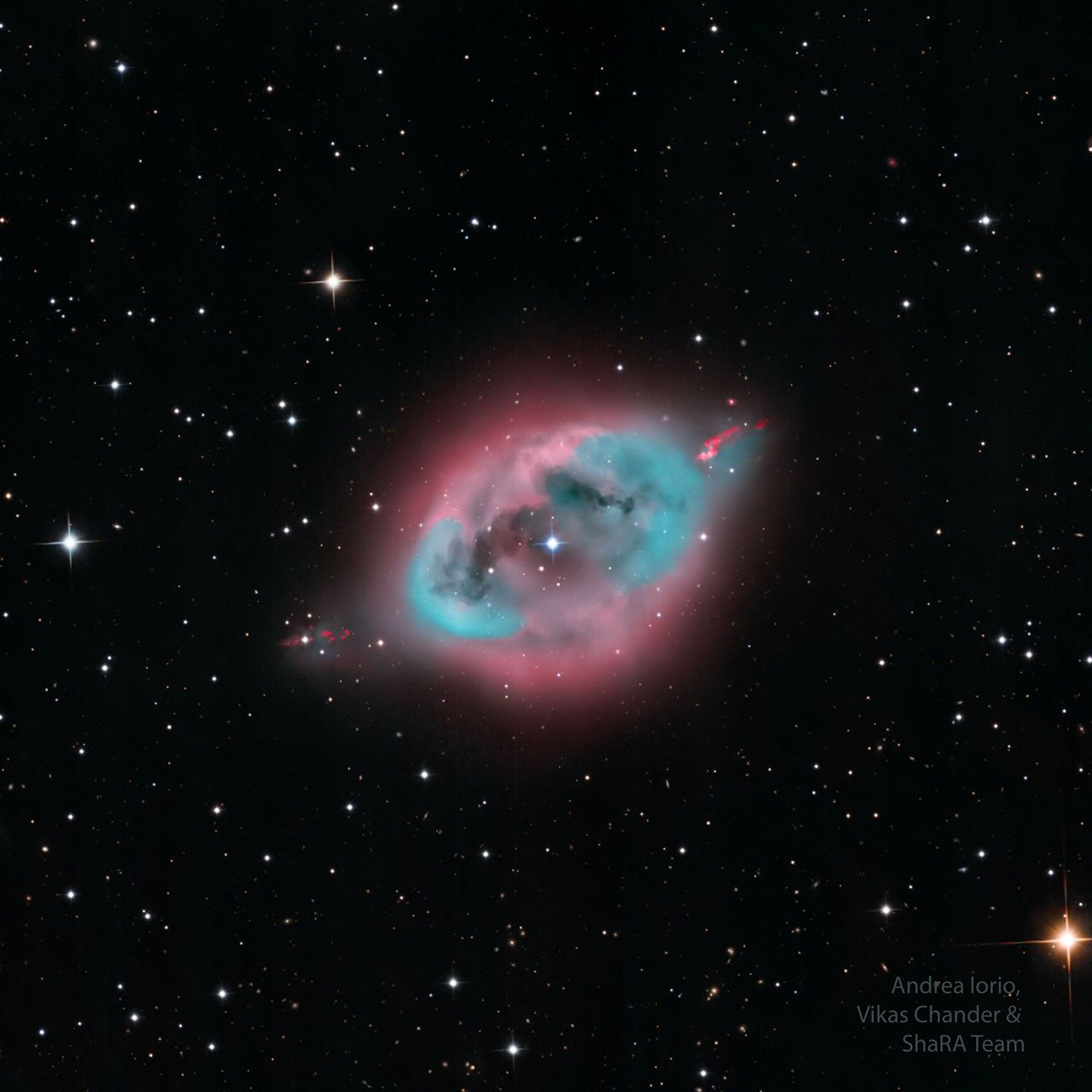
This pretty nebula lies some 1,500 light-years away, its shape and color in this telescopic view reminiscent of a robin's egg. The cosmic cloud spans about 3 light-years, nestled securely within the boundaries of the southern constellation of the Furnace (Fornax). Recognized as a planetary nebula, egg-shaped NGC 1360 doesn't represent a beginning, though. Instead, it corresponds to a brief and final phase in the evolution of an aging star. In fact, visible at the center of the nebula, the central star of NGC 1360 is known to be a binary star system likely consisting of two evolved white dwarf stars, less massive but much hotter than the Sun.
Their intense and otherwise invisible ultraviolet radiation has stripped away electrons from the atoms in their mutually surrounding gaseous shroud. The blue-green hue inside of NGC 1360 seen here is the strong emission produced as electrons recombine with doubly ionized oxygen atoms.
Celestial Surprise: What picture did APOD feature on your birthday? (post 1995)
Text from NASA APOD.
How to see it yourself
NGC 1360 — planetary nebula in the constellation Fornax.
- Best seen in October – December, when it stands highest around midnight.
- From New York it climbs to 23° above the horizon. Visible from latitudes -90° to 54°.
- Needs a small telescope, 70–100 mm, and a sky free of light pollution. A UHC or OIII filter brings out its contrast.
- Constellation
- Fornax
- Magnitude
- 9,4m
- Apparent size
- 6,4′ arcminutes
Whether NGC 1360 is up for you tonight, and how the clouds and the Moon look — AstroTools shows it.