IC 418: The Spirograph Nebula
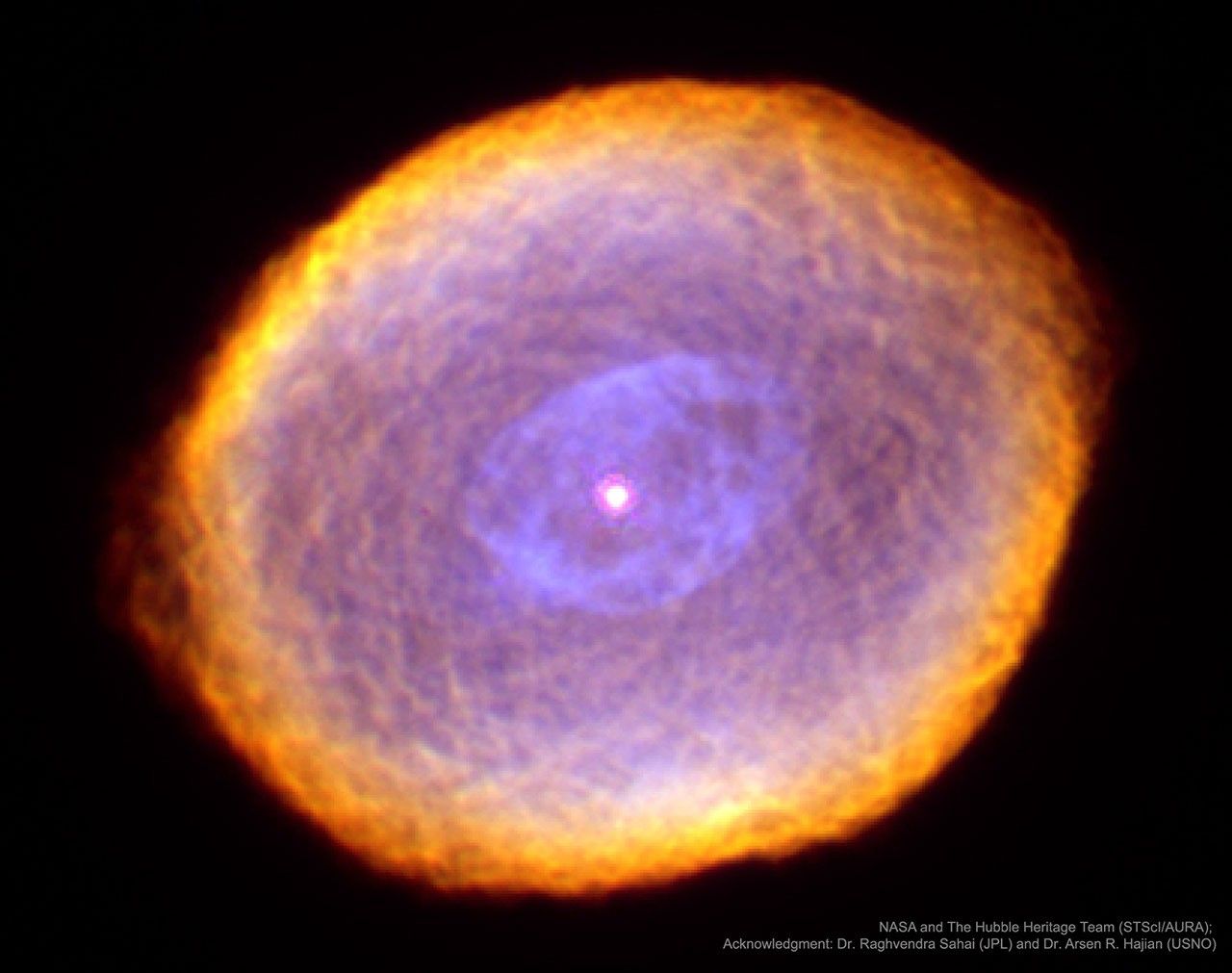
What is creating the strange texture of IC 418? Dubbed the Spirograph Nebula for its resemblance to drawings from a cyclical drawing tool , planetary nebula IC 418 shows patterns that are not well understood. Perhaps they are related to chaotic winds from the variable central star, which changes brightness unpredictably in just a few hours. By contrast, evidence indicates that only a few million years ago, IC 418 was probably a well-understood star similar to our Sun . Only a few thousand years ago, IC 418 was probably a common red giant star. Since running out of nuclear fuel , though, the outer envelope has begun expanding outward leaving a hot remnant core destined to become a white-dwarf star , visible in the image center. The light from the central core excites surrounding atoms in the nebula causing them to glow. IC 418 lies about 2000 light-years away and spans 0.3 light-years across. This false-color image taken from the Hubble Space Telescope reveals the unusual details .
Text from NASA APOD.
How to see it yourself
IC 418 — planetary nebula in the constellation Lepus.
- Best seen in November – January, when it stands highest around midnight.
- From New York it climbs to 37° above the horizon. Visible from latitudes -90° to 67°.
- Needs a small telescope, 70–100 mm, and a sky free of light pollution. A UHC or OIII filter brings out its contrast.
- Constellation
- Lepus
- Magnitude
- 9,4m
- Apparent size
- 0,2′ arcminutes
Whether IC 418 is up for you tonight, and how the clouds and the Moon look — AstroTools shows it.