Northern lights at mid-latitudes: when to watch and how not to miss them
At what Kp index the aurora is visible in Germany, Poland and France, where to look, why your phone sees it better than your eyes, and how to catch the next geomagnetic storm.
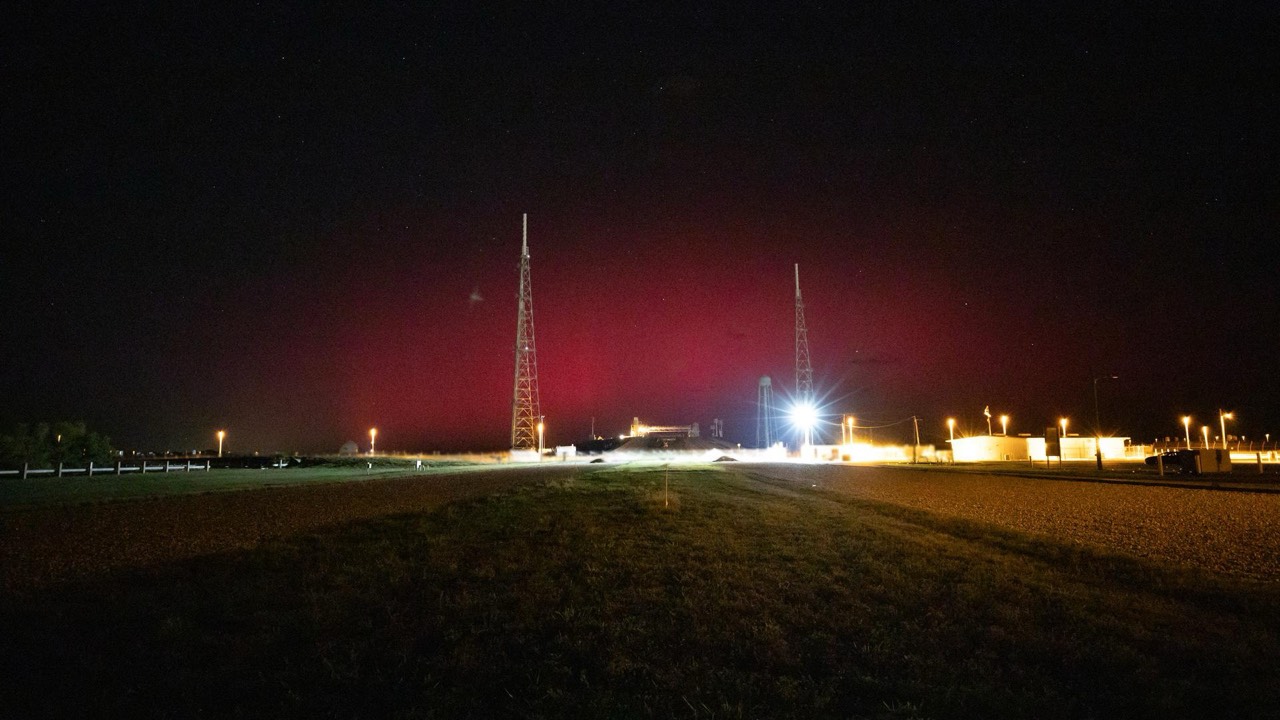
In May 2024, the northern lights were seen in Germany, Poland and even France. In October 2024 and November 2025, again. Each time, the next morning the feed is full of photos, and half the people learn about the aurora from someone else's stories. To see it yourself next time, it's enough to understand three things: what the Kp index is, where to look, and why your eye sees less than a phone camera.
Why the aurora reaches mid-latitudes at all
Usually auroras burn in a ring around the magnetic pole — over northern Scandinavia, Iceland, and northern Russia. This is the auroral oval. When the Sun ejects a cloud of plasma (a coronal mass ejection) and it slams into Earth's magnetic field 1–3 days later, a geomagnetic storm begins. The stronger the storm, the farther south the oval spreads.
Storm strength is measured by the Kp index — from 0 to 9. Each unit is a noticeable step south. At Kp 5 and above, it's called a geomagnetic storm, assigned a level from G1 to G5.
| Kp | Storm level | Where the aurora can be seen |
|---|---|---|
| 4 | — | Northern Scandinavia, northern Scotland, Iceland |
| 5 | G1 | Oslo, Stockholm, Edinburgh — low on the northern horizon |
| 6 | G2 | Copenhagen, Gdańsk, Hamburg — low in the north |
| 7 | G3 | Berlin, Warsaw, London, Amsterdam, Seattle — near the horizon |
| 8 | G4 | Paris, Munich, Kraków, New York, Chicago — low in the north |
| 9 | G5 | Madrid, Rome, Lisbon, northern Japan, Texas — low on the northern horizon |
The table is a guide, not a guarantee. What matters is not only Kp but also a dark sky, no clouds or Moon, and what hour of the night the storm peaks.
Where and when to look
Look north. At mid-latitudes, the aurora is almost always low above the northern horizon — a reddish or pink glow, sometimes with vertical rays. Overhead it appears only during the strongest storms.
The best time is from 22:00 to 02:00. Around local midnight the oval is closest to us. But a storm has a life of its own: bursts (substorms) last 15–40 minutes and can happen at any hour of darkness. Look out every half hour.
You need a dark sky. City glow completely drowns out a faint aurora. Driving 30–50 km out of a big city means seeing far more. The light pollution map will help you find the nearest dark spot, and why your eyes need time to adjust to darkness is explained in the article "Dark adaptation".
You need clear sky to the north. Even at Kp 8, clouds will hide everything. Check the hourly cloud cover in astroweather.
Why it looks brighter in photos than in real life
This is not a trick and not filters. At mid-latitudes you mostly see red aurora — it glows at an altitude of 200–400 km, so it's visible from far away, from beyond the horizon. But this glow is faint, and the eye in the dark barely distinguishes colors: the red glow looks like a grayish-white cloud.
A phone camera in night mode accumulates light for several seconds and honestly shows the color. So the rule is simple: if you see a strange light "cloud" in the north on a clear night, photograph it. If it's red or green in the photo, it's the aurora.
How to shoot: phone on a support, night mode, exposure 3–10 seconds, flash off. In detail — in the article "How to photograph the starry sky with a phone".
How not to miss a storm
- 1–3 days ahead the solar ejection is already known, and a storm forecast appears. But it's inaccurate in time by 6–12 hours and often wrong in strength.
- 30–60 minutes ahead the main thing becomes clear. Satellites at the L1 point between Earth and the Sun see the approaching wind. If its magnetic field points south (the Bz parameter is negative), the storm will be strong. If north, even a powerful ejection can pass with almost no auroras.
- Spring and autumn are storm season. Around the equinoxes (March–April, September–October) Earth's field "accepts" the solar wind more readily. In summer, short nights at mid-latitudes get in the way.
The Sun is now coming out of the maximum of the 11-year cycle. It's often during this decline that the strongest storms occur, so 2026–2027 is still a good time.
Questions and answers
What Kp is needed to see the aurora in Berlin?
Usually 7 and above — then the aurora is visible low in the north outside the city. At Kp 8–9 it rises higher and is noticeable even on the outskirts.
And in Copenhagen?
Copenhagen is farther north; Kp 5–6 is enough. It's best to look from the northern coast or from rural areas away from city lights.
Why is the aurora red at mid-latitudes and not green?
Green aurora burns lower, at an altitude of about 100 km, and from mid-latitudes it's usually hidden below the horizon. Red burns higher and is visible from far away. During very strong storms, green and even purple rays appear.
Can you see the aurora from the city center?
Only during a very strong storm, and even then worse than outside the city. In May 2024, it was seen from city centers in Germany and Poland, but mostly in photos.
How long does the aurora last?
A storm can last from several hours to two days. But bright bursts come in waves of 15–40 minutes, and between them the sky may seem empty.
Aurora at mid-latitudes is when a strong storm, clear sky and darkness come together. The AstroTools app monitors the Kp index, sends a notification when a storm begins, and shows whether it will be clear for you tonight.
Plan your observing with AstroTools
Weather, the Moon, light pollution and satellite passes — in one app.