The Red Glow of the Cosmic Bat Nebula
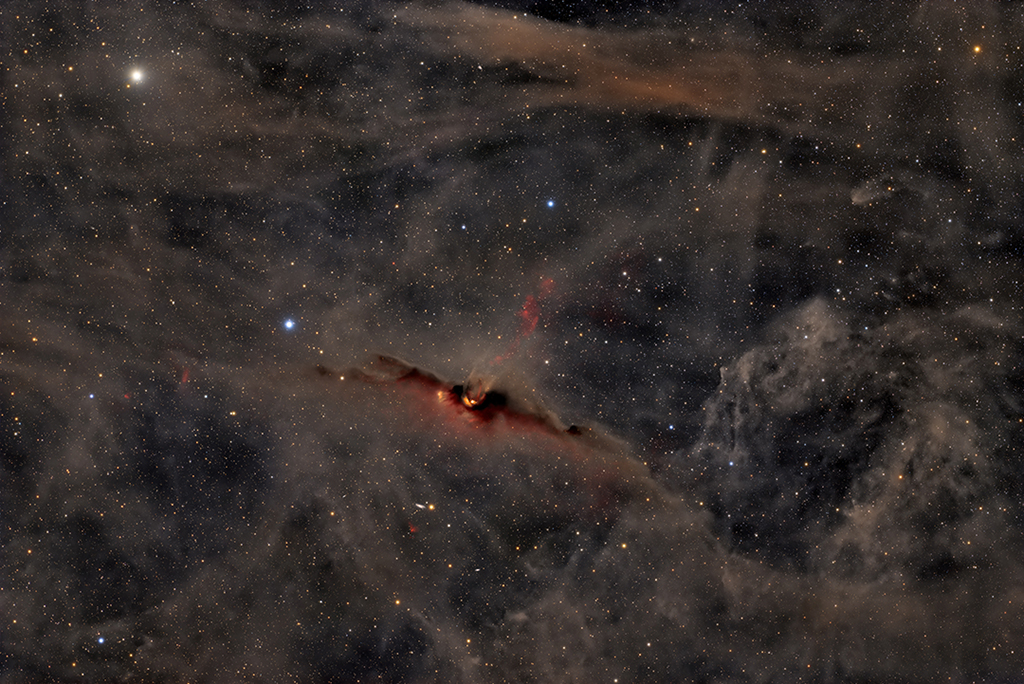
This Cosmic Bat wishes you a happy Summerween! This mid-year celebration of Halloween transcends hemispheres, even though summer in the Northern hemisphere is winter in the South. Contrary to its eery aura, the Cosmic Bat Nebula (LDN 43), not to be confused with the Bat Nebula (NGC 6995), is a vibrant birthplace for stars. A bit of young starlight peeks through the dense clouds of gas and dust that make up the Cosmic Bat’s 12 lightyear wingspan. The ultraviolet light from the young stars energizes the nebula’s hydrogen gas, causing it to glow an ominous red. The jet of glowing hydrogen gas emerging from the bat’s head hints at the star formation hidden within.
Text from NASA APOD.
How to see it yourself
Eastern Veil (NGC 6995) — supernova remnant in the constellation Cygnus.
- Best seen in July – September, when it stands highest around midnight.
- From New York it climbs to 81° above the horizon. Visible from latitudes -49° to 90°.
- An easy binocular target; under a dark sky it shows in a finder scope too. A UHC or OIII filter brings out its contrast.
- Constellation
- Cygnus
- Magnitude
- 7,0m
- Apparent size
- 12′ arcminutes
Whether NGC 6995 is up for you tonight, and how the clouds and the Moon look — AstroTools shows it.