Sibling Supernova Remnants
What happens when one of the stars in a binary goes supernova?
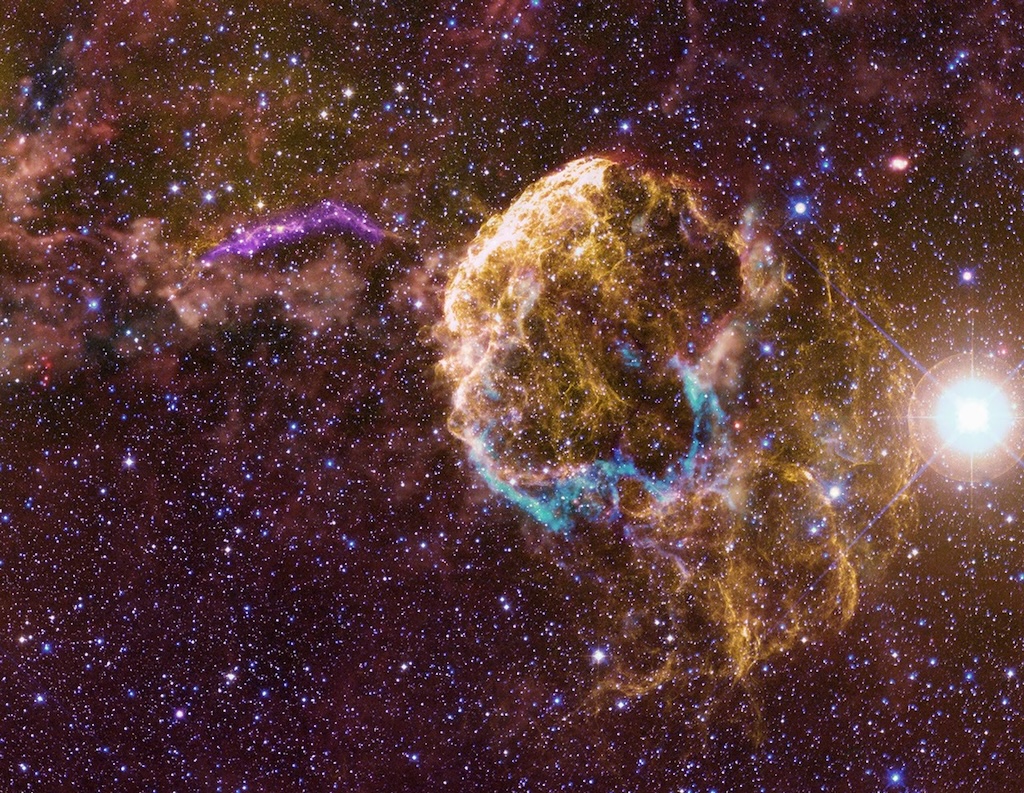
This image combines visible (yellow), ultraviolet (purple) and infrared light (cyan, red and orange) to show two supernova remnants and their surrounding environment, about 6,000 light-years away.
The younger one is the well-known Jellyfish Nebula in the center (mostly in yellow).
If we could see it by eye, it would appear larger than the full moon in the sky.
The filament shown in purple is part of an older, overlapping supernova remnant, G189.6+3.3.
A new study used data from NASA's Fermi Gamma-ray Space Telescope to piece together their story.
Astronomers believe that there were two stars in a binary system, then the first one exploded as a supernova, kicking away its companion, which also exploded as a supernova tens of thousands of years later, creating the superimposed supernova remnants we see today.
The bright star on the right is actually a triple star system named Propus.
Text from NASA APOD.
How to see it yourself
Gem A (IC 443) — supernova remnant in the constellation Gemini.
- Best seen in November – January, when it stands highest around midnight.
- From New York it climbs to 72° above the horizon. Visible from latitudes -57° to 90°.
- A very faint object: it takes a large telescope or astrophotography. A UHC or OIII filter brings out its contrast.
- Constellation
- Gemini
- Magnitude
- 12,0m
- Apparent size
- 50′ arcminutes
Whether IC 443 is up for you tonight, and how the clouds and the Moon look — AstroTools shows it.