M1: The Crab Nebula
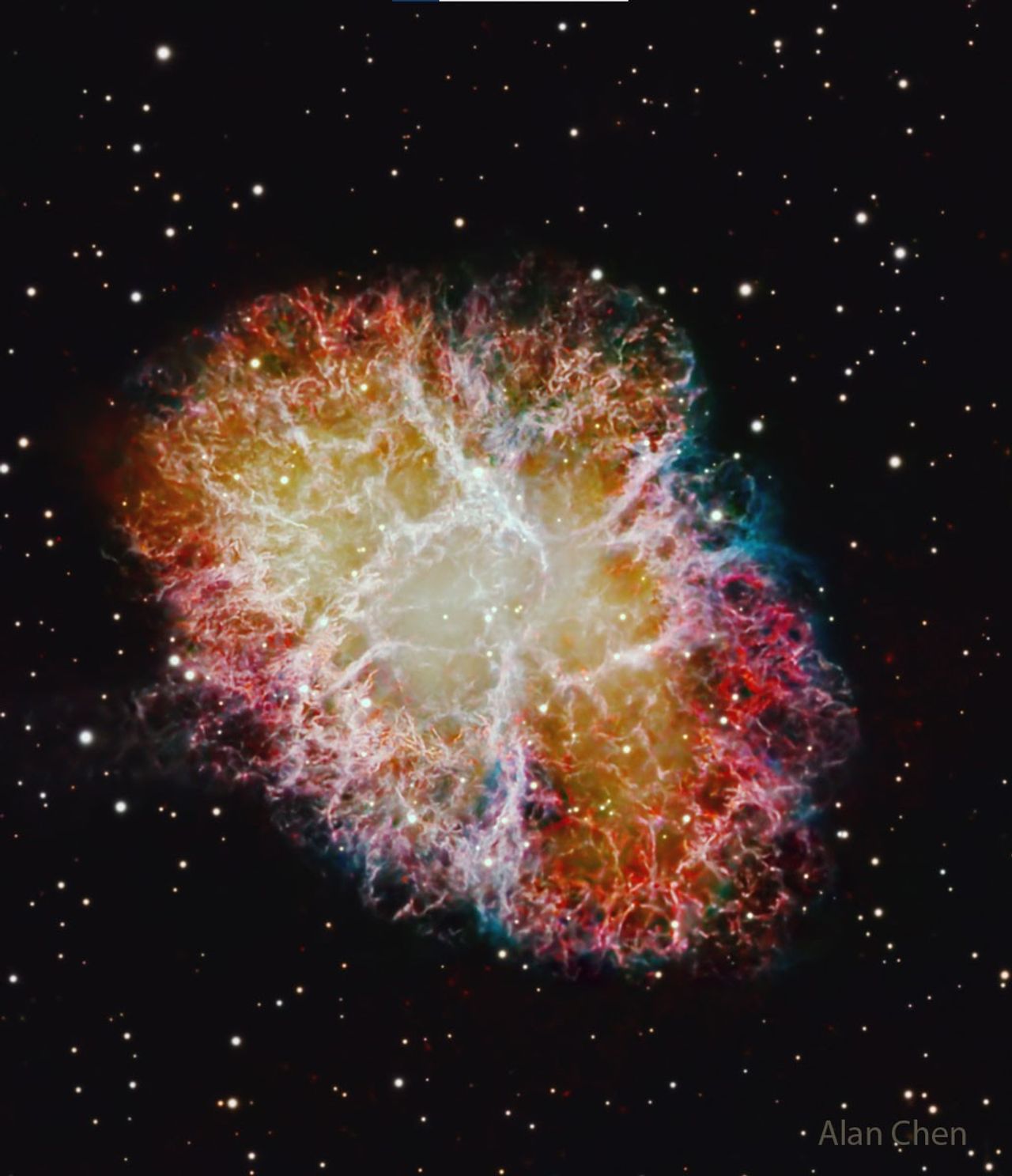
This is the mess that is left when a star explodes.
The Crab Nebula, the result of a supernova seen in 1054 AD, is filled with mysterious filaments.
The filaments are not only tremendously complex but appear to have less mass than expelled in the original supernova and a higher speed than expected from a free explosion.
The featured image was taken by an amateur astronomer in Leesburg, Florida, USA over three nights last month. It was captured in three primary colors but with extra detail provided by specific emission by hydrogen gas. The Crab Nebula spans about 10 light years.
In the Nebula's very center lies a pulsar: a neutron star as massive as the Sun but with only the size of a small town.
The Crab Pulsar rotates about 30 times each second.
Explore the Universe: Random APOD Generator
Text from NASA APOD.
How to see it yourself
Crab Nebula (M1) — supernova remnant in the constellation Taurus.
- Best seen in November – January, when it stands highest around midnight.
- From New York it climbs to 71° above the horizon. Visible from latitudes -58° to 90°.
- Needs a small telescope, 70–100 mm, and a sky free of light pollution. A UHC or OIII filter brings out its contrast.
- Constellation
- Taurus
- Magnitude
- 8,4m
- Apparent size
- 8′ arcminutes
Whether M1 is up for you tonight, and how the clouds and the Moon look — AstroTools shows it.