The Conjunction of Comet R3 PanSTARRS and the Orion Nebula
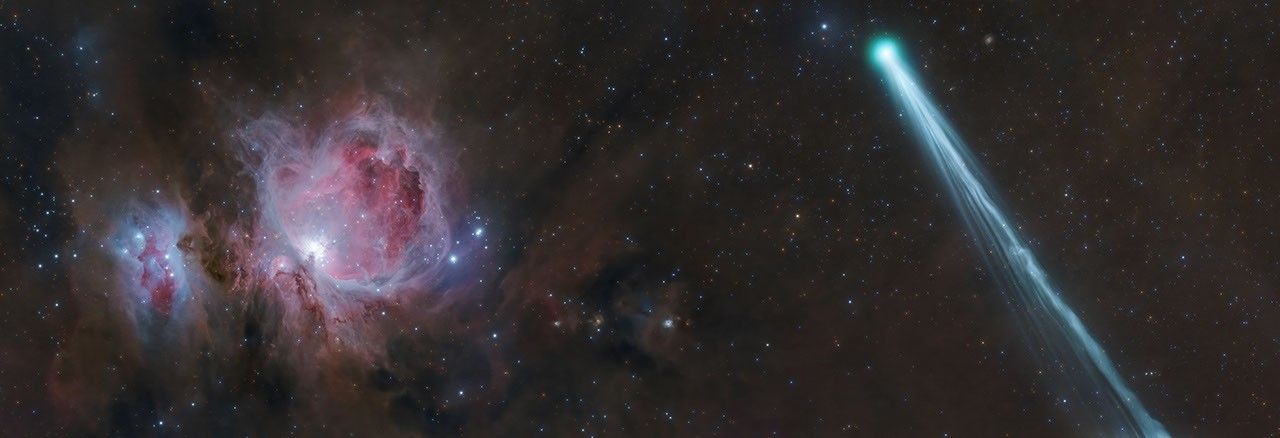
Today’s composite image features something old, something new, something borrowed, and something blue! Comet R3 PanSTARRS, streaking across the right of the image, likely originated from the Oort Cloud, meaning it is an old Solar System relic from billions of years ago. It’s bright extended ion tail glows blue as the gas escaping the comet’s core is ionized by sunlight. Astronomers are fascinated by comets for all sorts of reasons: comet compositions are untouched time capsules containing the building blocks of Solar System planets; comets may have delivered water to the young Earth; the behavior of cometary tails shed light on solar wind and radiation interactions. The background mosaic, featuring the Orion Nebula (M42), was taken over two nights of observation with the comet captured on the third night. The Orion Nebula is our nearest stellar nursery and, at about 2 million years old, is our something (relatively) new! Now at around 127.5 million kilometers from Earth, we wave goodbye to the borrowed Comet R3 PanSTARRS as it leaves the Solar System.
Growing Gallery: Comet R3 in 2026
Text from NASA APOD.
How to see it yourself
Great Orion Nebula (M42) — emission nebula in the constellation Orion.
- Best seen in November – January, when it stands highest around midnight.
- From New York it climbs to 44° above the horizon. Visible from latitudes -85° to 75°.
- An easy binocular target; under a dark sky it shows in a finder scope too. A UHC or OIII filter brings out its contrast.
- Constellation
- Orion
- Magnitude
- 4,0m
- Apparent size
- 90′ arcminutes
Whether M42 is up for you tonight, and how the clouds and the Moon look — AstroTools shows it.