Orion's Cradle
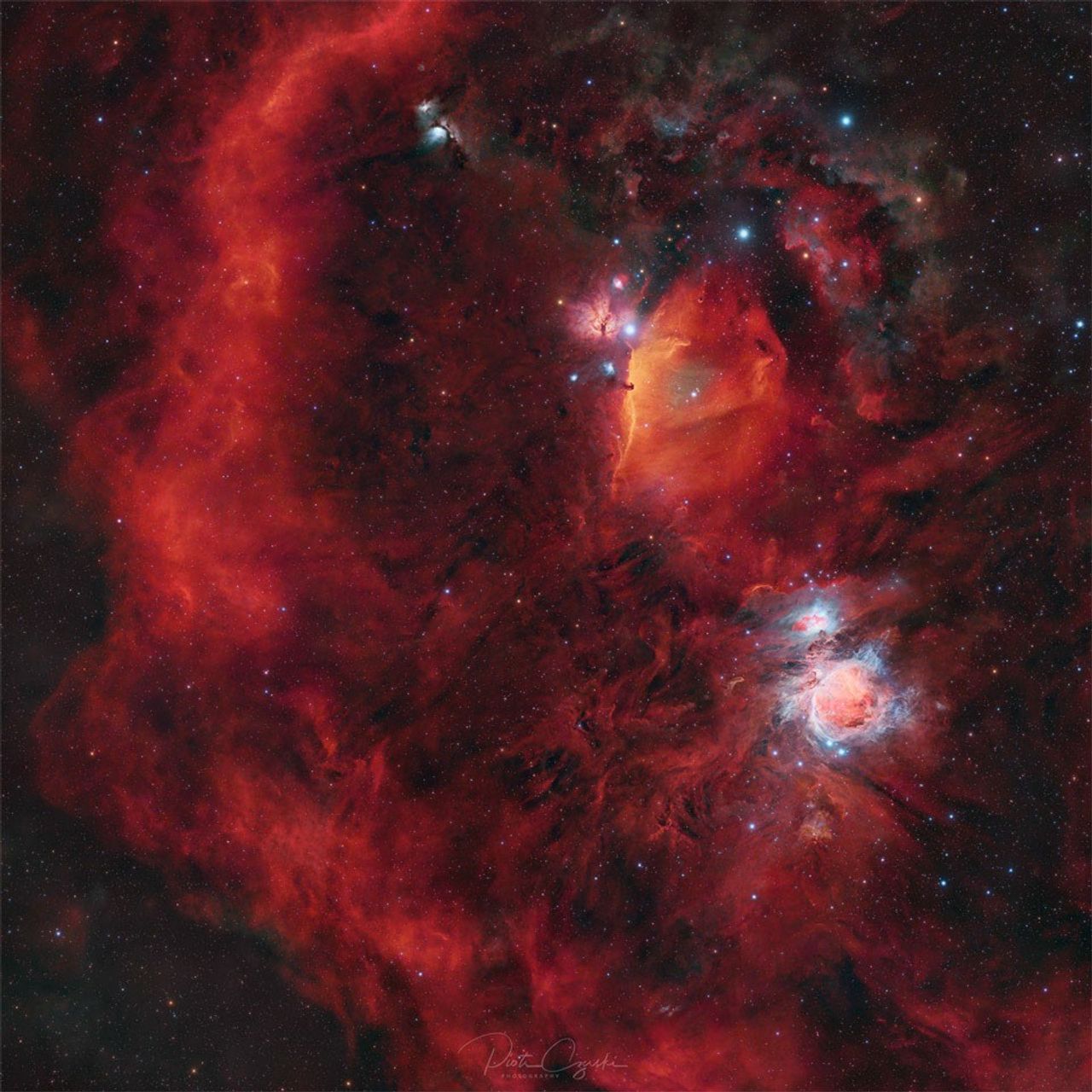
Cradled in red-glowing hydrogen gas, stars are being born in Orion.
These stellar nurseries lie at the edge of the giant Orion molecular cloud complex, some 1,500 light-years away.
This detailed view spans about 12 degrees across the center of the well-known constellation, with the Great Orion Nebula, the closest large star-forming region, visible toward the lower right.
The deep mosaic also includes, near the top center, the Flame Nebula and the Horsehead Nebula.
Image data acquired with a hydrogen-alpha filter adds other remarkable features to this wide-angle cosmic vista: pervasive tendrils of energized atomic hydrogen gas and portions of the surrounding Barnard's Loop. While the Orion Nebula and many stars in Orion are easy to see with the unaided eye, emission from the extensive interstellar gas is faint and much harder to record, even in telescopic views of the nebula-rich complex.
Sky Surprise: What picture did APOD feature on your birthday? (after 1995)
Text from NASA APOD.
How to see it yourself
Great Orion Nebula (M42) — emission nebula in the constellation Orion.
- Best seen in November – January, when it stands highest around midnight.
- From New York it climbs to 44° above the horizon. Visible from latitudes -85° to 75°.
- An easy binocular target; under a dark sky it shows in a finder scope too. A UHC or OIII filter brings out its contrast.
- Constellation
- Orion
- Magnitude
- 4,0m
- Apparent size
- 90′ arcminutes
Whether M42 is up for you tonight, and how the clouds and the Moon look — AstroTools shows it.