NGC 188: Old Cluster in the New General Catalog
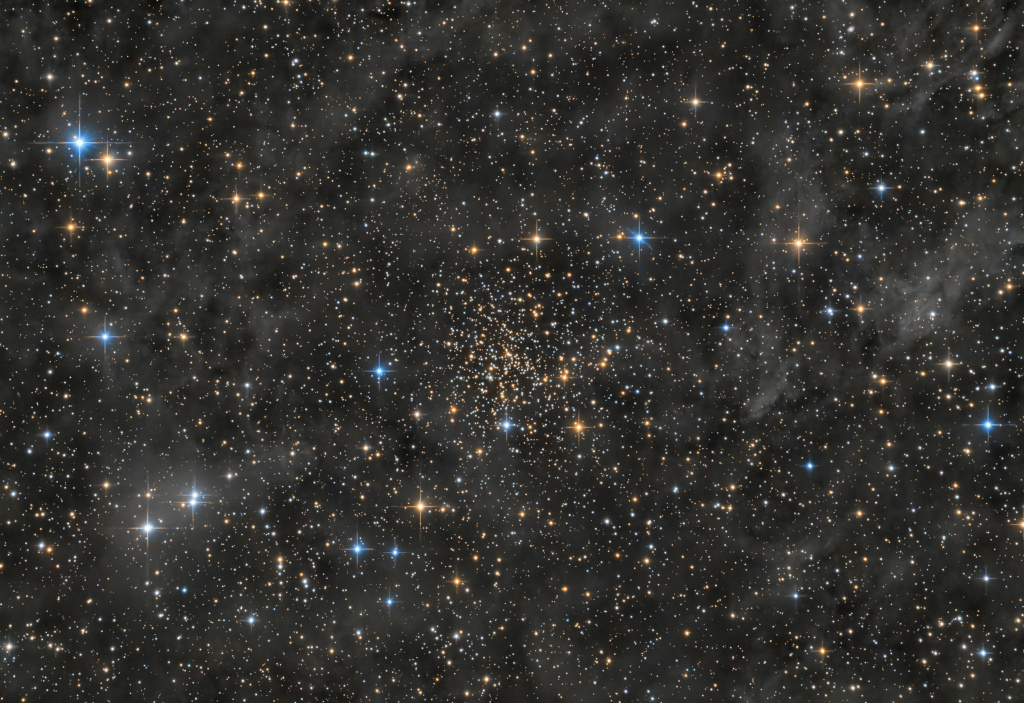
The New General Catalog of star clusters and nebulae really isn't so new. In fact, it was published in 1888 - an effort by J. L. E. Dreyer to consolidate the work of astronomers William, Caroline, and John Herschel along with others into a useful single, complete catalog of astronomical discoveries and measurements. Dreyer's work was largely successful and is still important today, as this famous catalog continues to lend its "NGC" to bright clusters, galaxies, and nebulae. Take for example the star cluster known as NGC 188 (item number 188 in the NGC compilation). It lies about 6,000 light-years distant in the northern constellation Cepheus and represents a galactic or open star cluster. With an age of about 7 billion years, NGC 188 is old for an open cluster. Its old, evolved red giant stars have yellowish hues in this colorful, deep sky view. NGC 188 also enjoys the designation Caldwell 1 in a modern compilation of deep sky objects. Located well above the plane of the Milky Way and seen in the direction of planet Earth's north celestial pole, the ancient stellar group is known to some as the Polarissima Cluster.
Text from NASA APOD.
How to see it yourself
NGC 188 — open star cluster in the constellation Cepheus.
- Best seen in September – November, when it stands highest around midnight.
- From New York it never sets and climbs to 45°. Visible from latitudes 5° to 90°.
- Needs a small telescope, 70–100 mm, and a sky free of light pollution.
- Constellation
- Cepheus
- Magnitude
- 8,1m
- Apparent size
- 17,7′ arcminutes
Whether NGC 188 is up for you tonight, and how the clouds and the Moon look — AstroTools shows it.