Trapezium: In the Heart of Orion
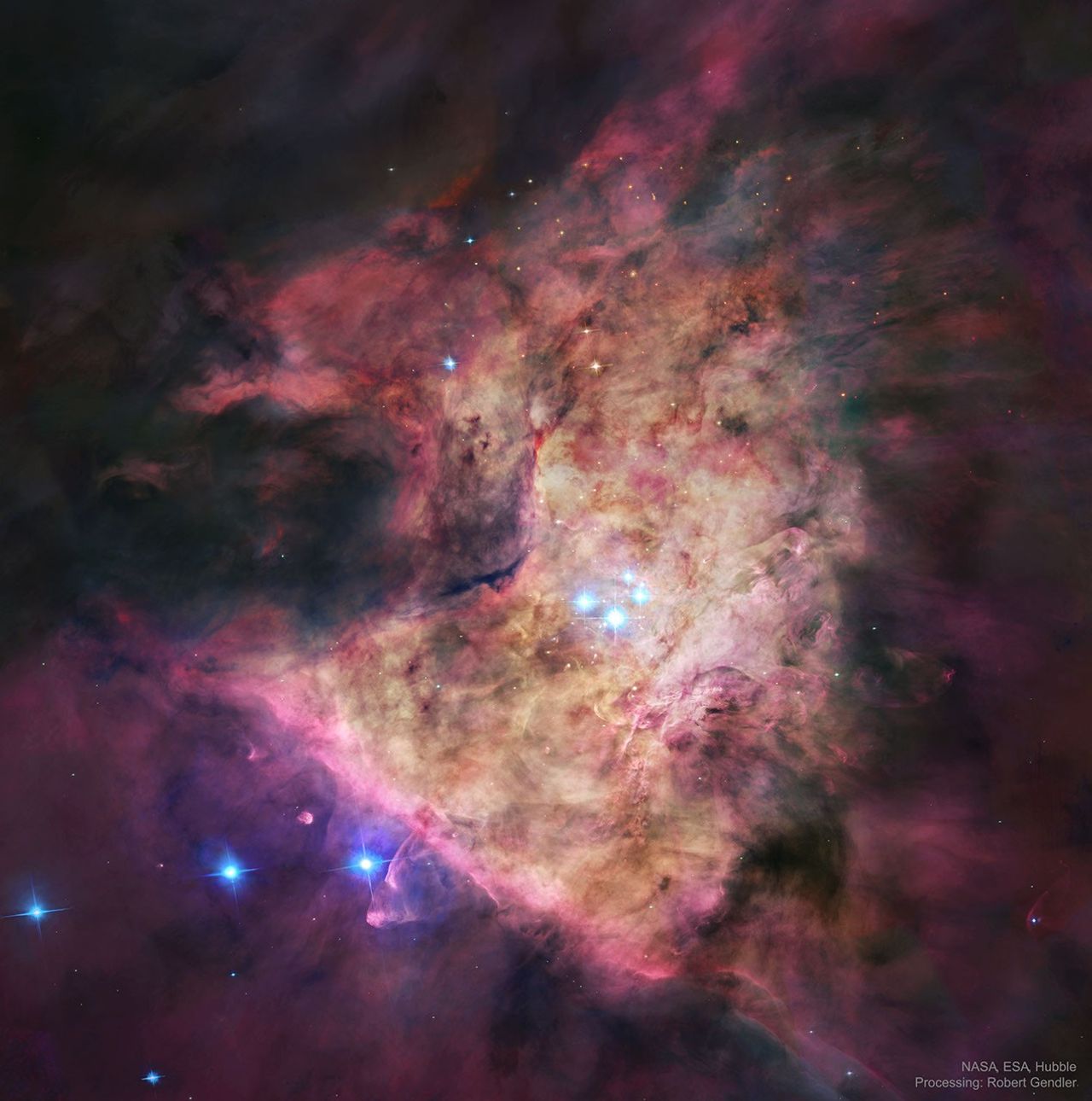
What lies in the heart of Orion?
Trapezium: four bright stars, that can be found near the center of this sharp cosmic portrait. Gathered within a region about 1.5 light-years in radius, these stars dominate the core of the dense Orion Nebula Star Cluster. Ultraviolet ionizing radiation from the Trapezium stars, mostly from the brightest star Theta-1 Orionis C powers the complex star forming region's entire visible glow. About three million years old, the Orion Nebula Cluster was even more compact in its younger years and a dynamical study indicates that runaway stellar collisions at an earlier age may have formed a black hole with more than 100 times the mass of the Sun. The presence of a black hole within the cluster could explain the observed high velocities of the Trapezium stars. The Orion Nebula's distance of some 1,500 light-years make it one of the closest candidate black holes to Earth.
Text from NASA APOD.
How to see it yourself
Great Orion Nebula (M42) — emission nebula in the constellation Orion.
- Best seen in November – January, when it stands highest around midnight.
- From New York it climbs to 44° above the horizon. Visible from latitudes -85° to 75°.
- An easy binocular target; under a dark sky it shows in a finder scope too. A UHC or OIII filter brings out its contrast.
- Constellation
- Orion
- Magnitude
- 4,0m
- Apparent size
- 90′ arcminutes
Whether M42 is up for you tonight, and how the clouds and the Moon look — AstroTools shows it.