NGC 1566: The Spanish Dancer Galaxy
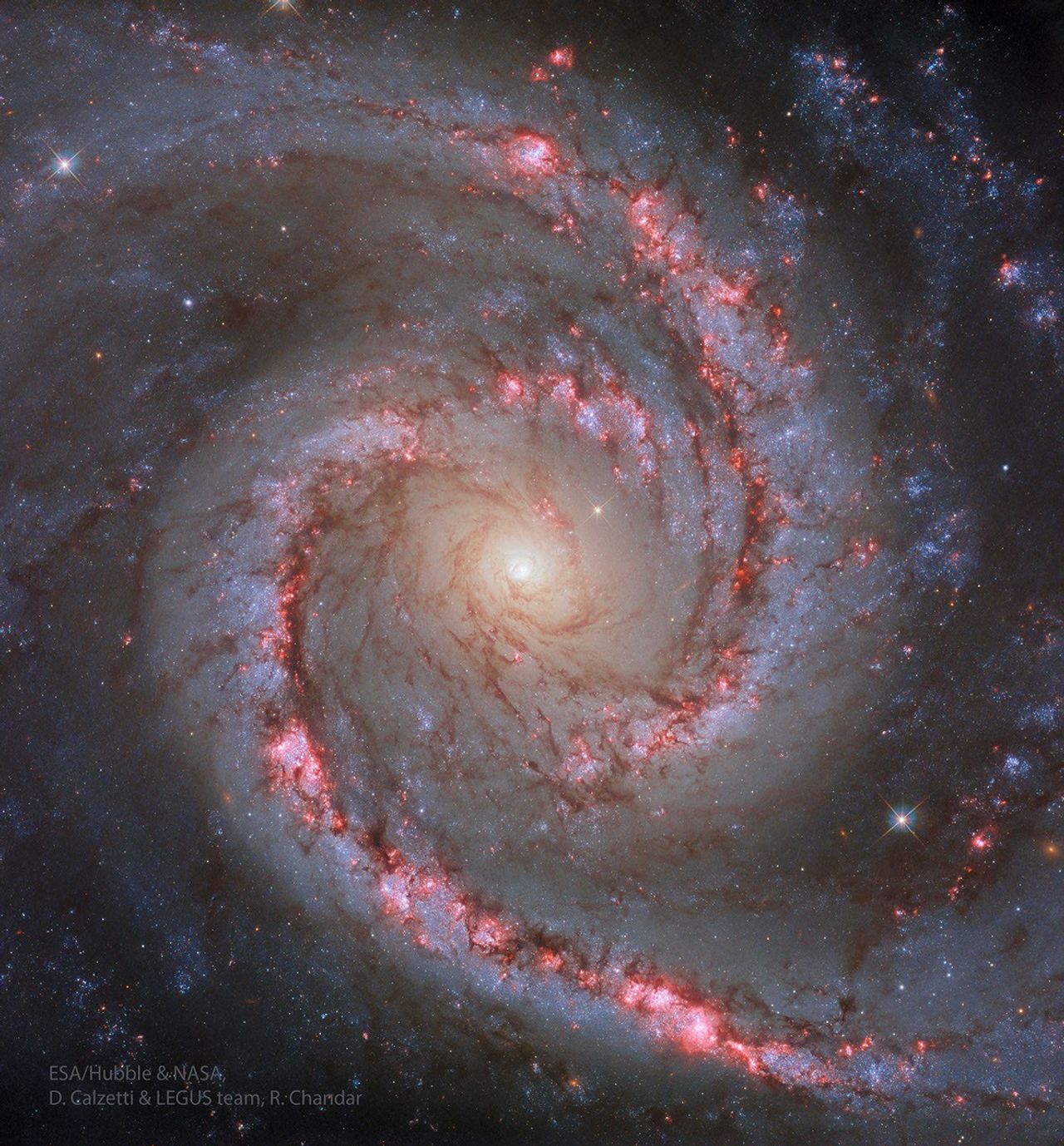
If not perfect, then this spiral galaxy is at least one of the most photogenic. An island universe containing billions of stars and situated about 40 million light-years away toward the constellation of the Dolphinfish (Dorado), NGC 1566 presents a gorgeous face-on view. Classified as a grand design spiral, NGC 1566 shows two prominent and graceful spiral arms that are traced by bright blue star clusters, red emission nebulas, and dark cosmic dust lanes. Numerous Hubble Space Telescope images of NGC 1566 have been taken to study star formation, supernovas, and the spiral's unusually active center. NGC 1566's flaring center makes the spiral one of the closest and brightest Seyfert galaxies, likely housing a central supermassive black hole wreaking havoc on surrounding stars and gas.
Sky Surprise: What picture did APOD feature on your birthday? (after 1995)
Text from NASA APOD.
How to see it yourself
NGC 1566 — galaxy in the constellation Dorado.
- Best seen in October – December, when it stands highest around midnight.
- From New York it never rises: you need to be further south. Visible from latitudes -90° to 25°.
- Needs a 150–200 mm telescope and a dark sky outside the city.
- Constellation
- Dorado
- Magnitude
- 9,7m
- Apparent size
- 7,2′ arcminutes
Whether NGC 1566 is up for you tonight, and how the clouds and the Moon look — AstroTools shows it.