M104: The Sombrero Galaxy’s Tidal Streams
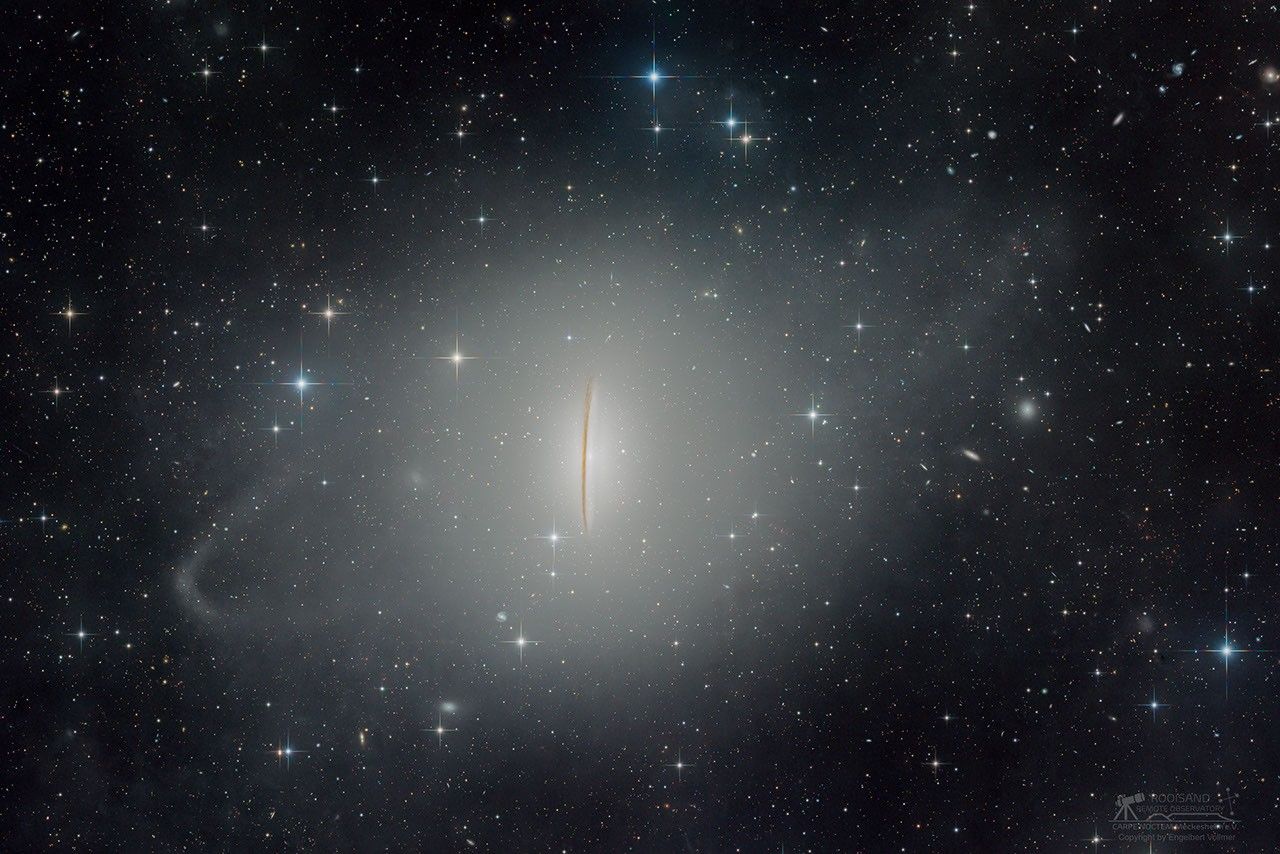
A deep image of the Sombrero galaxy reveals surprises. M104 is named the Sombrero galaxy because, on shorter exposures, it looks like a hat. A key defining feature of this huge galaxy is a dark brim of dust that circles the disk galaxy’s center. A much longer exposure, however, brings up a hairy past where a bright, hazy halo is revealed that extends well past the central disk and contains many unresolved stars. Surprisingly, in this stellar haze, structures can be seen that include a diagonal ring. These structures and tidal streams provide fresh evidence that M104 had a violent past and is surely the result of collisions and mergers of smaller galaxies. Light takes about 30 million years to reach us from the Sombrero galaxy, which fully spans about 150 thousand light years across. The featured image was taken over seven days in mid-2026 from Namibia.Your Sky Surprise: What picture did APOD feature on your birthday? (post 1995)
Text from NASA APOD.
How to see it yourself
Sombrero Galaxy (M104) — galaxy in the constellation Virgo.
- Best seen in February – April, when it stands highest around midnight.
- From New York it climbs to 38° above the horizon. Visible from latitudes -90° to 68°.
- Needs a small telescope, 70–100 mm, and a sky free of light pollution.
- Constellation
- Virgo
- Magnitude
- 8,6m
- Apparent size
- 8,5′ arcminutes
Whether M104 is up for you tonight, and how the clouds and the Moon look — AstroTools shows it.