NGC 4449: Small Galaxy, Big Impact
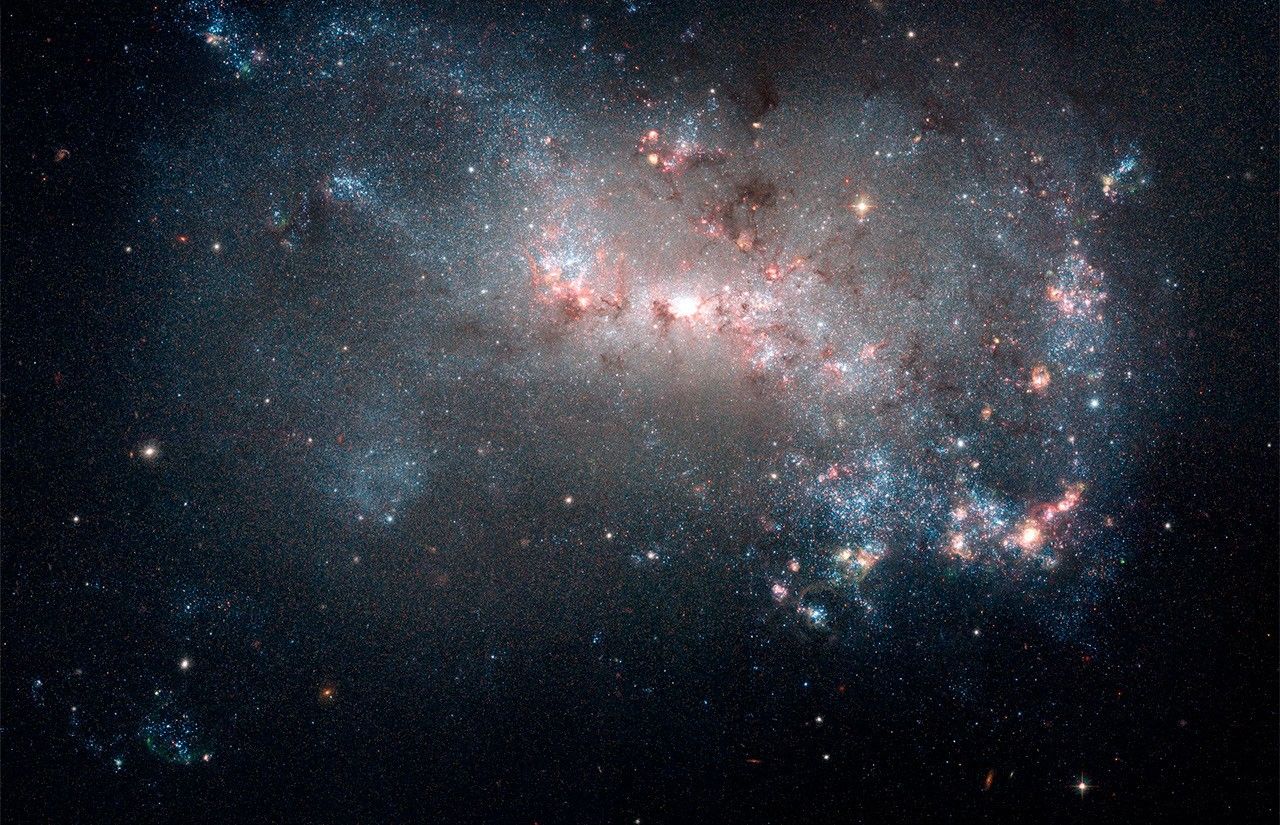
Don’t judge a galaxy by its size. Our home galaxy, the Milky Way, is about 100,000 light years across. This huge expanse of space contains hundreds of billions of stars! The smallest galaxies, called dwarf galaxies, are about 1/10th the size of the Milky Way and only contain a few billion stars. They are also the most common type of galaxy in the whole universe. Today’s image shows one such dwarf galaxy, NGC 4449, captured by the Hubble Space Telescope. NGC 4449 and similar dwarf galaxies are missing more oxygen than models predict. This suggests their stellar winds and supernovae are surprisingly effective at blowing away oxygen and other heavy elements. Turns out these tiny galaxies may play a big role in spreading heavy elements — the building blocks of stars, planets, and life — throughout the universe!
Text from NASA APOD.
How to see it yourself
NGC 4449 — galaxy in the constellation Canes Venatici.
- Best seen in February – April, when it stands highest around midnight.
- From New York it climbs to 87° above the horizon. Visible from latitudes -36° to 90°.
- Needs a 150–200 mm telescope and a dark sky outside the city.
- Constellation
- Canes Venatici
- Magnitude
- 9,6m
- Apparent size
- 4,7′ arcminutes
Whether NGC 4449 is up for you tonight, and how the clouds and the Moon look — AstroTools shows it.