The Tadpoles of IC 410
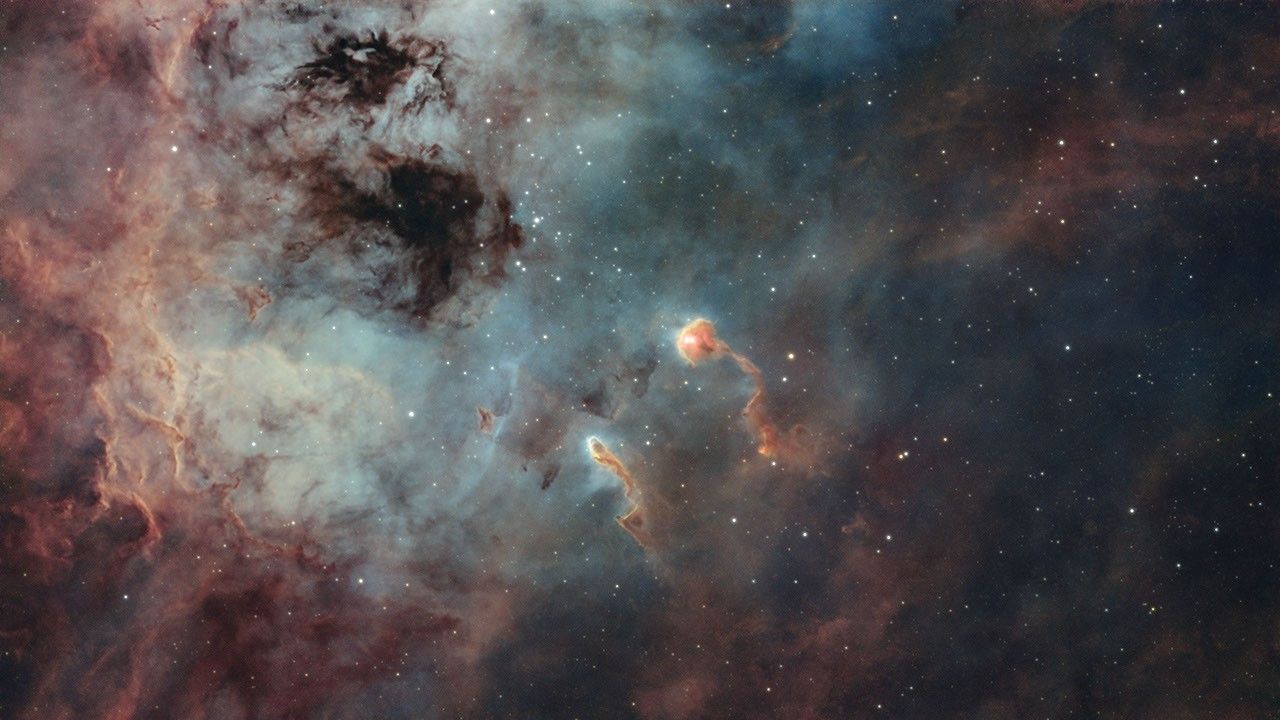
This telescopic close-up shows off the central regions of otherwise faint emission nebula IC 410, captured under backyard skies. Presented in a Hubble color palette, the image combines visible broadband and narrowband data with data from the near-infrared. Below and right of center are two remarkable inhabitants of the interstellar pond of gas and dust. the Tadpoles of IC 410. Partly obscured by foreground dust, the nebula itself surrounds NGC 1893, a young galactic cluster of stars. Formed in the interstellar cloud a mere 4 million years ago, the intensely hot, bright cluster stars energize the glowing gas. But the cosmic tadpoles themselves are composed of denser cooler gas and dust. Around 10 light-years long they are likely sites of ongoing star formation. Sculpted by stellar winds and radiation their heads are outlined by bright ridges of ionized gas while their tails trail away from the cluster's central young stars. IC 410 lies some 10,000 light-years away, toward the nebula-rich constellation Auriga.
Text from NASA APOD.
How to see it yourself
IC 410 — emission nebula in the constellation Auriga.
- Best seen in November – January, when it stands highest around midnight.
- From New York it climbs to 83° above the horizon. Visible from latitudes -47° to 90°.
- Needs a 150–200 mm telescope and a dark sky outside the city. A UHC or OIII filter brings out its contrast.
- Constellation
- Auriga
- Apparent size
- 40′ arcminutes
Whether IC 410 is up for you tonight, and how the clouds and the Moon look — AstroTools shows it.