NGC 1275 in the Perseus Cluster
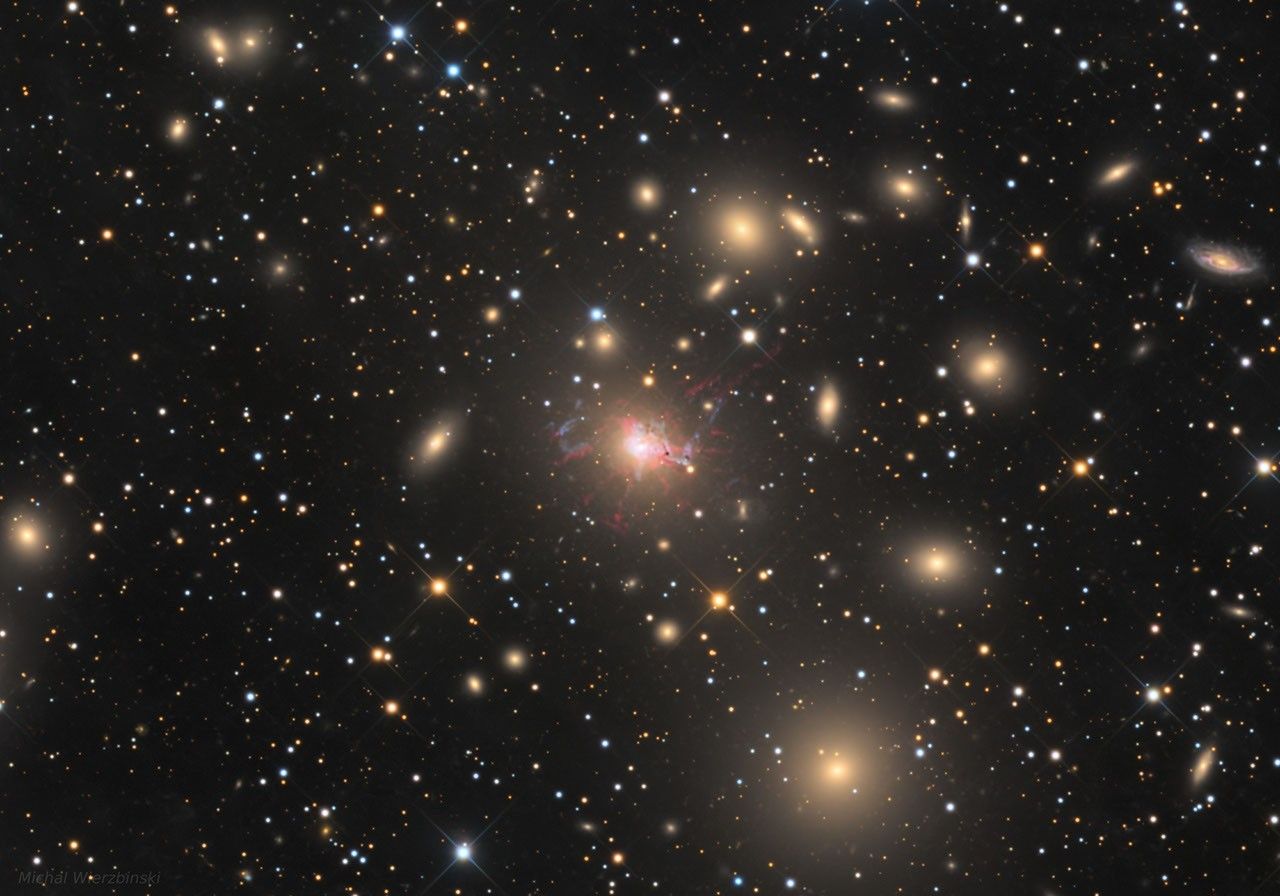
Active galaxy NGC 1275 is the central, dominant member of the large and relatively nearby Perseus Cluster of Galaxies. Wild-looking at visible wavelengths, the active galaxy is also a prodigious source of x-rays and radio emission. NGC 1275 accretes matter as entire galaxies fall into it, ultimately feeding a supermassive black hole at the galaxy's core. Narrowband image data used in this sharp telescopic image highlights the resulting galactic debris and filaments of glowing gas, some up to 20,000 light-years long. The filaments persist in NGC 1275, even though the turmoil of galactic collisions should destroy them.
What keeps the filaments together? Observations indicate that the structures, pushed out from the galaxy's center by the black hole's activity, are held together by magnetic fields. Also known as Perseus A, NGC 1275 itself spans over 100,000 light years and lies about 230 million light years away.
Text from NASA APOD.
How to see it yourself
Perseus A (NGC 1275) — galaxy in the constellation Perseus.
- Best seen in October – December, when it stands highest around midnight.
- From New York it climbs to 89° above the horizon. Visible from latitudes -38° to 90°.
- A very faint object: it takes a large telescope or astrophotography.
- Constellation
- Perseus
- Magnitude
- 12,2m
- Apparent size
- 2,2′ arcminutes
Whether NGC 1275 is up for you tonight, and how the clouds and the Moon look — AstroTools shows it.