Spiral Galaxy NGC 1512: Wide Field
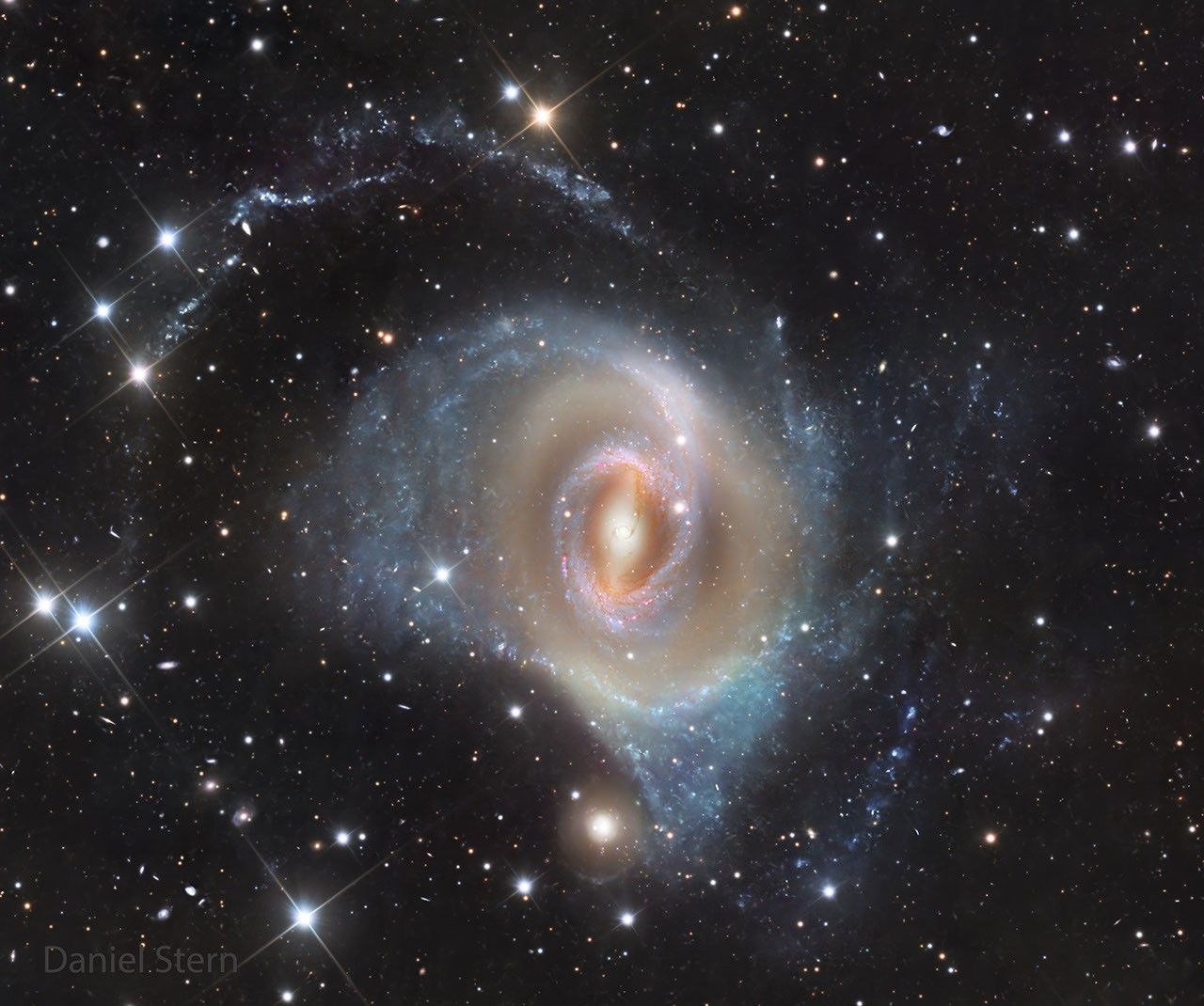
Most galaxies don't have any rings -- why does this galaxy have three?
To begin, a ring that's near NGC 1512's center -- and so hard to see here -- is the nuclear ring which glows brightly with recently formed stars.
Next out is a ring of stars and dust appearing both red and blue, called, counter-intuitively, the inner ring.
This inner ring connects ends of a diffuse central bar of stars that runs horizontally across the galaxy.
Farthest out in this wide field image is a ragged structure that might be considered an outer ring. This outer ring appears spiral-like and is dotted with clusters of bright blue stars.
All these ring structures are thought to be affected by NGC 1512's own gravitational asymmetries in a drawn-out process called secular evolution.
The featured image was captured last month from a telescope at Deep Sky Chile in Chile.
Text from NASA APOD.
How to see it yourself
NGC 1512 — galaxy in the constellation Horologium.
- Best seen in October – December, when it stands highest around midnight.
- From New York it climbs to 6° above the horizon. Visible from latitudes -90° to 37°.
- Needs a 150–200 mm telescope and a dark sky outside the city.
- Constellation
- Horologium
- Magnitude
- 10,4m
- Apparent size
- 8,4′ arcminutes
Whether NGC 1512 is up for you tonight, and how the clouds and the Moon look — AstroTools shows it.