Wolf Rayet Star 124: Stellar Wind Machine
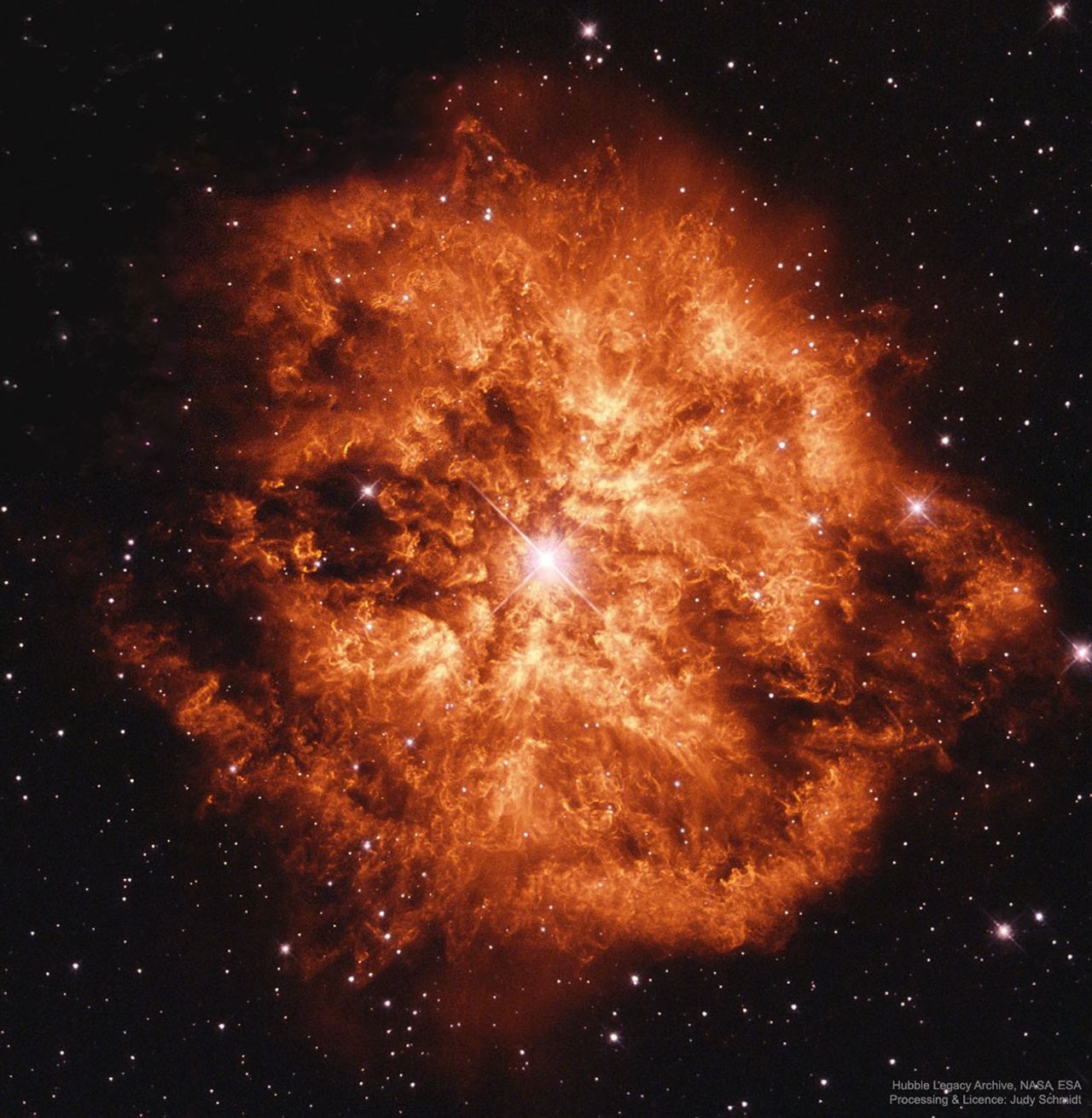
Some stars explode in slow motion. Rare, massive Wolf-Rayet stars are so tumultuous and hot that they are slowly disintegrating right before our telescopes. Glowing gas globs each typically over 30 times more massive than the Earth are being expelled by violent stellar winds . Wolf-Rayet star WR 124 , visible near the featured image center, is thus creating the surrounding nebula known as M1-67 , which spans six light years across. Details of why this star has been slowly blowing itself apart over the past 20,000 years remains a topic of research. WR 124 lies 15,000 light-years away towards the constellation of the Arrow ( Sagitta ). The fate of any given Wolf-Rayet star likely depends on how massive it is, but many are thought to end their lives with spectacular explosions such as supernovas or gamma-ray bursts . Explore Your Universe: Random APOD Generator
Text from NASA APOD.
How to see it yourself
Crab Nebula (M1) — supernova remnant in the constellation Taurus.
- Best seen in November – January, when it stands highest around midnight.
- From New York it climbs to 71° above the horizon. Visible from latitudes -58° to 90°.
- Needs a small telescope, 70–100 mm, and a sky free of light pollution. A UHC or OIII filter brings out its contrast.
- Constellation
- Taurus
- Magnitude
- 8,4m
- Apparent size
- 8′ arcminutes
Whether M1 is up for you tonight, and how the clouds and the Moon look — AstroTools shows it.