Small Dark Nebula
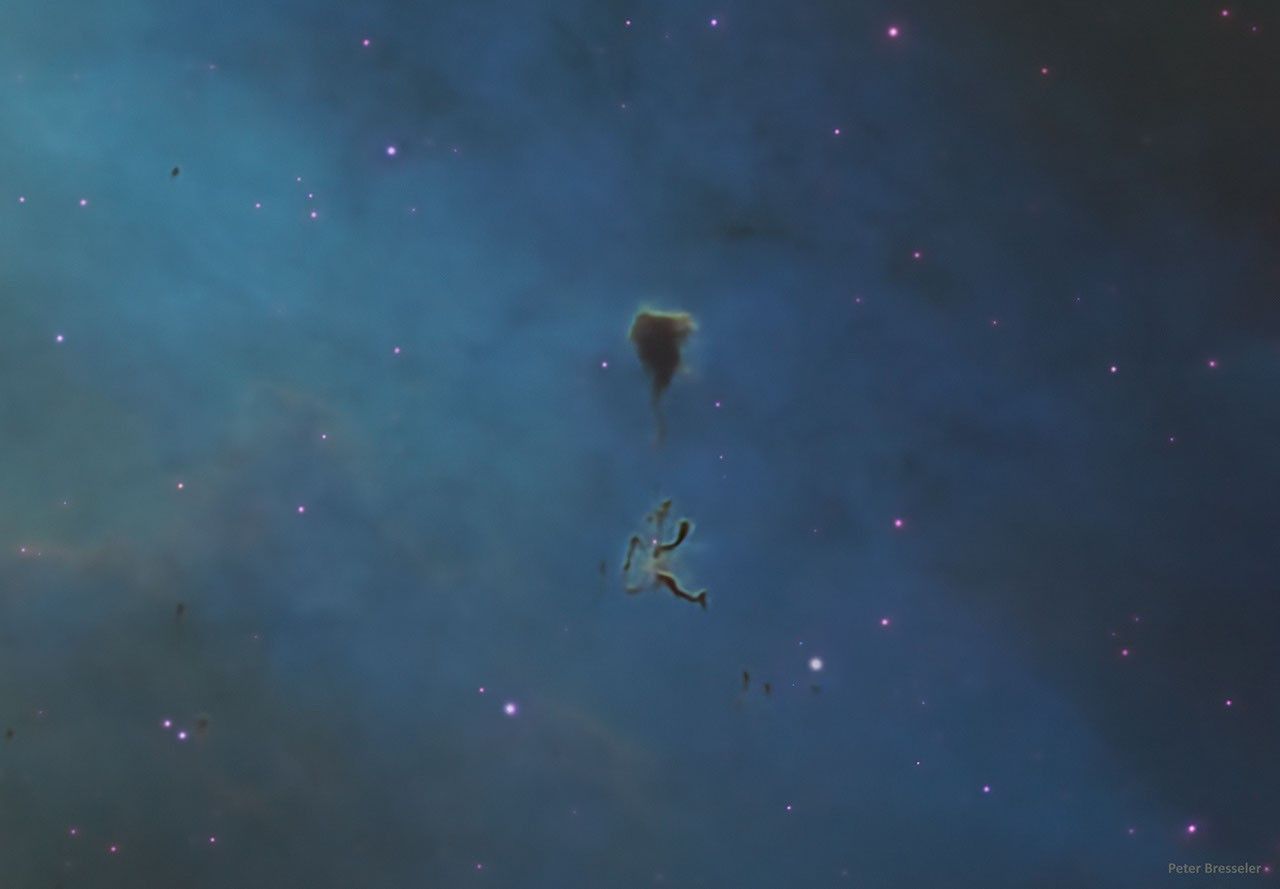
A small, dark, nebula looks isolated near the center of this telescopic close-up. The wedge-shaped cosmic cloudlet lies within a relatively crowded region of space though. About 7,000 light-years distant and filled with glowing gas and an embedded cluster of young stars, the region is known as M16 or the Eagle Nebula. Hubble's iconic images of the Eagle Nebula include the famous star-forming Pillars of Creation, towering structures of interstellar gas and dust 4 to 5 light-years long. But this small dark nebula, known to some as a Bok globule, is a fraction of a light-year across. The Bok globule stands out in silhouette against the expansive background of M16's diffuse glow. Found scattered within emission nebulae and star clusters, Bok globules are small interstellar clouds of cold molecular gas and obscuring dust that also form stars within their dense, collapsing cores.
Text from NASA APOD.
How to see it yourself
Eagle Nebula (M16) — emission nebula in the constellation Serpens Cauda.
- Best seen in May – July, when it stands highest around midnight.
- From New York it climbs to 35° above the horizon. Visible from latitudes -90° to 66°.
- An easy binocular target; under a dark sky it shows in a finder scope too. A UHC or OIII filter brings out its contrast.
- Constellation
- Serpens Cauda
- Magnitude
- 6,0m
- Apparent size
- 120′ arcminutes
Whether M16 is up for you tonight, and how the clouds and the Moon look — AstroTools shows it.