Supernova 2025rbs in NGC 7331
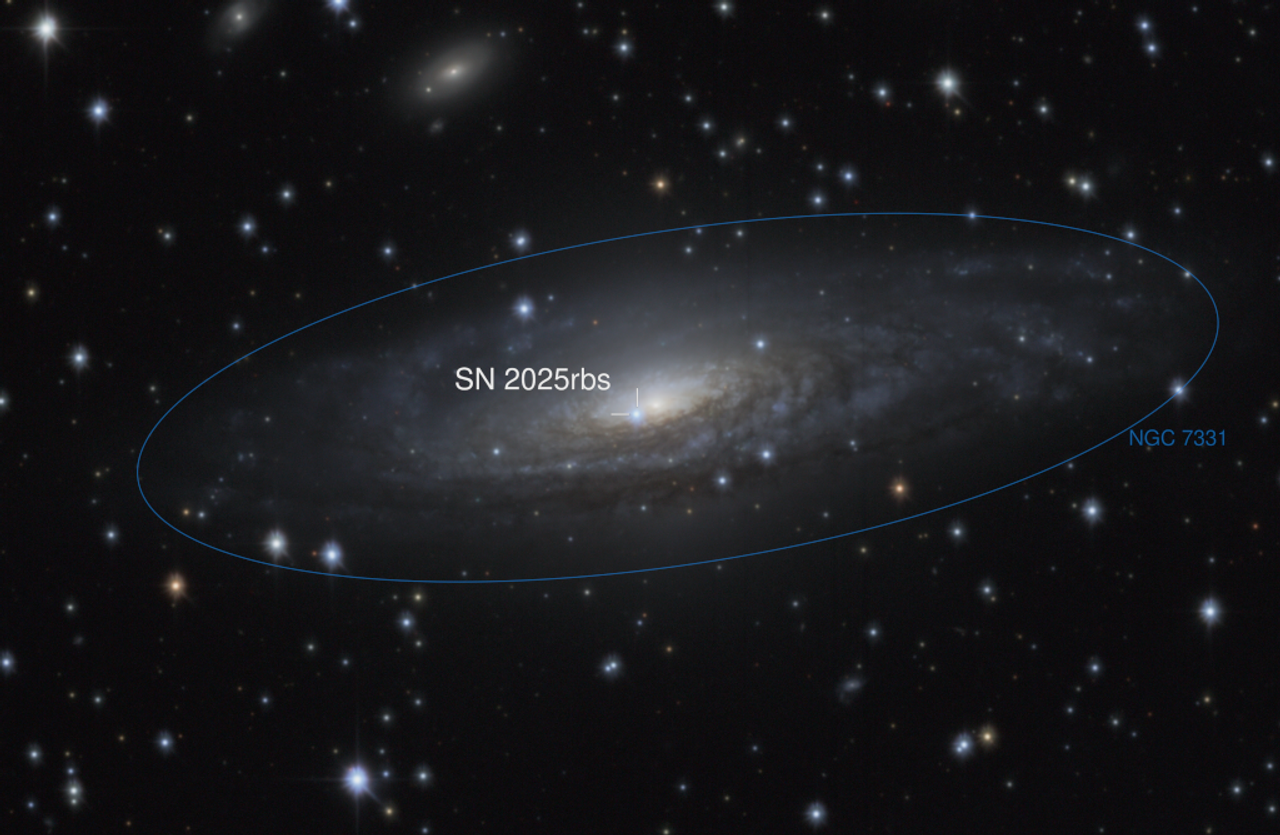
A long time ago in a galaxy 50 million light-years away, a star exploded. Light from that supernova was first detected by telescopes on planet Earth on July 14th though, and the extragalactic transient is now known to astronomers as supernova 2025rbs. Presently the brightest supernova in planet Earth's sky, 2025rbs is a Type Ia supernova, likely caused by the thermonuclear detonation of a white dwarf star that accreted material from a companion in a binary star system.
Type Ia supernovae are used as standard candles to establish the distance scale of the universe. The host galaxy of 2025rbs is NGC 7331. Itself a bright spiral galaxy in the northern constellation Pegasus, NGC 7331 is often touted as an analog to our own Milky Way.
Text from NASA APOD.
How to see it yourself
NGC 7331 — galaxy in the constellation Pegasus.
- Best seen in July – September, when it stands highest around midnight.
- From New York it climbs to 84° above the horizon. Visible from latitudes -46° to 90°.
- Needs a small telescope, 70–100 mm, and a sky free of light pollution.
- Constellation
- Pegasus
- Magnitude
- 9,4m
- Apparent size
- 9,3′ arcminutes
Whether NGC 7331 is up for you tonight, and how the clouds and the Moon look — AstroTools shows it.