Eagle Nebula Pillars in Infrared from Hubble
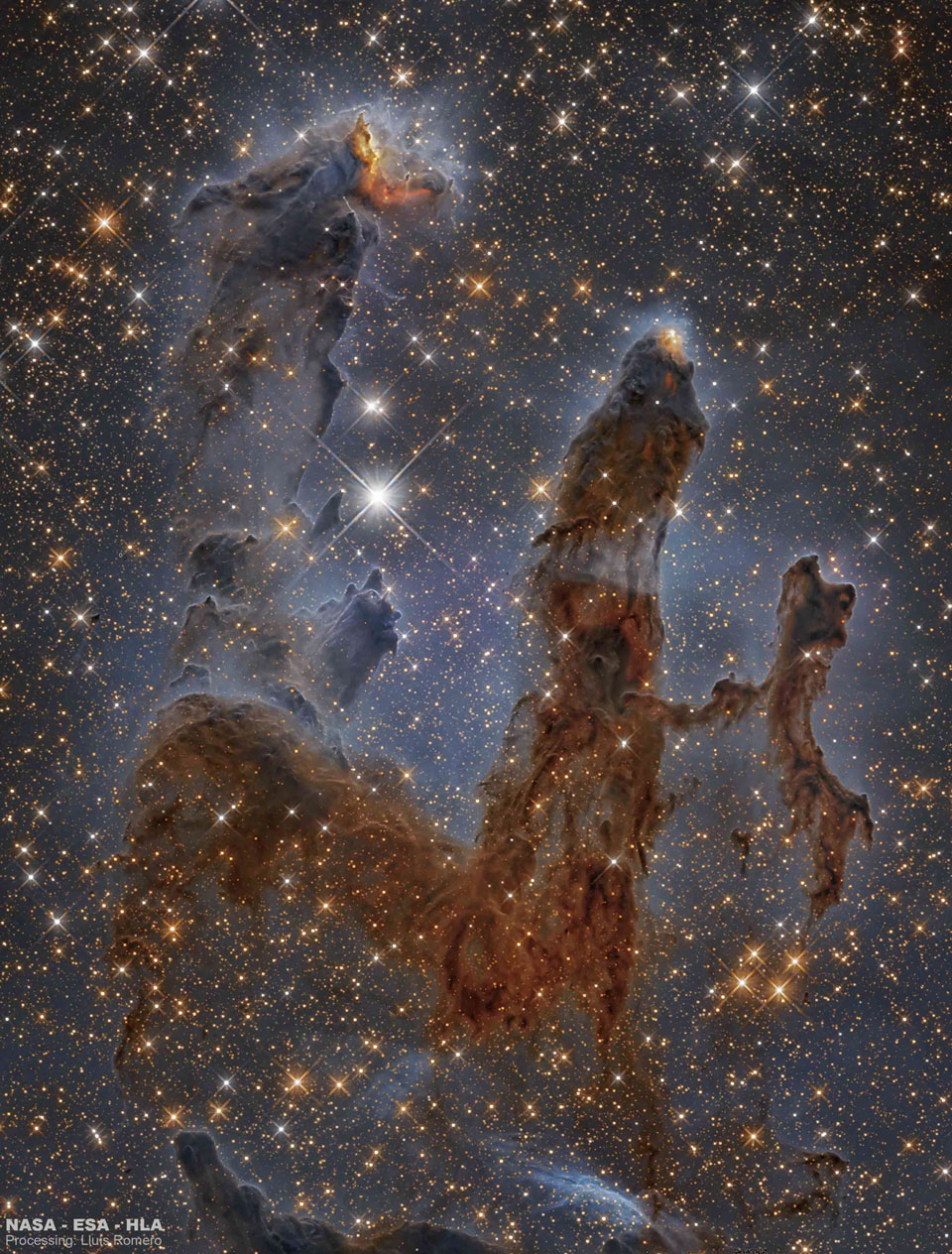
Newborn stars are forming in the Eagle Nebula.
They are gravitationally contracting in pillars of dense gas and dust.
The intense radiation of these newly-formed bright stars is causing surrounding material to boil away. This image, taken with the Hubble Space Telescope in near infrared light, allows the viewer to see through much of the thick dust that makes the pillars opaque in visible light.
The giant structures are light years in length and dubbed informally the Pillars of Creation.
Associated with the open star cluster M16, the Eagle Nebula lies about 6,500 light years away.
The Eagle Nebula is a satisfying target for small telescopes in a nebula-rich part of the sky toward the split constellation Serpens Cauda (the tail of the snake).
Sky Surprise: What picture did APOD feature on your birthday? (after 1995)
Text from NASA APOD.
How to see it yourself
Eagle Nebula (M16) — emission nebula in the constellation Serpens Cauda.
- Best seen in May – July, when it stands highest around midnight.
- From New York it climbs to 35° above the horizon. Visible from latitudes -90° to 66°.
- An easy binocular target; under a dark sky it shows in a finder scope too. A UHC or OIII filter brings out its contrast.
- Constellation
- Serpens Cauda
- Magnitude
- 6,0m
- Apparent size
- 120′ arcminutes
Whether M16 is up for you tonight, and how the clouds and the Moon look — AstroTools shows it.