SWAN, Swan, Eagle
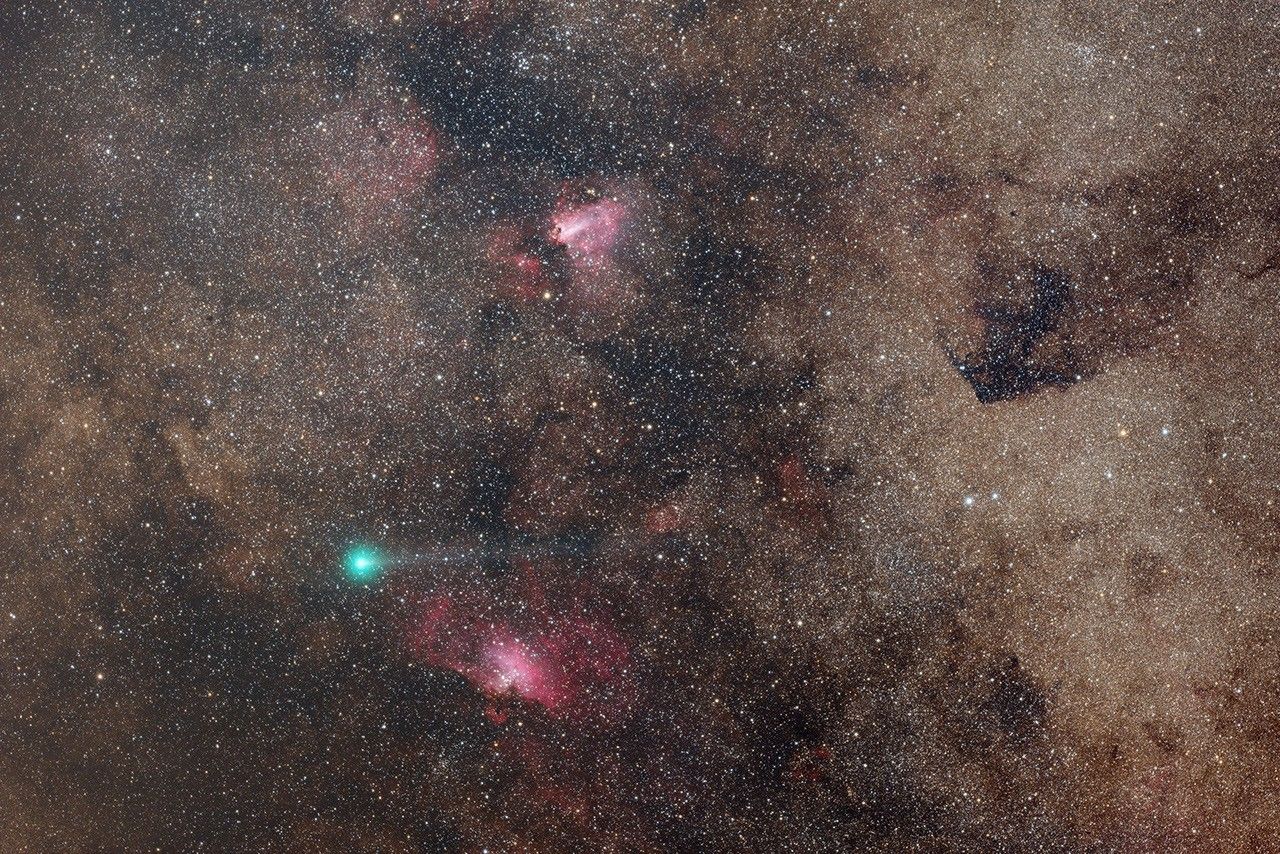
Comet C/2025 R2 (SWAN) sports a greenish coma and fainter tail, seen against congeries of stars and dusty interstellar clouds in this 7 degree wide telescopic field of view from October 17. On that date, the new visitor to the inner Solar System obligingly posed with two other celestial birds seen toward the center of our Milky Way. Messier 16, near the bottom of the frame, and Messier 17 are also known to deep skywatchers as the Eagle and the Swan nebulae. While the comet coma's greenish glow recorded in the image is due to diatomic carbon gas fluorescing in sunlight, reddish hues seen in the nebulae, star forming regions some 5,000 light-years distant, are characteristic of ionized hydrogen gas. Comet SWAN is outbound now but still a good comet for binoculars and small telescopes that can look close to the southern horizon in the northern hemisphere's early evening skies. C/2025 R2 (SWAN) was closest to our fair planet on October 20, a mere 2.2 light-minutes away.
Text from NASA APOD.
How to see it yourself
Eagle Nebula (M16) — emission nebula in the constellation Serpens Cauda.
- Best seen in May – July, when it stands highest around midnight.
- From New York it climbs to 35° above the horizon. Visible from latitudes -90° to 66°.
- An easy binocular target; under a dark sky it shows in a finder scope too. A UHC or OIII filter brings out its contrast.
- Constellation
- Serpens Cauda
- Magnitude
- 6,0m
- Apparent size
- 120′ arcminutes
Whether M16 is up for you tonight, and how the clouds and the Moon look — AstroTools shows it.