Veil Nebula: Wisps of an Ancient Supernova
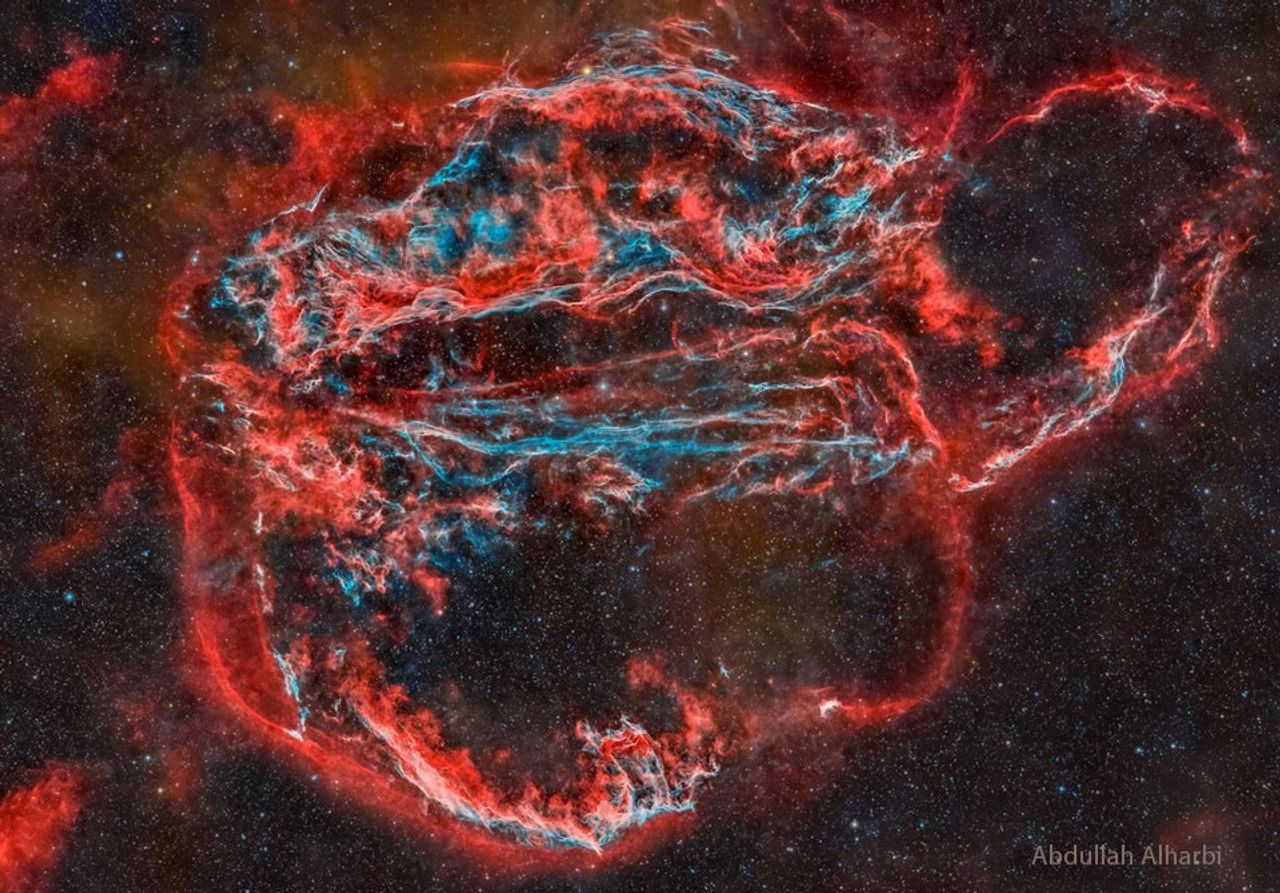
Wisps like this are all that remain visible of a Milky Way star.
About 7,000 years ago that star exploded in a supernova, leaving the Veil Nebula.
At the time, the expanding cloud was likely as bright as a crescent Moon, remaining visible for weeks to people living at the dawn of recorded history.
Today, the resulting supernova remnant, also known as the Cygnus Loop, has faded and is now visible only through a small telescope directed toward the constellation of the Swan (Cygnus).
The remaining Veil Nebula is physically huge, however, and even though it lies about 1,400 light-years distant, it covers over five times the size of the full Moon.
The featured picture was taken in Kuwait in mid-2024 and features light emitted by hydrogen in red and oxygen in blue.
In deep images of the complete Veil Nebula like this, even studious readers might not be able to identify the iconic filaments.
Piece it All Together: Astronomy Puzzle of the Day
Text from NASA APOD.
How to see it yourself
Veil Nebula (NGC 6960) — supernova remnant in the constellation Cygnus.
- Best seen in July – September, when it stands highest around midnight.
- From New York it climbs to 80° above the horizon. Visible from latitudes -49° to 90°.
- Needs a small telescope, 70–100 mm, and a sky free of light pollution. A UHC or OIII filter brings out its contrast.
- Constellation
- Cygnus
- Magnitude
- 7,0m
- Apparent size
- 210′ arcminutes
Whether NGC 6960 is up for you tonight, and how the clouds and the Moon look — AstroTools shows it.