Unraveling NGC 3169
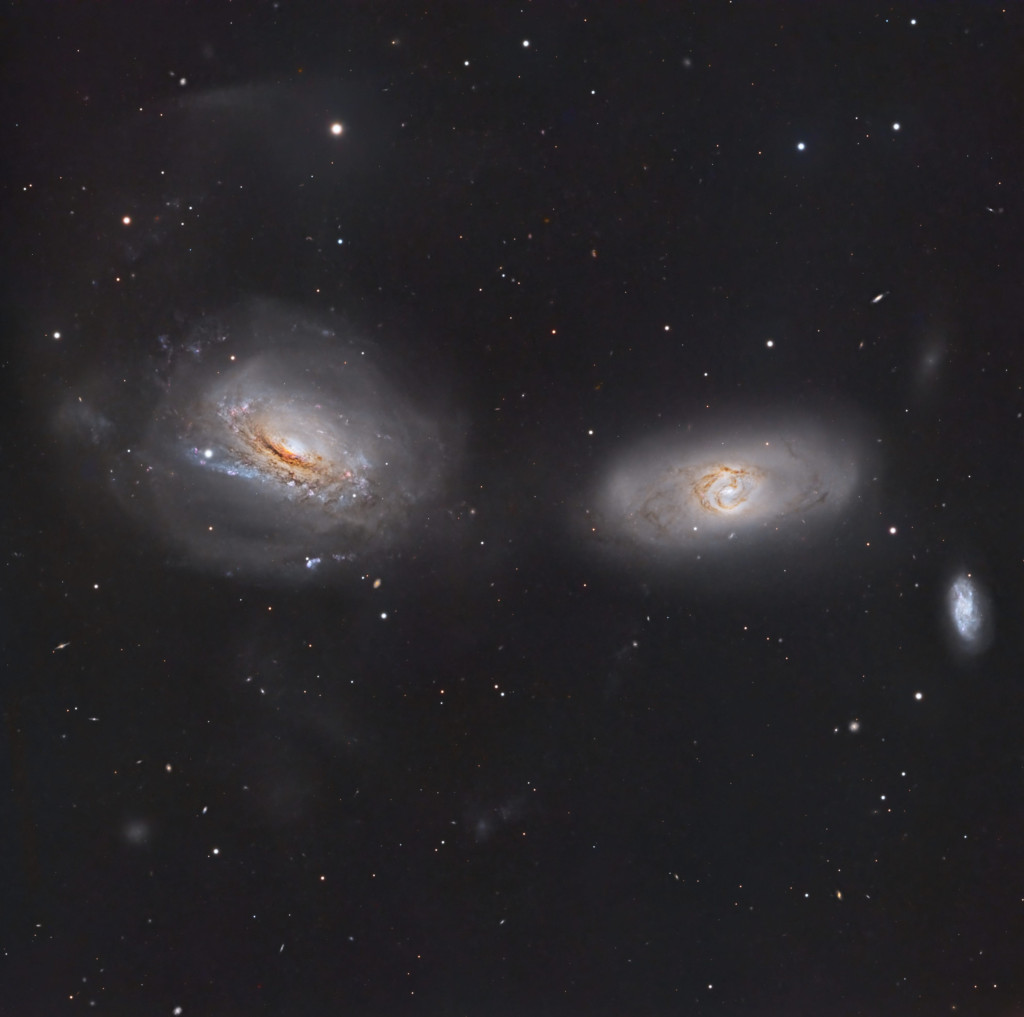
Spiral galaxy NGC 3169 looks to be unraveling like a ball of cosmic yarn. It lies some 70 million light-years away, south of bright star Regulus toward the faint constellation Sextans. Wound up spiral arms are pulled out into sweeping tidal tails as NGC 3169 (left) and neighboring NGC 3166 interact gravitationally. Eventually the galaxies will merge into one, a common fate even for bright galaxies in the local universe. Drawn out stellar arcs and plumes are clear indications of the ongoing gravitational interactions across the deep and colorful galaxy group photo. The telescopic frame spans about 20 arc minutes or about 400,000 light-years at the group's estimated distance, and includes smaller, bluish NGC 3165 to the right. NGC 3169 is also known to shine across the spectrum from radio to X-rays, harboring an active galactic nucleus that is the site of a supermassive black hole.
Text from NASA APOD.
How to see it yourself
NGC 3169 — galaxy in the constellation Sextans.
- Best seen in January – March, when it stands highest around midnight.
- From New York it climbs to 53° above the horizon. Visible from latitudes -77° to 83°.
- Needs a 150–200 mm telescope and a dark sky outside the city.
- Constellation
- Sextans
- Magnitude
- 10,9m
- Apparent size
- 4,3′ arcminutes
Whether NGC 3169 is up for you tonight, and how the clouds and the Moon look — AstroTools shows it.